
Listen to the audio version of this article (generated by AI).
On December 25, 2015, the city of Brovary, located on the outskirts of Kyiv, decided to rename Moscow Street to Fontenay-sous-Bois in honor of its sister city, which is situated 5 kilometers to the east of Paris. Little did this Ukrainian city know how significant this gesture would become. Seven years later, in the wake of Russia’s full-scale invasion of Ukraine, residents of Fontenay-sous-Bois offered children of Ukrainian soldiers the opportunity to spend time away from the war.
Brovary and Fontenay-sous-Bois became sister cities in the 1990s, during the post-Soviet transition, as Ukraine adopted a democratic system of government. During this time, Patrick Roullet founded the French association Les Amis de Brovary in his hometown to strengthen cultural ties between both cities. In 2010, school exchanges began, allowing children with strong academic performance or those learning French to travel to the Parisian suburb for two weeks each November to participate in the Children’s Rights festival.
However, the Russian annexation of Crimea in 2014, following Ukraine’s Revolution of Dignity, disrupted these school exchanges. French students were advised against traveling to Ukraine. In 2015, to continue facilitating cultural exchanges, Les Amis de Brovary initiated a program to host children of military officers who had been mobilized to fight Russian forces in Crimea or had gone missing on the front lines. That same year, the Brovary City Council adopted an urban policy to rename the streets and alleys of the city, guided by a Ukrainian law titled “On the Condemnation of Communist and National Socialist (Nazi) Totalitarian Regimes in Ukraine and the Prohibition of Propaganda of Their Symbols.”
Today, this law stands in stark contrast to any claims made by Vladimir Putin about the “denazification” of Ukraine when he invaded the country in February 2022. Four years into the war, millions of Ukrainians have been displaced, many children have lost parents on the front, and their lives continue to be disrupted, facing challenges even to attend school.
***
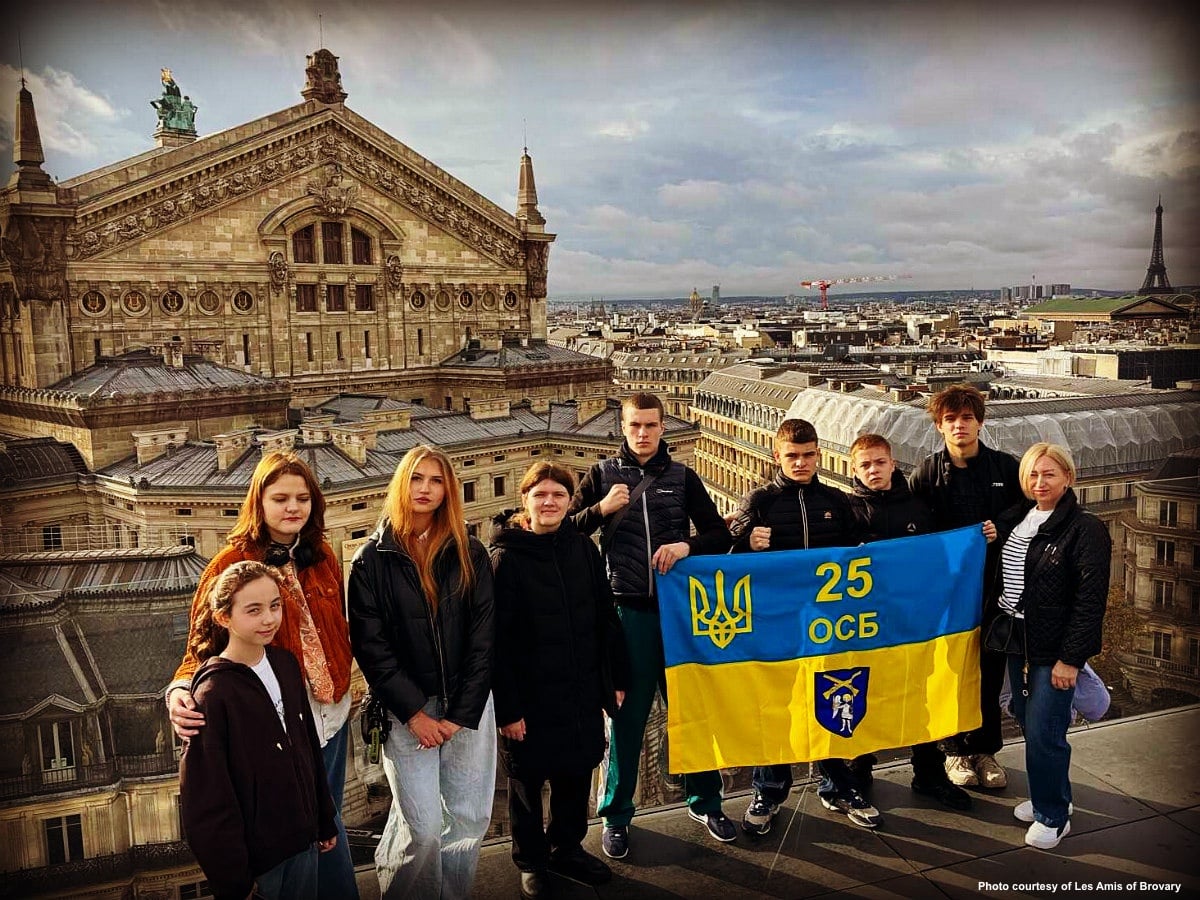
In a large central hall of a community centre in Fontenay-sous-Bois, a group of teens was hanging out in the darkest, gloomiest corner of the room, glancing back and forth at their phones. Some used translation apps on their phones to communicate, while others spoke broken English. “I’ve tried to teach them some Ukrainian,” said Heorhii Ishchenko, one of the eight Ukrainian youngsters aged 10 to 16 from Brovary, who are staying in the Parisian suburb for two weeks, hosted by members of Les Amis de Brovary. They are attending the Children’s Rights festival.
At a stand, children from various primary schools are invited to draw on cards that will be gifted to Ukrainian children in two schools in Brovary — a symbol for children’s right to peace. The drawings include French and Ukrainian flags, hearts, houses, flowers, stars, and messages of support. “I hope the war will end and that everything will be better,” wrote one child.


Six of the Ukrainian children visiting have lost their fathers to the war against Russia, while two others have fathers who are soldiers on the frontline. After a three-day bus journey, the kids arrived in Fontenay-sous-Bois on the evening of November 24, accompanied by English teacher Viktoriia Medynska and educator Anna Solntseva. Their arrival was delayed by a day due to a long wait at the Ukrainian border with Poland. They traveled at a time when the EU was preparing to tighten visa rules for Russian citizens as part of its efforts to punish Moscow for its ongoing war in Ukraine. Brussels had already made it harder and more expensive for Russians to obtain visas, suspending its visa facilitation agreement with Moscow in late 2022 after Russia’s full-scale invasion.
“It’s awful what’s going on in Brovary, and we want to bring smiles back on the children’s faces,” said Roullet. He used to travel to the Ukrainian city regularly. “I’ve been there, I wouldn’t want to lie, but maybe 100 times,” he recalled. But the war has changed everything.
Brovary was pivotal in preventing Kyiv from being encircled from the east. Its sizable modern suburbs, with dense residential areas, provided defensive positions and allowed Ukrainian military and territorial defense units to mobilize rapidly. This slowed and disrupted Russian movements, contributing to Russia’s abandonment of the Kyiv offensive.
Although Brovary is no longer on the front lines, it remains within range of Russian long-range strikes and drone attacks. In late November 2025, explosions from a Russian attack caused fires and building damage in Brovary, resulting in reported casualties.
Since March 2022, Les Amis de Brovary has helped thirty Ukrainian families from that city settle in Fontenay-sous-Bois and has raised funds to send food, warm clothing, sweets, and toys to its residents.
According to Olena Korovina, an employee in the international relations department of the Brovary town hall, more than 15,000 internally displaced refugees have moved to Brovary from southern and western Ukraine since the beginning of the invasion. “With the influx of people, any aid the city receives is invaluable,” she explained. “We really value our relationship with our sister city. Especially during the war, it feels like we are constantly supported.”
Recommended Read: Neutrality Shows Its Limits in Berlin: The Museum Berlin-Karlshorst
Paradoxically, the war in Ukraine has strengthened the old concept of sister cities, which was developed during the Cold War to de-escalate tensions between the Soviet Union and the West. Now, that connection is helping Ukraine in its fight against Russian aggression.
“Drones and missiles fly over our town almost every night, destroying our homes, shops, and businesses, injuring residents, and even taking lives,” Korovina said. “During alerts, we need to get to safety. Children miss lessons, which means they cannot study normally like other Europeans.”
The visit to Fontenay-sous-Bois offers a welcome respite. For a few days, these children of Ukrainian soldiers lived in a different reality. They played and relaxed with their French peers, engaging in simple activities like the French game “La Patate” (The Potato), where they attempted to swap a potato for items from shoppers, leading to amusing interactions. “I will bring this game back to the children at my school,” said English teacher Medynska.
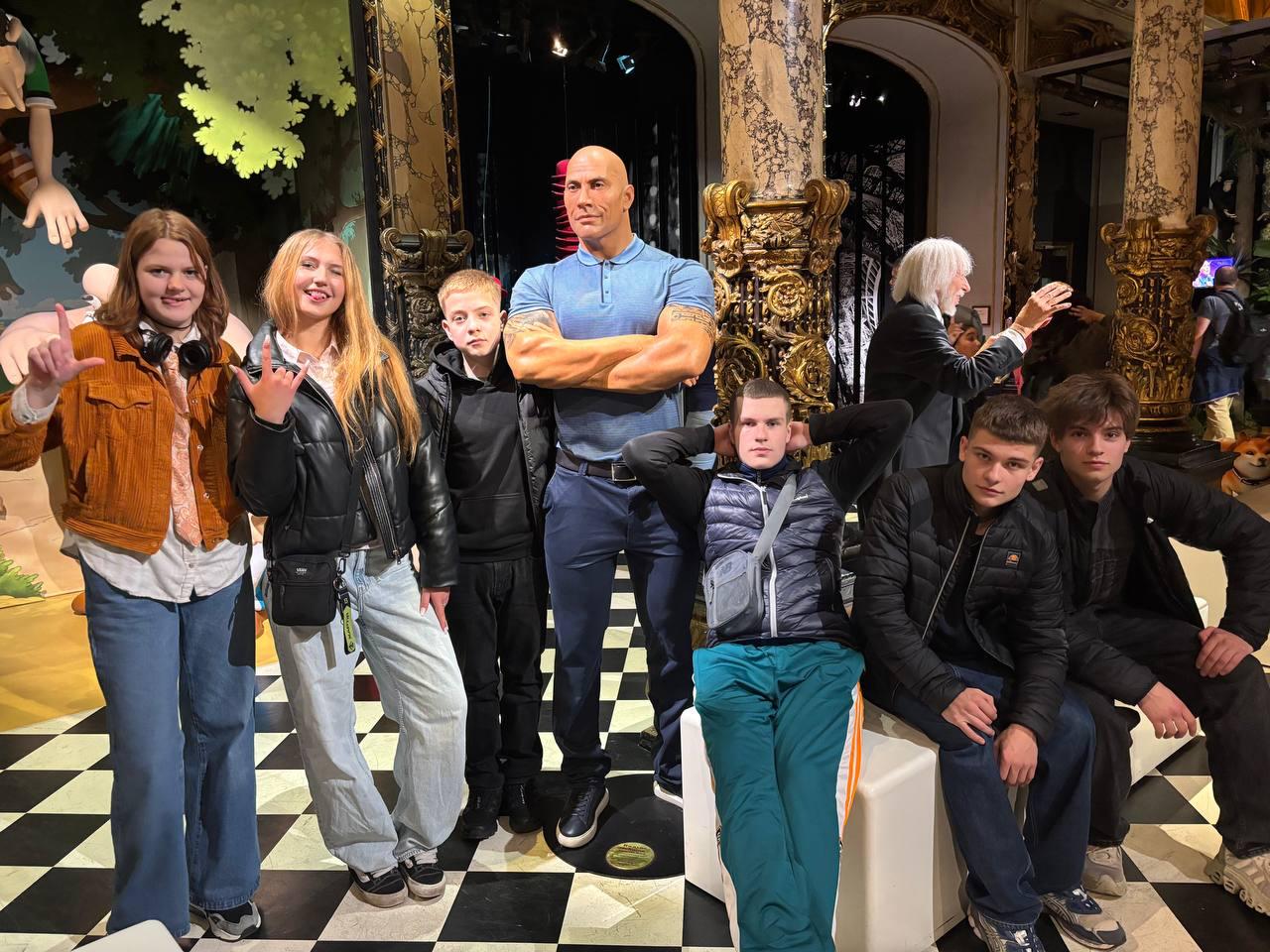
The kids spent time together every day, joked, relaxed, and did what teenagers should do — be kids again. They also visited monuments, museums, and restaurants in Paris, all under unforgettable Christmas decorations. For Ishchenko, it was his first time in France. Another Ukrainian student, 15-year-old Sasha Radniana, had visited France with her family eight years ago but had never been to Paris. “It’s really beautiful,” she said shyly.
However, their reactions shifted when Roullet tried to talk about the war. “I tried to bring it up very carefully, but it was too difficult,” he said. “A very long time ago, I read a book about deportations [organised by Nazi Germany],” said Roullet, gesturing to some sweets and foods he was preparing to send to some friends in Brovary. “A person who was deported said that during the moments when she was down — when she wanted to give up — she had found a sweet on the floor. And when she felt down, she would suck it, and she would tell herself, ‘Okay, I need to keep going, life has some good.’ It may not seem like much, but when someone is down, to be able to have something like a piece of candy.”
In 2023, Roullet hosted two other teenage boys, one of whom, a 16-year-old, had recently lost his father, a soldier in the war, and had stopped attending school. “After returning from France and my home, he resumed his studies,” Roullet recalled. “I tell myself, even if we only saved one, it was all worth it.”