
Listen to the audio version of this article (generated by AI).
This article is part of a series aimed at fostering grassroots wildlife conservation networks in urban areas.
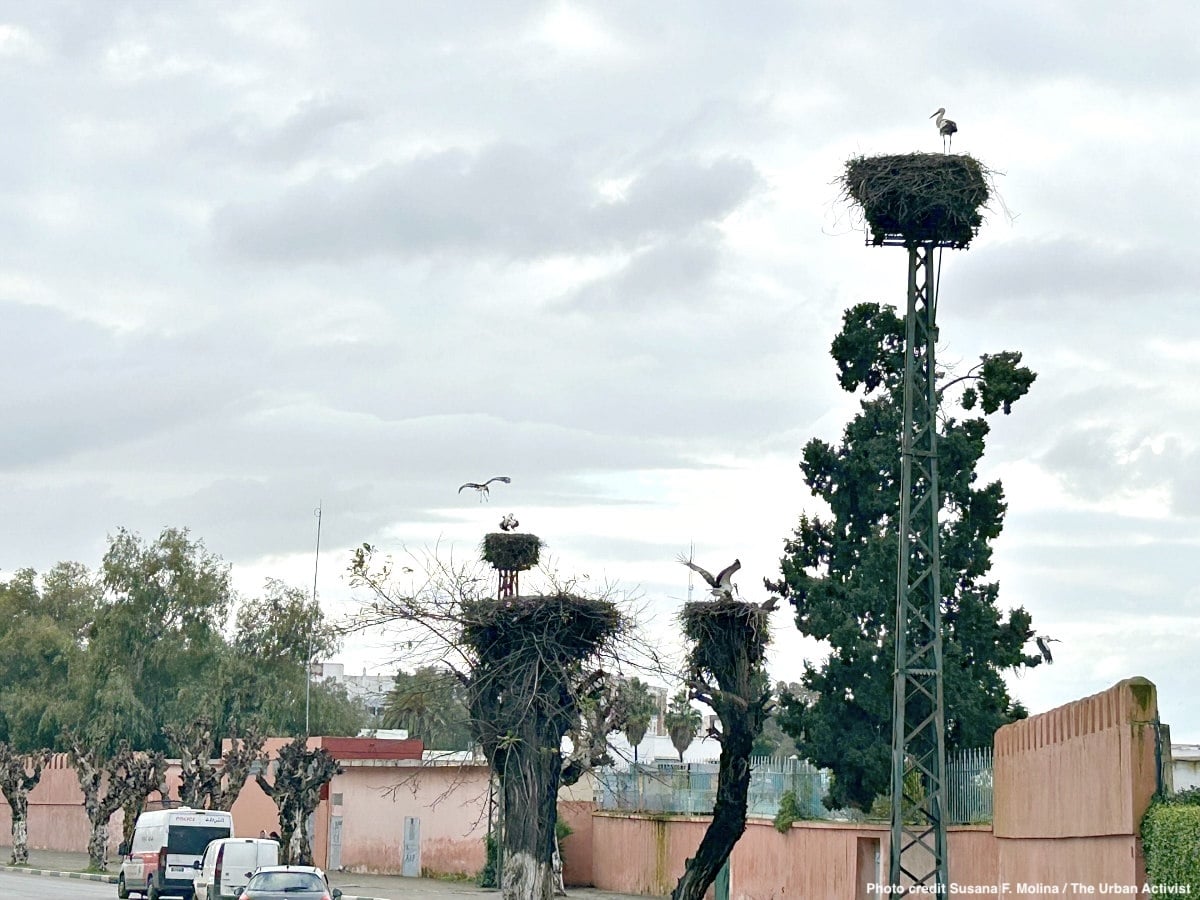
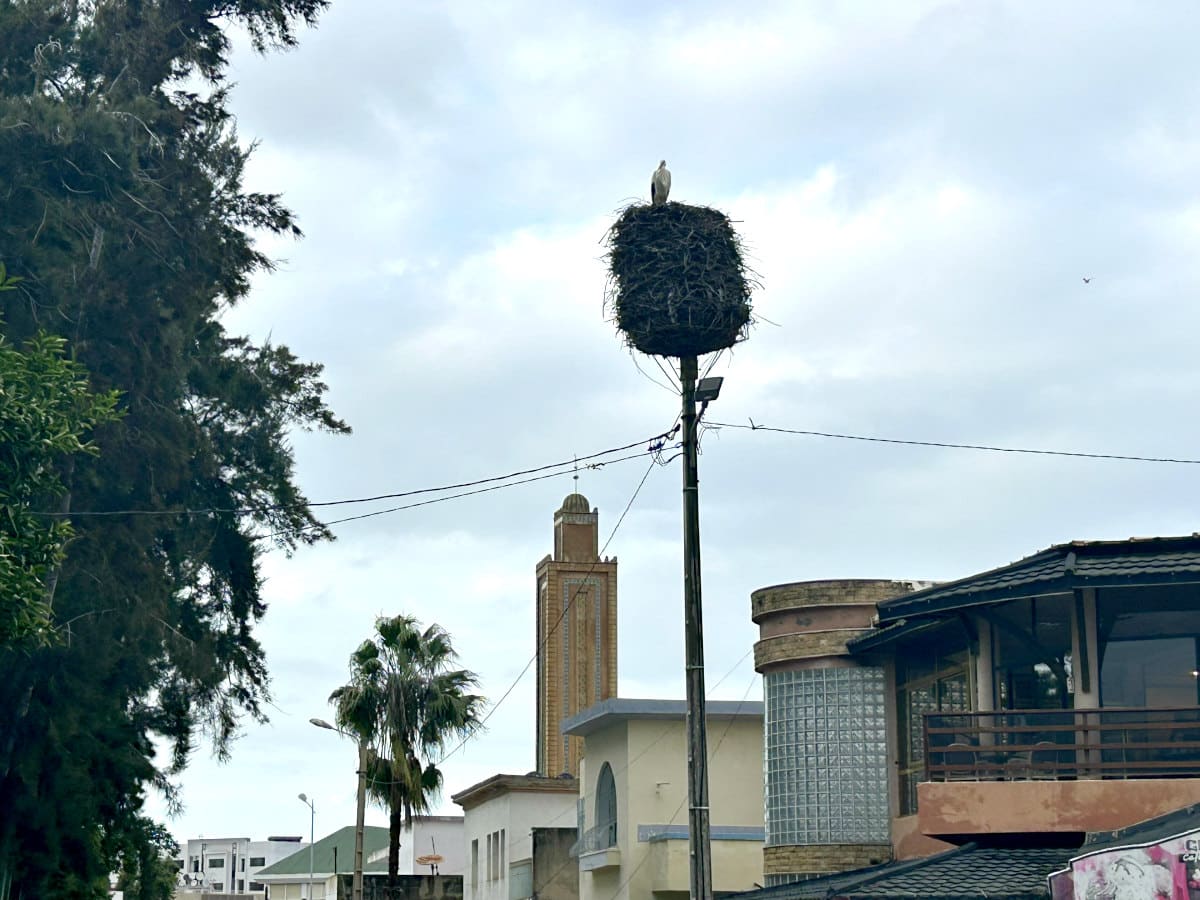
On any given day, all it takes is a glance at the sky or the roofs of Kenitra, a Moroccan city on the Atlantic coast, to spot the impressive nests of white storks perched on minarets, houses, and kasbahs. White storks are in big numbers throughout the city, a delightful sight for wildlife conservationists and ordinary visitors alike.
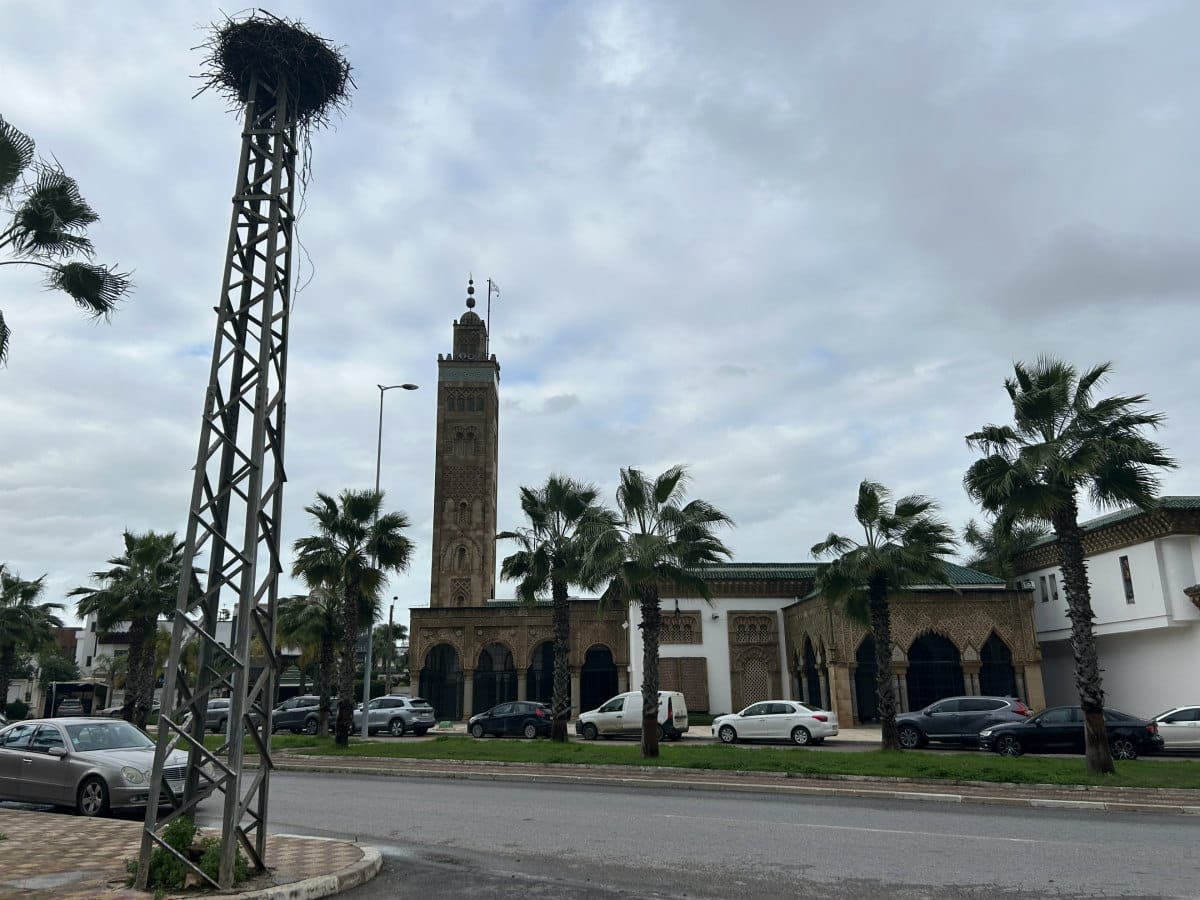
I vividly remember my first visit to Kenitra in May 2016, when one road had a nest on nearly every light pole. When I returned last January, I noticed that the city had replaced the old light poles with a new design that made nesting more difficult. Yet white storks were everywhere, occupying communication and energy towers. Standing tall on their long legs, they watch over the city below.
It’s not just ornithologists and a few conservationists who talk about white storks; they have captured the attention of the entire population of Kenitra. The city’s official coat of arms features a white stork standing on a bridge; a statue of a stork can be found at one of the city’s entrances. Apparently, at some point, a campaign on urban buses showcased the bird as well.
There’s a sense of pride among the residents that white storks have chosen their city as a home, and they seem to embrace the presence of these magnificent birds that fly over their heads in and out of their nests. Local newspapers often report on the harmony and coexistence between Kenitra’s inhabitants and the white storks. Urban planners and community activists emphasize the importance of integrating environmental and ecological considerations into sustainable development programs, ensuring “the sustainability of a peaceful life for the stork.” Many believe that Kenitra has provided sanctuary for these birds over the years and that the storks deserve recognition for their loyalty.
However, the conservation group GREPOM/BirdLife Morocco argues that this narrative is misguided. “It’s not just loyalty; it’s also the availability of food year-round, particularly from domestic waste in open dumps and industrial waste from chicken farms, that causes white storks to linger in Moroccan cities like Kenitra,” laments Mohamed Amezian, Project Manager at GEPROM/BirdLife Morocco, based in Salé on the outskirts of Rabat, only 30 kilometers from Kenitra.
White storks are migratory birds in the Western Palearctic that nest in Europe during spring, following specific routes such as the Strait of Gibraltar. They avoid flying over large bodies of water, which would require constant wing-flapping and consume 23 times more energy than soaring over land on thermal currents. In autumn, they return to sub-Saharan Africa (specifically Southern Mauritania, Senegal, Mali, and Niger in the Sahel region), stopping along the Atlantic coast of Morocco. This area still has several natural wetlands and marshes that provide food sources such as amphibians and fish. Although many have been drained for agriculture, Mohamed Amezian notes that there are still plenty of marshes along the migratory route that can sustain the birds.
However, he observes that white storks’ migratory patterns have changed over the past 30 years. “Migration is still happening, but many white storks and other species have shortened their migratory distances. Many birds from Europe now remain in Spain or North Africa.” Due to the abundance of food available year-round in marshlands and waste dumps around Moroccan cities, along with favorable weather conditions, white storks no longer have to worry about food shortages or freezing temperatures. When we factor in these wintering birds from Europe to the local Moroccan population, we see a significant increase in the breeding population, which has grown exponentially in Kenitra.
Recommended Read: How New Yorkers Help Birds Return to the City
Amezian shows me, through an application, eight birds currently at a dump outside Rabat. “They came from Spain, Portugal, Germany, France, all along the Western Flyway. If you look at this area a week later or a week before, there are always birds present,” he moans. In 2013, the Max Planck Institute for Ornithology tagged around 120 juvenile white storks in different countries to better understand the migration and survival of these birds from various populations.
For example, the white stork known as ‘C666’ was satellite-tagged as a nestling in June 2013 in Doñana National Park, Andalusia, southern Spain. During its short life, ‘C666’ crossed the borders of six countries—Spain, Morocco, Algeria, Mauritania, Mali, and Niger—where it spent the winter, before returning to northern Morocco, where it died in early November 2013. It successfully made the perilous desert crossing twice, only to perish in a rubbish dump not far from its birthplace.
Most likely, ‘C666’ got entangled in fishing lines discarded at the dump. “Hundreds of white storks gather along with other birds at nearby rubbish dumps to feed. Some storks become entangled in strings and lines of various kinds at the dump. At night, when they move to roost in cypress trees nearby, they may get snagged in these strings and die,” explains Amezian. Some fortunate storks can be rescued—even when they are already stuck in trees—if local people notice them in time.
Conservationists emphasize that people do not always grasp the complexities of living alongside migratory birds like white storks. Often, the conservation efforts of GREPROM/BirdLife Morocco take place behind the scenes to promote a safe coexistence between urban residents and wildlife.
In 2017, Amezian and his team assisted in relocating a small population of 23 white stork pairs that had nested on a mint building close to the airport. A crane moved the large nests into trucks and transported them to Maamora, 13 kilometers away. The airport authority commissioned a risk assessment study that identified storks near Rabat’s airport as a potential threat to air navigation due to the risk of bird-aircraft collisions. The High Commission for Water, Forests, and the Fight Against Desertification (HCEFLCD) provided a well-protected plot of land for the installation of nest boxes within the Bir Lahmar forest. GEPROM/BirdLife designed the pylons that housed the nest boxes. Amezian notes that the operation was successful, but white storks continue to return and nest in the area, creating an ongoing challenge for airport authorities to ensure passenger safety.

Human-made infrastructure has contributed to increasing bird populations. Electricity and telecommunications pylons offer more nesting opportunities for species such as white storks and other raptors. However, high-voltage pylons that connect cities and villages can be deadly. Amezian showed me through the application a Spanish Imperial Eagle that was tagged in Andalusia, Spain, which later died in southern Morocco due to electrocution.
He and his team conducted a study to report on this issue and raise awareness within the Ministry of Water and Electricity, achieving tangible results.
“We can’t fix all of Morocco, but we can address specific problematic areas. For instance, in Gulmimaria, an area with no trees and plenty of food but lacking suitable nesting sites, white storks and other birds are nesting on electricity pylons. We recommend retrofitting old, dangerous pylons in this area,” Amezian explains. He notes that countries like Spain have extensive experience in retrofitting energy infrastructure to protect birdlife, a task that is not easy to accomplish without causing power outages for consumers.
He and his team held workshops with private energy distribution providers in Morocco, including Rabat and Casablanca, in collaboration with the state-owned Office of Electricity. One private company agreed to retrofit its pylons, as they viewed the issue strictly from an economic perspective. They had to conduct repairs due to electrocutions two or three times a year. “The others were hesitant at first, but now they have reached out again. That’s a significant gain,” Amezian says proudly.
GREPROM/BirdLife Morocco also collaborates with international organizations on the reintroduction of protected species, such as the Northern Bald Ibis (Ibis eremita), in Germany and the Alps region of Austria. This species only exists in the wild in Morocco and some parts of Syria, as it has stopped returning to Europe. To support all the work done by Amezian and his team, they typically secure international funding for programs focused on endangered species.
However, obtaining funds to relocate nests without harming white storks is more challenging. Amezian is passionate about his work, and for him and his team, the welfare of any species matters. He hopes that with the increasing closure of open dumps in Moroccan cities, and the efforts of conservationists like him, more white storks will complete their route and return to sub-Saharan Africa and Europe.