
Listen to the audio version of this article (generated by AI).
It’s a cold evening in Jerusalem, and I’m in a waiting room with ten others, hoping to get into an over-capacity screening of a new documentary at the Educational Bookshop. The title, “Coexistence, My Ass!” encapsulates the life’s work of the film’s subject, Noam Shuster Eliassi, a Jewish-Israeli who previously led the United Nations peacebuilding initiative, Interpeace. Noam transitioned into comedy, focusing on the harsh realities on the ground rather than the dreams and good intentions of faraway foreign diplomats. The system is absurd, and Noam reveals this for a living.
The film is directed by Amber Fares, a Lebanese-Canadian filmmaker based in Brooklyn who lived in Ramallah for 7 years, and the editor and writer is Rabah Haj Yahya, a Palestinian-American. It’s produced by Rachel Leah Jones, a Jewish American-Israeli filmmaker who lives in Tel Aviv, and who shot the local footage.
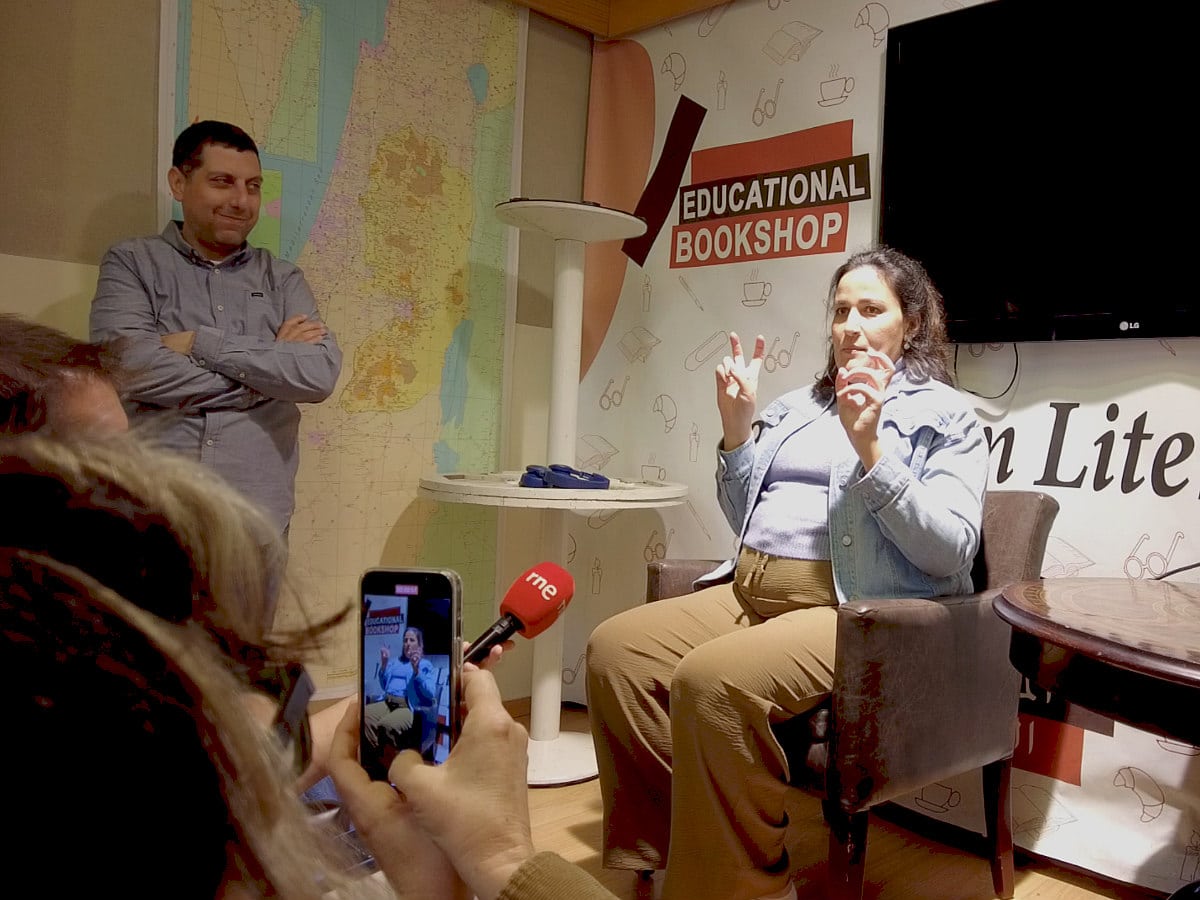
The event’s host, Mahmoud Muna, comes into the room to usher me into the screening. I run into Noam on the way, her expectant belly emphasizing her presence in the tiny entrance of the bookshop, a tall and charismatic woman with long curly locks of Iranian hair framing her smile, sad eyes, and frequent laughter. There’s pain in her brow despite the warmth of the welcome in this Palestinian space, where she, a true solidarity activist within Israeli society, is the guest of honor.
There’s a humility in her openness, nobody’s interactions brushed off, everyone seen and honored in return, as she leads through her repeated habit of treating everyone with equal dignity, whether it’s the large person who was clearly born male, but is now presenting as a religious Jewish woman wearing their gloves for modesty, or the petite figure of an ex-colleague from the UN, her Swiss style betraying her wealth and privilege as she empathizes with the dark comedy of our lives.
As a diverse audience, we buckled up for the rollercoaster that this movie is, emotionally soaring with belly laughs from hilarious observations, then dipping into the bare grief of our shared pain. Over the past two years, countless bombs were dropped on kids whose families are starved and now frozen under open skies, many burdened additionally with Israeli guilt, either as active participants from their conscription, or from the rewards they enjoy as citizens of the State, from free healthcare to kosher McDonalds, privileges very distant from the lack of freedom for Palestinians in the West Bank and Gaza. In this way, the system makes even the kindest of Israelis complicit, whether willingly, unknowingly, or neither.
The film follows Noam’s intimate yet public struggles to reorient her mission before and during the current genocide in Gaza. However, the foundation of the narrative rests on a portrait of her childhood, born in the only intentional community founded jointly by Jews and Palestinians with Israeli citizenship, called Oasis of Peace, Neve Shalom, and Wahat al-Salam, depending on the language, and where she currently lives. A utopian project founded to show that Jews and Arabs can live together, the village was named for a Bible quote that reflects the project’s basic Christian DNA. One Palestinian and four Jewish families were the seed population, settling here in 1978; each family was committed to retaining its own cultural and religious identity and to living as neighbors while remaining distinct.
The film is funny, and jokes rely on timing and empathy, so it’s hard to transfer them to the written word while retaining their foolishness and innocence. But when Noam steps onto the standup comedy stage in the film, in front of an audience of mostly Palestinians, and promises to stay for 7 minutes, and not 70 years, the audience in the movie roars with laughter, and so do we here at the screening. After which, Noam says she stole that joke from Amer Zahr, a Palestinian standup comedian, but that it’s hers now. He’s standing by the stage in the film, and he cracks up as much as we do.
We watch difficult scenes, too, like Noam talking about her childhood memory of refusing her father’s meat barbecued to celebrate Israeli Independence Day, i.e., the commemoration of the Nakba, marking the mass displacement and dispossession of Palestinians. Meanwhile, many of her Jewish neighbors man checkpoints in the West Bank, and even more distressingly, are deployed to Gaza as soldiers killing Palestinians who clearly didn’t get born in the Oasis of Peace.
On the other hand, the Palestinian neighbors have to maintain a neutral silence in the face of this, quietly shuffling to their work and school with muted grief, watching these same images on their phones with an opposite emotional response, within a society that fears them and simultaneously erases their existence from the face of the coastal strip, under siege.
It’s this erasure of their existence that’s at the heart of the film’s title — as Noam Shuster Eliassi says, you can’t coexist with a society that’s erasing your existence. It’s an oxymoron.
Recommended Read: An Ordinary Day in the Last Inclusive Space in Jerusalem
As the lights go on, and Noam walks clumsily to the front, her belly forbidding her grace for this moment of applause, she comments on the red eyes around her, and apologizes that we thought we were getting a comedy show, but instead, got a comedy show with a heavy dose of pain. Shared, communal pain. A public opportunity to sit together with the private mourning we’ve all clearly experienced individually, our phones purveying images of utter depravity in the name of Jewish safety, while we all sobbed quiet tears before a commute, or a visit to our families, where this grief was bottled up. Denied a collective outlet, the audience tonight was hit in the chest, grateful, but in a state of physiological emotional despair with double-inhaled sobs and swollen eyelids along with smile lines and aching ribs. It’s a weird feeling, solace mixed with horror.
In short, Noam destroyed this audience, and we loved it. But then we had to regain our composure, ready for the Q&A, which was moderated by Mahmoud Muna, the co-owner of the Educational Bookshop, and assisted by Rachel Leah, the film’s producer.
One person asked about the language choices, as Noam is fluent in Hebrew, Arabic, and English, yet the majority of the dialogue is in Hebrew and English, with Arabic subtitles. She described this as a creative choice to prioritize reaching an Israeli-Jewish audience, which has so few films of this nature created for them.
Noam went on to say, “I make an active choice to speak in Arabic. I’m operating in a system that has constant erasure of this language. This is part of my criticism of Neve Shalom, and by the way, if I type that on my phone, it auto-corrects it to ‘Never Shalom’” — and the audience laughs.
She continues to share more about learning Arabic in this coexistence village as a child: “The Arabic that I was taught was a specific kind of Arabic, for intelligence purposes. Intelligence officers would come and grade our level of Arabic with verbal exams, and it was very clear to me that my Arabic was about to be hijacked for a system I didn’t want to give it to. Once an officer took me out of the class, and their assistant had a tongue piercing. The officer was talking to me about all the roles I could play if I joined and what I could do with my Arabic in the army, and I said, ‘Yes, but did you know your assistant has a tongue piercing?’ and they looked at each other, and agreed I’m not a good fit for the army. Yeah, even in school, I was very aware that I wouldn’t let them use my Arabic. I later declared myself a conscientious objector, like my father. I’m not an army type.”
Similar open threads wove the Q&A together for an hour until Mahmoud brought it to an end with his last question — whether Noam and her partner knew yet if their unborn baby would be Jewish or Palestinian. At that moment, the audience shared one last dark laugh as they took the remnants of our spent emotions to the streets of Jerusalem. Ancient stone soothed the sturm und drang of the film, the event, and this brutal container of our lives, as flags fluttered from lampposts above, and video projections of menorahs punctuated the ancient city walls, no matter the quarter or the season. At least it’s Hanukkah, but they’ll still be there, even in July, in this place that peddles Judaism as a political jab.
The ebbs and flows of the film are brilliantly abrupt, shattering each laugh into sharp shards that pierce hearts, as is appropriate.
Why does a beautiful protagonist use comedy as a tool to break the system around us? Perhaps the question should be, how could she not? Noam Shuster Eliassi has that natural ability — a unique grace that enables her to pluck the preposterous out of her surroundings with exceptional precision.
She’s a human on the internet with access to a vast array of resources, including thousands of United Nations reports, B’Tselem documents, International Court of Justice findings, and reports from Médecins Sans Frontières, among other agencies that compile witness accounts and testimonies on all aspects of State control. These include the International Federation of Red Cross’ Critical Incident Management logs that document everyday breaches of decency, from bleeding kids at checkpoints to poisoned olive trees on hillsides. Mundane details, all verified beyond any doubt.
Everyone who knows what Noam knows uses what they have to reach their own people. For Noam, that’s Jewish people, and it’s also people who love standup comedy, whether they’re Jewish or not. She uses comedy because she’s good at cracking jokes, and jokes are equal to every other tool, from an academic report to the sharp edge of a brick.
The times call for using whatever works until justice is achieved, at which point we’ll all enjoy an evening of coexistence, without anyone’s existence being erased while we’re eating our popcorn. But while we’re waiting for that day, go see “Coexistence, My Ass!” Noam Shuster Eliassi’s approach to justice is unique and powerful.
“Coexistence, My Ass!” will be in movie theaters across the US and UK in January 2026, in Germany in February, or available on selected online platforms.
For full information, visit @coexistencemyass on socials and coexistencemyass.com


