
Listen to the audio version of this article (generated by AI).
From a young age—at just eight years old—Saad Al Balhi Al Qahtani worked with his father in trade in Dammam, located in the Eastern Province of Saudi Arabia. Still a child, he often played behind his parents’ house, digging in the sand. At the age of ten, he discovered four old coins buried in the sand, and from that moment, he says, “my heart became attached to searching and collecting.”
By the turn of the 1980s, Al Balhi began working for the Saudi National Guard, an armed force tasked with defending the Kingdom of Saudi Arabia’s territory and borders and maintaining internal security and stability. He stayed for more than a decade.
The 1970s oil boom brought dramatic changes to the nation. In just one generation, mud-brick towns transformed into modern cities, nomadic lifestyles declined, and traditional crafts began to fade. In response, it doesn’t seem unlikely that the son of a merchant would feel a strong urge to preserve Saudi heritage in the revamped city of Dammam before it was lost.
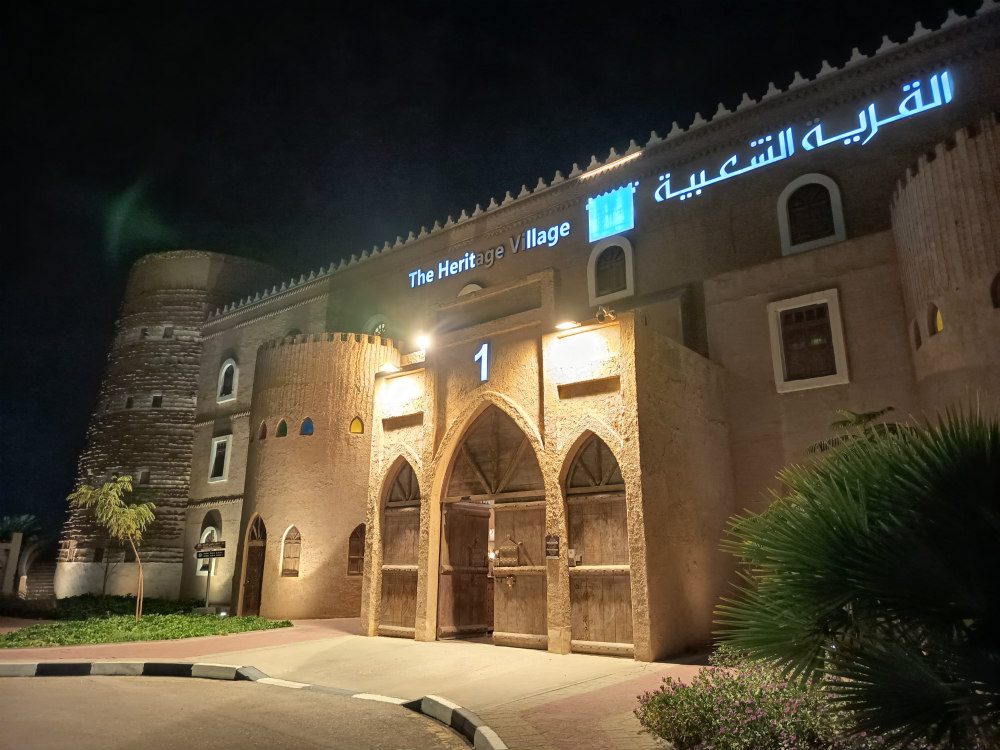
In 1998, Saad Al Balhi established Heritage Village, a 21,000-square-meter building in the traditional Saudi adobe palace style, located on Dammam’s waterfront corniche. On the ground floor, various rooms recreate the interiors of houses from different regions of the Kingdom, surrounding the largest restaurant in the world, as recognized by Guinness World Records. On the second floor, a private museum showcases Al Balhi’s rare heritage collection. I visited this site during a recent trip to Saudi Arabia and met Al Balhi.
***
Saad Al Balhi has been collecting artifacts for 37 years — a total of more than 12,000. Behind each of them is a story waiting to be told, from its origins to how it got into Al Balhi’s hands. The collection features heritage artifacts and traditional tools from across Saudi Arabia, antiques, rare pieces, and coins from the early Islamic eras, as well as thousands of archaeological items dating back to the flourishing Abbasid Empire, known as the Islamic Golden Age, in the ninth century. Additionally, there is a massive collection of memorabilia and an extensive archive of documents, manuscripts, and correspondence that narrate the region’s modern history. It is Alibaba’s treasure for today’s historians, but without the robbers.
Al Balhi has acquired these pieces through his travels across Saudi Arabia and around the world, from Ethiopia to Yemen and India, sourcing them from old houses in villages, local markets, and auctions.
This was a way to save all these objects before they fell into oblivion amid the country’s rapid transformation. “I want to teach the new generations about our history, our past, how we used to live,” he states.
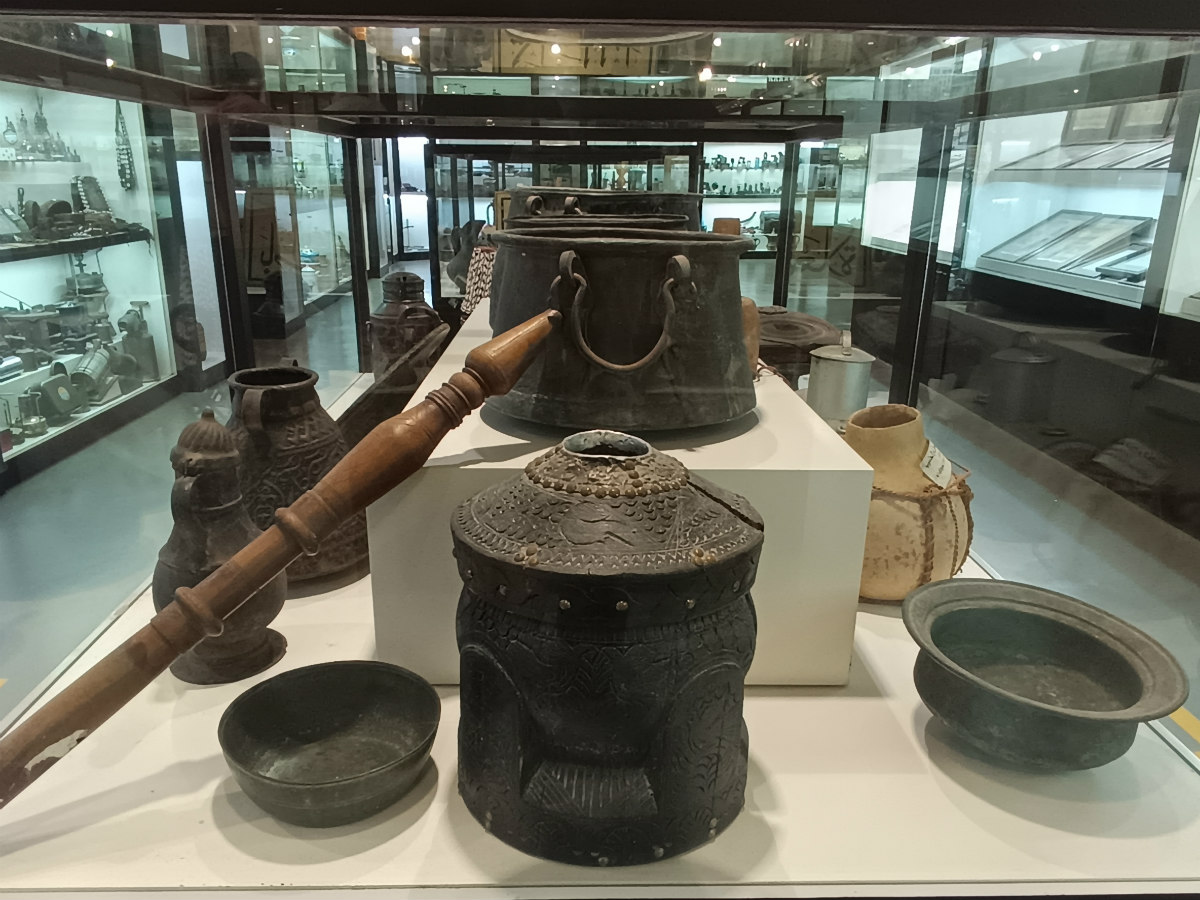
At the entrance to the museum, a one-meter-high wooden barrel stands on four feet, with a handle at the top. Initially, I would have guessed it was an alembic used to distill medicines for therapeutic purposes. During the Islamic Golden Age, scholars from the Arab and Persian worlds preserved and significantly improved upon the techniques of ancient Greek and Egyptian alchemists. However, it turned out to be something less glamorous yet incredibly ingenious: an old washing machine. The top handle was used to spin laundry.
The museum also features various ancient household appliances, including a wooden “refrigerator,” a 100-year-old metal coffee grinder that made a loud noise to signal to the entire village that coffee was being prepared, a leather container for preserving camel milk, and various cooking and agricultural tools.
Recommended Read: Hidden Recipes: Inside a Woman’s Culinary Academy in Saudi Arabia
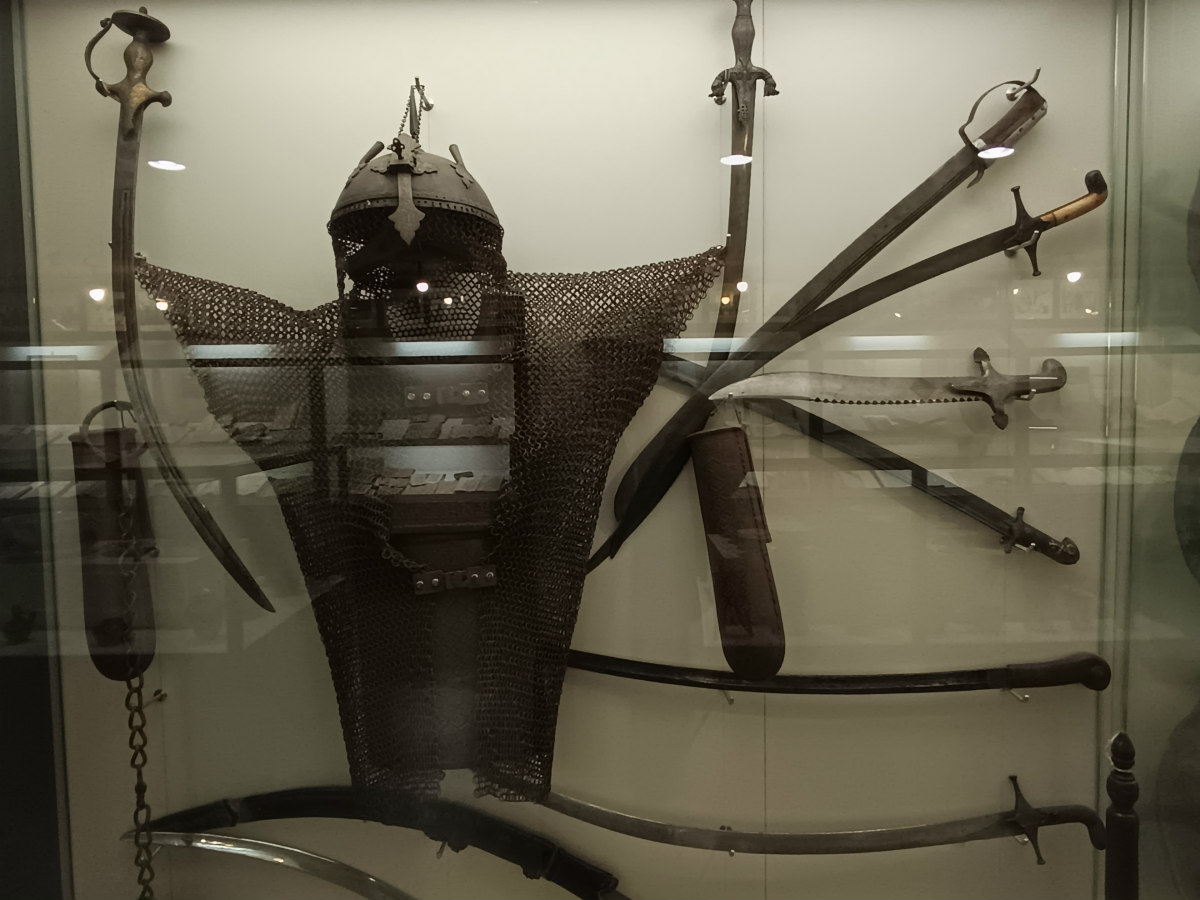
Inside the vitrines on the right wall, there is an extensive display of historical weapons, rare firearms, and tools for cleaning and polishing these weapons. Among the collection are curved and straight double-edged swords, daggers, and blades. At the center, a chainmail shirt (hauberk) — a long shirt made of interlinked metal rings used to protect the torso. Next to it hangs a metal helmet, likely designed to be worn with the chainmail, possibly with a nasal guard or mail extension for neck protection. This type of traditional warrior’s armor was commonly used in the Middle East and surrounding regions, likely dating from the medieval to early modern Islamic period. The curved blades suggest cavalry-style weapons typical of the region, though these remain conjectures, as there are few exhibit labels or didactic panels at the museum.
On the left wall, another vitrine displays early Islamic manuscripts and writing materials. At the centre, a large wooden board with Arabic script appears to be a traditional Qur’anic writing tablet (lawḥ). The script looks handwritten in classical Arabic calligraphy. Historically, students used wooden tablets to write and memorize Qur’anic verses. The ink could be washed off and reused. To the left, there is an open manuscript with Arabic text and a geometric diagram — possibly a religious, legal, or scientific text, likely dating to earlier centuries before modern printing.
Also, an antique optician’s trial lens set caught my attention. Al Balhi explains that he bought this large wooden trial lens case with rows of circular lenses in Rajasthan, India, and it belonged to a British settler. It probably dates from the late 19th to early 20th century, when optometry was becoming more standardized and professionalized. Opticians and ophthalmologists used it to test eyesight before prescribing glasses.
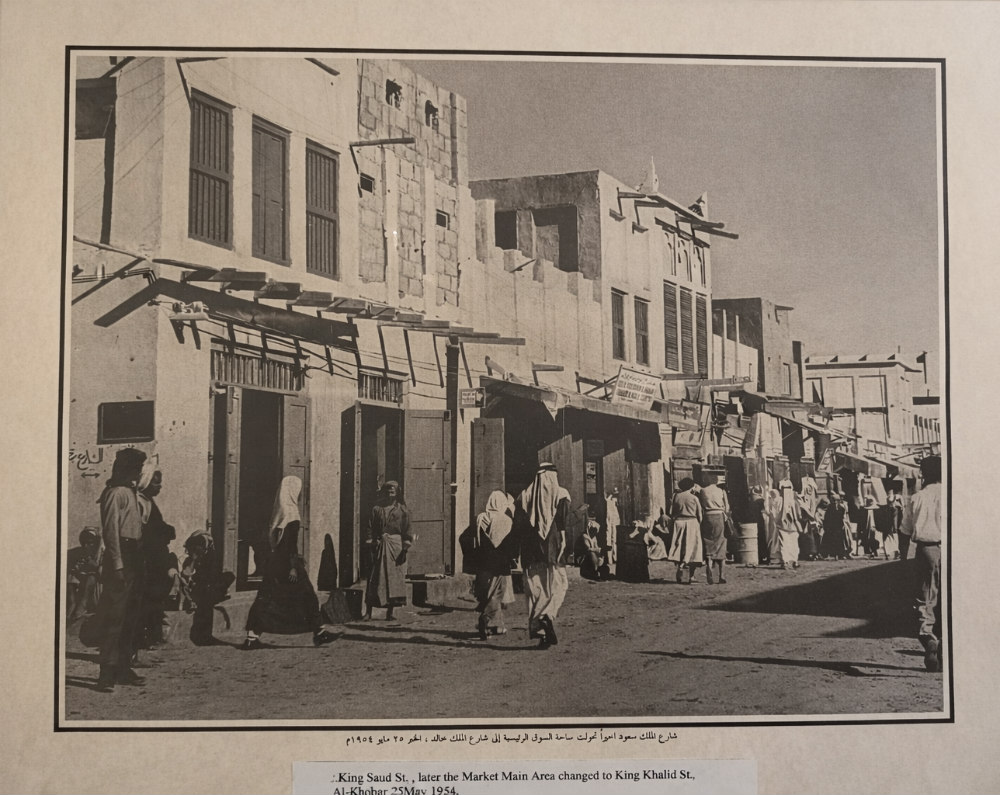
The museum also houses communication devices from various periods, such as telegraphs, telephones, radios, and televisions, that offer a nostalgic glimpse into a rapidly changing country. The walls are adorned with old photographs capturing the leisurely pace of life in cities before oil was discovered, images of American officials with former Saudi kings and princes following the discovery of oil, and various photographs of contemporary foreign government officials who visited the Heritage Village. Additionally, there are samples of old official documents, passports, IDs, traffic licenses, and other records issued by various state agencies, whether in the Kingdom or the Gulf states, including the visa application forms for the first Americans who came to work for the oil company Aramco 80 years ago.
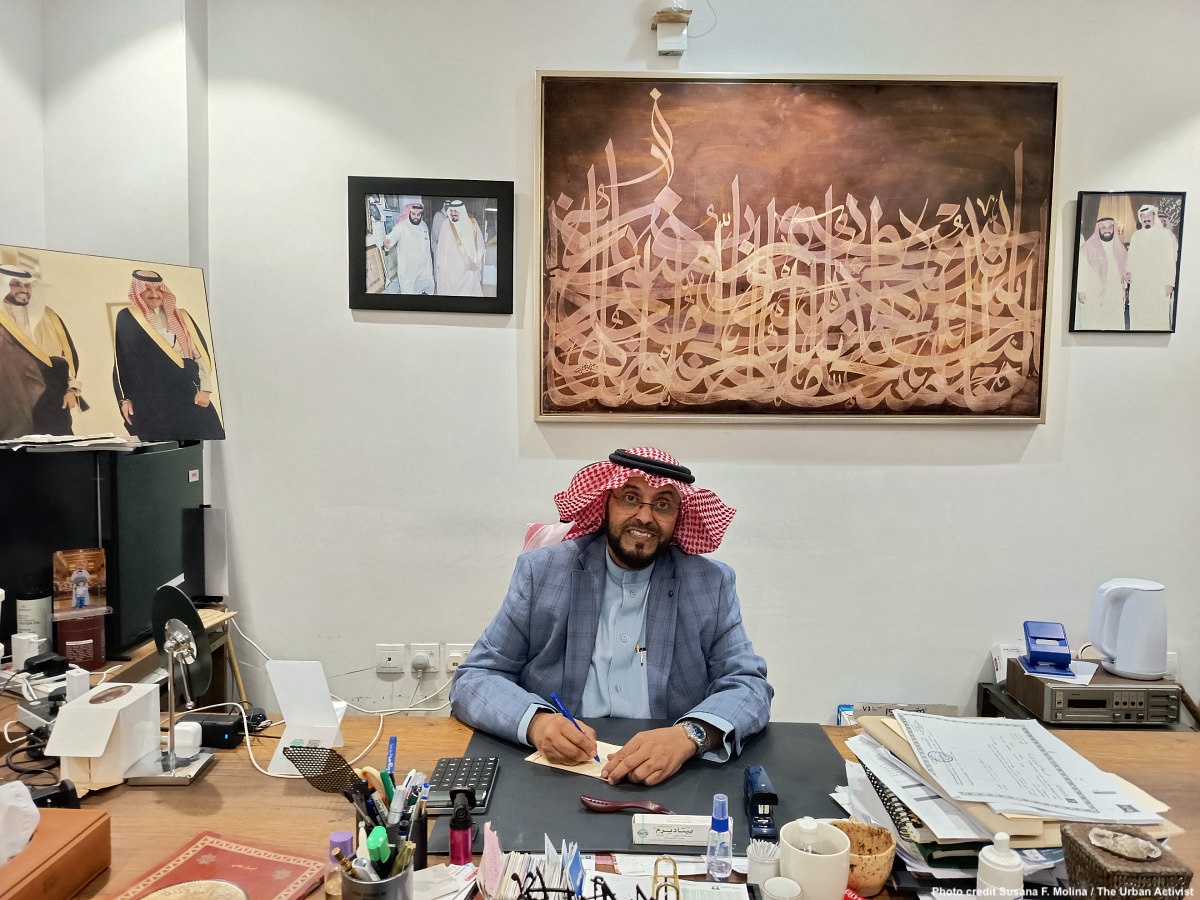
Also, the museum includes a collection of vintage cars, including a 1977 maroon Cadillac Fleetwood with four seats upholstered in white leather that belonged to King Salman bin Abdulaziz. Al Balhi not only collects Saudi heritage but also preserves items from other countries. For instance, as we sit down in his office, he shows me an antique china set from a now-defunct English manufacturer that once served Queen Elizabeth. “No matter how much they offer me, I won’t ever sell this piece,” he says, referring to the action that the Heritage Village organizes twice a year that provides funds to buy new pieces.
Recommended Read: Saudi DJ Baloo in Riyadh: “We Still Think It’s Our Woodstock”
An ancient vase from the holy city of Madinah flanks Al Balhi’s office. Inside, his desk is cocooned among photos of the King, stacks of documents, items awaiting display, and an old-school radio. When he holds a 100-year-old vessel, I inquire about how he acquired it, along with some other pieces I have seen. “Secret,” he chuckles, his directness charming.
He adds, “I bought most of the pieces; others I saved before they were thrown away,” pointing to a table in the restaurant made of colorful wood and old doors from ancient houses. I express appreciation for the extensive knowledge he safeguards and ask about his documentation process for the origins of these items. He explains that he aims to create a detailed catalog of all the antiques, which requires considerable time and effort. “We want to produce something of high quality, which is why it’s taking so long.”
Interestingly, Saudi Arabia has an unusually high number of private, individually owned museums. They often began as personal rescue missions in a dramatically transformed country after the 1970s oil boom, and have persisted during a period of stricter interpretations of Islam post-1979. However, in recent years, especially under Vision 2030, cultural preservation has become a national priority in Saudi Arabia.
With the opening of King Abdulaziz Center for World Culture (Ithra) in Dammam in 2016, and the cultural programming at heritage sites spreading across the Eastern Region, as well as the notable upcoming museums and cultural institutions in other parts of Saudi Arabia, privately owned museums come on the back of accelerated cultural activity in the Kingdom.
Institutions like the Museums Commission under the Ministry of Culture have licensed private museums, provided support and recognition, and encouraged documentation and public access. This formal acknowledgment has helped legitimize personal collections, such as Al Balhi’s museum, as vital for preserving Saudi folk heritage and showcasing the country’s metamorphosis through these artifacts.
His Heritage Village is an invitation to remember the Saudi country through its diverse fabric of provinces, but also a call to arms to protect its rich heritage and identity; the private museum’s objects each echo back to a moment in time, or at least remind us of its passage. A private museum can foster community pride; it cultivates a sense of belonging among citizens without giving the impression of being stuck in the past. On the contrary, the country is rapidly morphing and evolving on the cultural front.