
Listen to the audio version of this article (generated by AI).
Under a blue sky in Madrid, I joined a stream of people wearing name tags as we made our way to the elegant opera house, Teatro Real. As we passed by tourists and locals near the famous “Puerta del Sol,” an elderly woman asked with curiosity, “Who are you all?” I explained that they were city officials and innovators attending the Bloomberg CityLab summit, and she continued walking.
Madrileños are keeping an eye on their rapidly transforming city. “The city is in a process of growth,” described its mayor, José Luis Martínez-Almeida, during the opening of the Bloomberg CityLab summit. He advocated for creating the necessary conditions for urban developments across Madrid to build new homes—the city is also at a crossroads with affordable housing. Yet, he called for the importance “to grow as a society without depersonalizing the city of Madrid.”
Less than an hour into the summit, in a move reminiscent of a “clásico” match, the mayor of Barcelona, Jaume Collboni, stepped in with a markedly different approach to housing: capping rent increases, phasing out tourist apartment licenses after 2028, and expanding social housing.
Two very different messages in one summit. It remains to be seen whether Madrid will balance its urban identity with the mayor’s ambitious plans to increase density and expand housing supply—and whether Barcelona’s measures will succeed in bringing down rents over the long term.
Meanwhile, on the streets, people are speaking out.
After Madrid’s mayor left the Bloomberg CityLab summit, he encountered Madrileños protesting outside. They represented 60 vulnerable families at risk of losing their homes in municipal housing, accusing the city of ignoring them. A woman shouted, “I’m a 40-year-old mother. They want to evict me.” The mayor claimed he was unaware of this issue and promised to help arrange meetings with the housing authority. But it leaves one wondering if his ambitious housing plans could ever help this woman.
As I strolled down to the Palace Hotel, the other venue for the Bloomberg CityLab summit, I passed the Congreso de los Diputados, Spain’s lower house of parliament. Inside, members were preparing to vote on a national law that would limit rent increases. Outside, people with banners chanted in support of the proposed law (it wasn’t passed).
I can’t imagine a summit about cities these days without the housing drama, but the summit offered much more than that.
***
Mike Bloomberg, founder of Bloomberg Philanthropies and former mayor of New York City, opened the summit by encouraging city leaders and innovators to exchange ideas and cooperate in a jovial atmosphere of diplomacy. There was a joke about cultural differences: “Dinner in Spain finishes when I start breakfast,” he said. And the moment, when London’s mayor Sadiq Khan joked in his opening remarks, “You are welcome to the second greatest city in the world. We are less in agreement about which one is the greatest first.”

For all their differences, Bloomberg called to show more similarities, noting that “In a period of extraordinary transformation, climate change, isolationism, and national government retreat from international stages, the more important are the mayors.” This theme resonated throughout the two-day summit, demonstrating Bloomberg Philanthropies’ capability to pull strings behind this network.
In his speech, Mike Bloomberg announced a $350 million commitment to continue supporting the Bloomberg Philanthropies Initiative for Global Road Safety, including the Bloomberg Initiative for Cycling Infrastructure, further advancing efforts to enact life-saving policies that improve road design, vehicle safety, and help cities build safer, more connected cycling networks. One day later, Bloomberg Philanthropies CEO Patricia E. Harris announced the expansion of the Youth Climate Action Fund to 300 new city halls—tripling the program’s reach since its launch in 2024. The Fund provides capital and capacity to support municipalities in mobilizing young residents ages 15–24 to design and deliver solutions aligned with citywide priorities.
“The Youth Climate Action Fund has made a real difference in Cincinnati by opening the door for more young people to engage directly with their city hall,” said Mayor Aftab Pureval of Cincinnati, Ohio. “Instead of standing on the sidelines, young residents are now actively shaping our future, leading projects in their own neighborhoods and turning ideas into action,” said Mayor Haris Doukas of Athens, Greece.
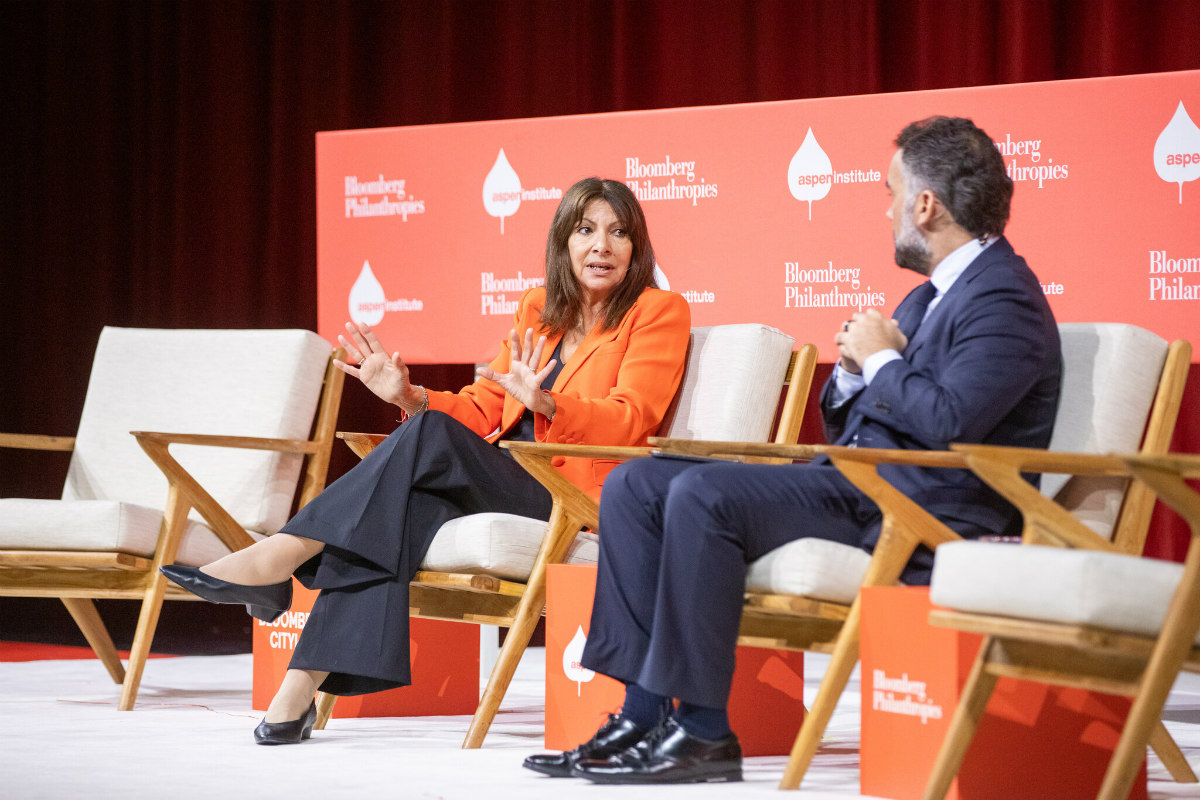
While citizen participation is crucial, bold leadership must complement it; this is the experience from former Paris mayor Anne Hidalgo, shared with the mayors present at the summit. “Very quickly, when you tackle the issue of cars in the city,” she said, “you come up against the entire fossil fuel lobby—and that’s when a battle began.” Her formula is “not to isolate yourself, work with the people, hold consultations, and engage in citizen participation,” and embrace the work of scientists, doctors, hospitals, or even international organizations such as the World Health Organization, because they back up your plans with scientific data.
“I remember when I had this proposal—which the people also voted on—to turn the entire Seine riverfront into a pedestrian zone. I told my team: ‘This battle is going to be fierce, isn’t it?’ We’re going to have to be very firm in the course we need to take, and we’re going to have to work together and build alliances.” The global networks of mayors, through which Hidalgo could share experiences and values, gave her personal strength.
At a grassroots level, the help of such a network is evident. At the summit in Madrid, I met Okela Douglas-Norgrove, the founder and CEO of the By&For-curated charitable organization, Sister System, in London. She is seeking support from the Bloomberg CityLab network to expand her model to other cities. Sister System delivers holistic programs that offer mentoring and qualifications to girls and young women aged 13 to 24 in London who have been referred to them through statutory services such as social care, police, and the NHS, guiding them through their transition into early womanhood.
“We are building a community within North London, particularly in Enfield, Waltham Forest, Islington, and recently Hackney. This community is rooted in the girls’ real-life experiences as adolescents living in an urban metropolis where they face deprivation, criminality, and trauma related to race and gender,” Douglas-Norgrove explains. It is concerning that around two-thirds of girls and young women who exit the care system in London become involved in crime. Two years ago, Sister System received funding support from the New Deal for Young People, an initiative by Bloomberg Philanthropies in partnership with the Greater London Authority (GLA).
The results are notable: approximately 75% of women transition into employment, education, or training after graduating from Sister System programs. Moreover, 90% report an improved understanding of healthy relationships, allowing them to avoid violence and abuse, while around 85% indicate that their mental well-being has increased through their work with Sister System.
***
“Great people create great acts of kindness,” stated Daniel Porterfield, President and CEO of the Aspen Institute, at the summit—echoing Miguel de Cervantes. The Aspen Institute has partnered with Bloomberg Philanthropies for the Bloomberg CityLab summit every year since its inception in 2013. This year, the summit’s philosophy has come full circle in Spain. The ideas of Spanish philosopher José Ortega y Gasset deeply shaped the thinking of the Institute’s founder, Walter Paepcke.
Like Ortega, Paepcke was concerned about the decline of thoughtful civic leadership in mass society. As a result, he built the Aspen Institute around the belief that leaders should engage with the humanities—philosophy, history, and literature—which mirrors Ortega’s view that education should cultivate well-rounded, culturally aware citizens and leaders, not just technical specialists. “Seventy-five years later, Ortega’s spirit still guides us,” Porterfield remarked.
In the same spirit, and in addition to numerous sessions with city leaders and experts, the humanities took center stage at the Bloomberg CityLab summit. To name a few, we watched an opening plenary featuring an opera performance by Anthony Roth Contanzo, listened to violinist Francisco Fullana perform Asturias by Albeniz, and attended an interactive experience organized by Musical Thinkers, where people co-created music alongside three musicians, a DJ, and even plants!
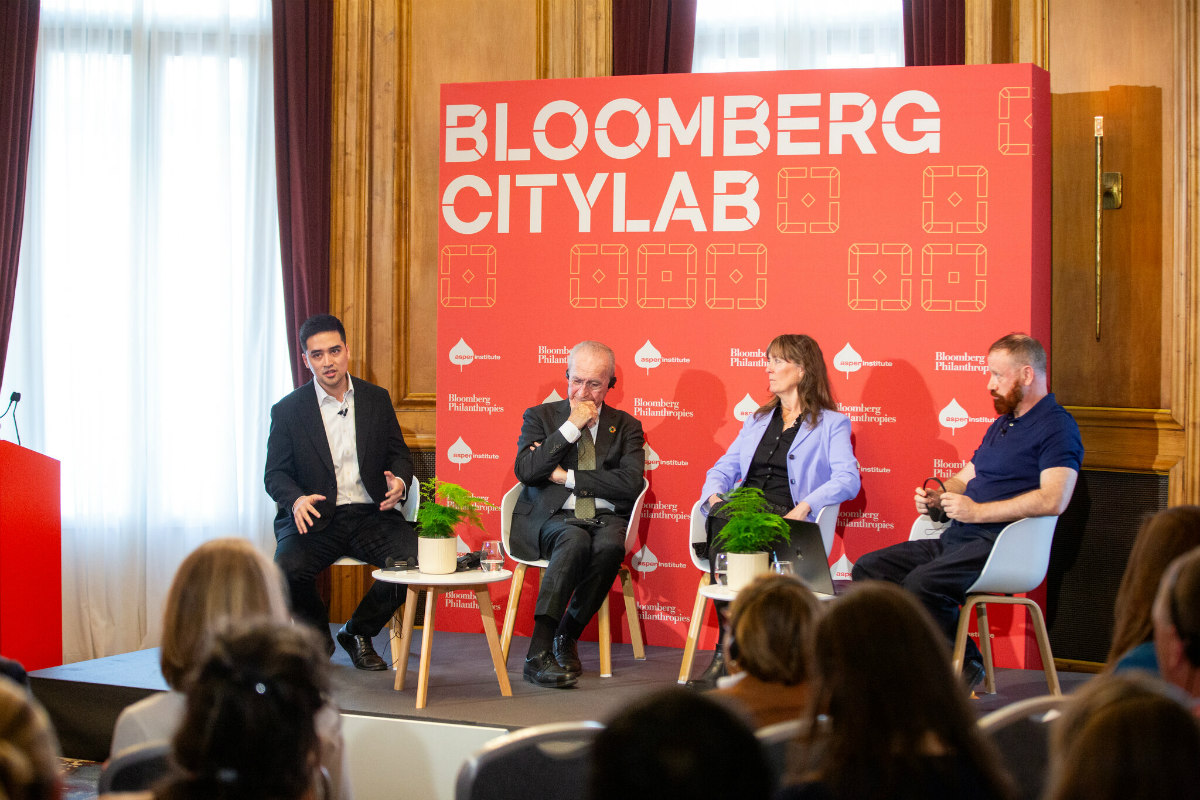
Additionally, there was also a panel with Fátima Sánchez Santiago, Executive Director of Centro Botín, and Spanish artist Cristina Iglesias, who immersed us in the meaning of her imposing pieces in public space, which stop the city’s rhythm, allowing people to gather and mentally connect with the place’s memory. The talk was moderated by Pilar Frank O’Leary, Executive Director of Aspen Conexión at the Aspen Institute. She emphasized the importance of the creative economy for urban development, a concept that she passionately promotes as part of Aspen Conexión’s mission. This program is dedicated to highlighting the economic and cultural contributions of the Hispanic community in the United States.
Frank O’Leary noted that there are currently 68 million Latinos in the United States, making up 20% of the population. This segment is the youngest and continues to grow, representing a powerful economic force—Hispanics launched 36% of all new businesses in the country. Despite the controversies surrounding immigration in the United States, she argued that this demographic is driving growth not only domestically but also globally. “Spain truly serves as the gateway to Europe for Hispanics,” she stated. “Bringing together mayors from various cities and facilitating their interactions with cultural figures, business leaders, and members of civil society highlights the significance of the collaboration between Bloomberg and the Aspen Institute.”
Recommended Read: London Calling: Inside the Fight to Stay on London’s Streets
And so my two days on the summit drew pleasantly, if intensely, to a close. But as I observed the connections among these mayors, city technicians, and innovators, I was struck by some revealing data. Caitlin Lewis, former Deputy Chief of Staff for Housing and Economic Development in the de Blasio administration and founder of Work For America, shared insights into the hiring landscape within local government in the United States. According to their research, many positions at the local government level, particularly those requiring specialized skills or licenses, remain consistently understaffed due to a low volume of applicants. “In the United States, every city struggles to hire police officers, firefighters, engineers, city planners, among others,” she noted.
The public sector has also faced considerable challenges this year, with a significant reduction in the federal workforce. Approximately 317,000 federal employees left government service in 2025 following the transition to the new Trump administration.
In 2020, Caitlin Lewis founded Work for America to strengthen the local government workforce and inspire the next generation to choose government as a career path. The organization launched Civic Match, a talent-matching platform that connects former federal employees who wish to continue working in public service with local governments across the country. Additionally, Work for America collaborates directly with Human Resources teams in local governments to streamline the hiring process, reduce time-to-hire, and identify specific bottlenecks. Currently, the average time to recruit and hire an individual in local government in the US is 130 days, compared to just 35 days in the private sector.
Lewis also works with creators and influencers who have substantial followings in their communities to share positive narratives about local government efforts. “We help them tell inspiring stories about how local government is successfully serving communities, without weighing into the kind of partisan fray of the moment,” she explained.
Reflecting on her previous role in New York, Lewis observed, “It was clear across our portfolio that when you place the right individuals in the right roles within government, you can actually move fast, you can change things.”
And given what we have heard these two days at the summit, a great city will come up if its leaders have an ear for citizens and their engagement, and strongly act with the values that this summit so fervently advocates.