Listen to the audio version of this article (generated by AI).
On a typical morning in Suginami, a quiet ward on the western side of central Tokyo, people on bikes reflect the diverse rhythms of daily life. A businessman in a sharp suit weaves his electric-assisted “Mamachari” — a ubiquitous Japanese utility bike literally meaning “Mom’s bike” — through a crowd of commuters with practiced ease. With a child seat attached to the back, he has likely just dropped off his child at preschool and is now racing to catch his train. A shopkeeper pedals quickly down a narrow shopping street to open their store.
By midday, the pace slows. A man in his 70s pedals leisurely past a neighborhood cafe, his small dog sitting proudly in the front basket. In the afternoon, groups of elementary school children cycle with pure excitement, their backpacks swaying as they make their way to a friend’s house. As evening falls, mothers return home with their children on bikes from grocery shopping, bags hanging from their handlebars as they navigate the fading light.
This is the “normal” Tokyo I have observed for years—both as a resident and as an urban planning researcher.
In Tokyo, cycling is more than a mode of transport; it sustains every-ness for residents. Most daily errands are completed within a 2-to-3-kilometer radius—a distance easily covered by walking or cycling, even in a mega-city of 14 million people. Monthly parking for a car can cost 20,000 to 30,000 JPY—enough to buy a whole new bicycle every single month.
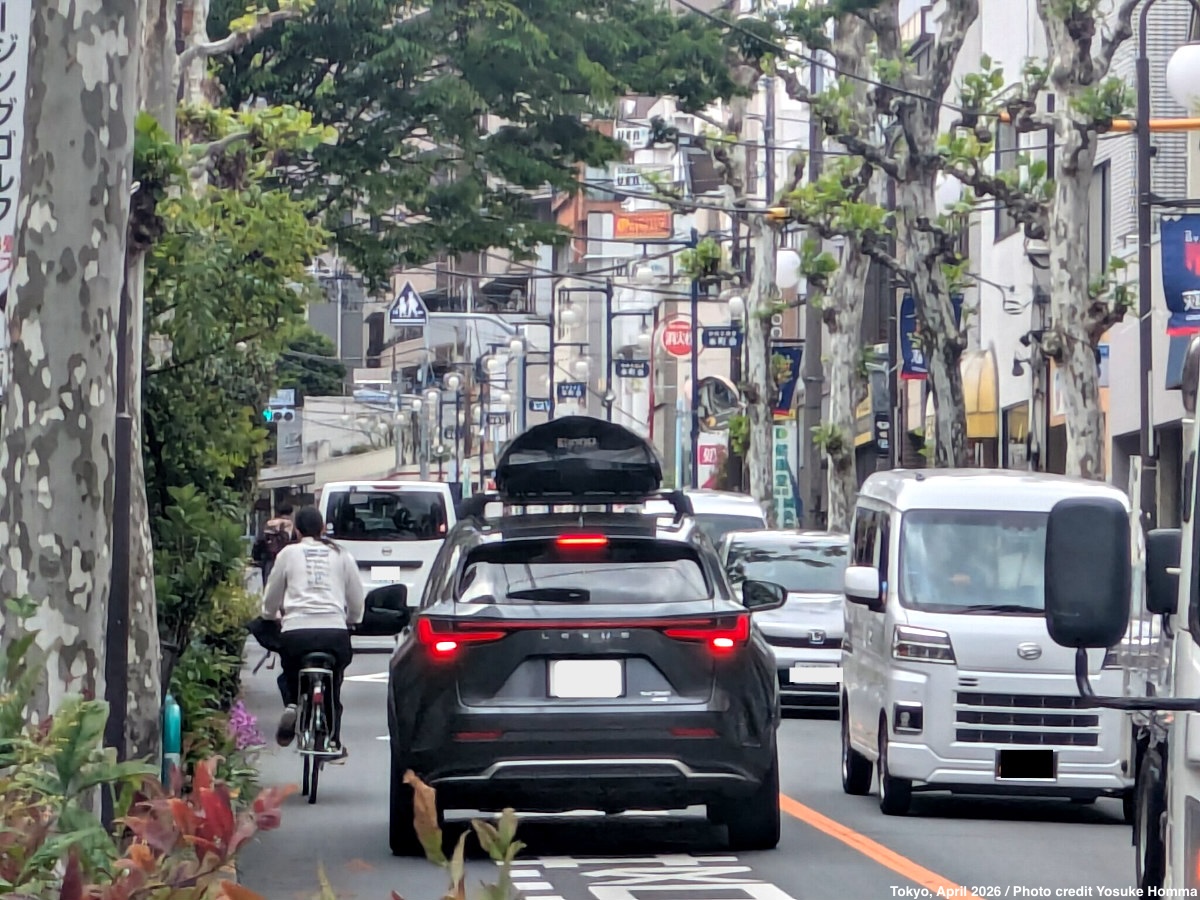
Tokyo is a cycling powerhouse. Despite the lack of the iconic, wide cycling lanes found in Utrecht or Copenhagen, a notably high percentage (14%) of trips in Tokyo are made by bike. Yet, to outsiders, the infrastructure is baffling. We have a few dedicated lanes; instead, we have “blue arrows” painted on the edges of roads to indicate the correct direction for cyclists, or shared sidewalks where pedestrians and cyclists constantly negotiate for space.
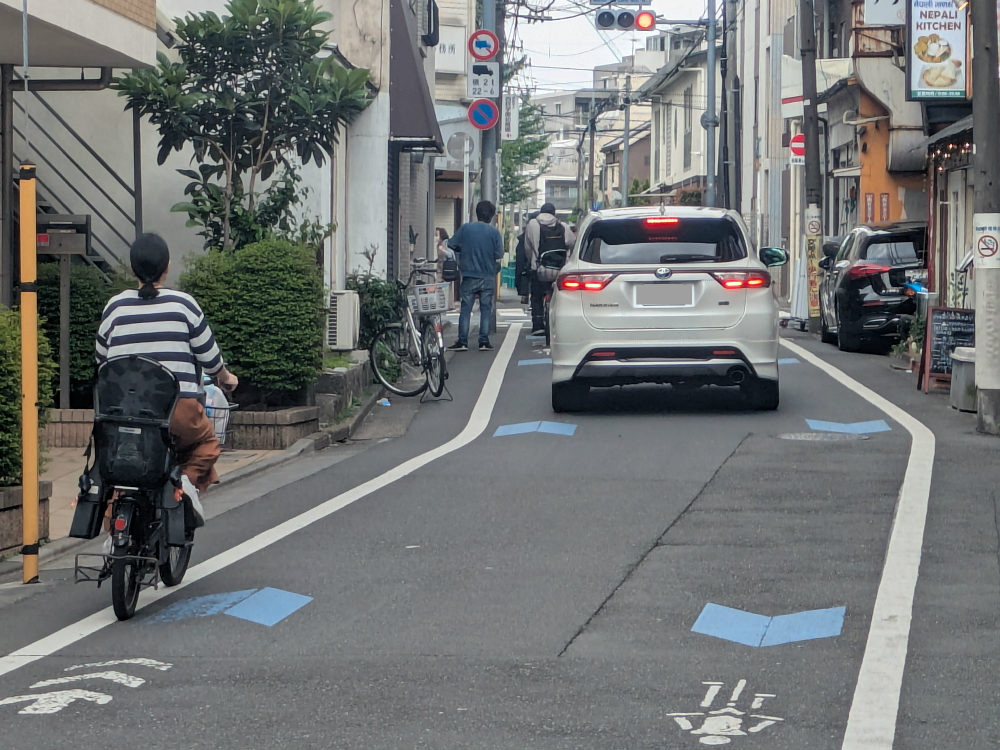
So, why do people still cycle? The answer lies in what I call “Invisible Infrastructure.” First, Tokyo’s dense network of backstreets—narrow, winding, and often one-way—naturally keeps through-traffic out. These residential roads are “slow by design,” allowing residents to cycle without the constant fear of high-speed vehicles. Second, there is a deep-rooted “culture of negotiation.” Since the physical infrastructure is incomplete, cyclists have learned to be fluid—switching between the road and the sidewalk, making eye contact with pedestrians, and finding a chaotic but functional order within the mess. It is a form of tacit knowledge passed down from childhood; children learn not just how to pedal, but how to “read” the street. To a first-time visitor, it looks like total chaos. To a Tokyoite, it is a functional, albeit fragile, harmony.
Unfortunately, this delicate balance is now under threat. In April 2026, the Japanese government introduced a new enforcement system, the “Blue Ticket.” Riding on the wrong side of the road or on the sidewalk (In Japan, people drive and cycle on the left side) can now cost you 6,000 JPY (approx. $40), and holding a smartphone while riding can result in a 12,000 JPY fine.
According to national data, there were approximately 70,000 bicycle-related accidents in Japan in 2024, accounting for 23.5% of all traffic accidents—a figure that has been on a gradual upward trend in recent years. Due to the rising trend of bicycle-related accidents, police have shifted from issuing mere warnings to imposing strict fines for minor infractions that were previously overlooked.
While safety is the priority, the reaction on the ground has been one of anxiety and confusion rather than a sense of improved security.
“I feel uneasy,” a mother in her 40s told me during a recent neighborhood discussion. “The city hasn’t given us proper lanes to ride in, yet now we could be penalized for simply continuing the same daily routines we’ve always relied on to get our kids to preschool. It feels like the burden is entirely on the rider, not the designers of the road.”
An elderly gentleman added, “The rules feel so ambiguous now that I’m afraid of being caught for something I’ve done for years. I’m starting to think it’s better not to ride at all.”
The core of the problem is this: when the state enforces strict rules without providing the right conditions—in this case, cycling infrastructure—personal freedom is the first thing to vanish, in particular for the most vulnerable groups. In urban policy circles in Tokyo, cycling is often treated as a “nuisance,” or a “danger to pedestrians,” rather than being recognized for the invaluable efficiency cyclists demonstrate and the individual resilience they show despite the lack of infrastructure. Now, decision-makers find themselves at a crossroads regarding this “invisible infrastructure,” which they are attempting to regulate out of existence.
This sense of crisis pushed me to take action, starting right here on the streets of my neighborhood, Suginami. I realized that if we waited for a “top-down” miracle from the government, Tokyo’s cycling culture would be choked by regulation long before the first bike lane was ever built.
Recommended Read: Black Women Heroines Put an End to Whiteness of Cycling
Last year, I helped form a local grassroots initiative called the “Nishiogi Bicycle Team” (Nishiogi is the nickname for our neighborhood in Suginami). Our goal is simple yet radical: to defend our right to cycling in Tokyo by proving that residents already know how to make the city better. Our team consists of a diverse mix of generations—from young to long-time residents—who all share a common concern for our local streets.
We started with a “Mental Mapping” workshop. We invited residents to mark up physical maps of our neighborhood with their lived experience. We didn’t find any requests for multi-million-dollar infrastructure projects. Instead, we found a collection of specific, granular, and deeply personal anxieties.
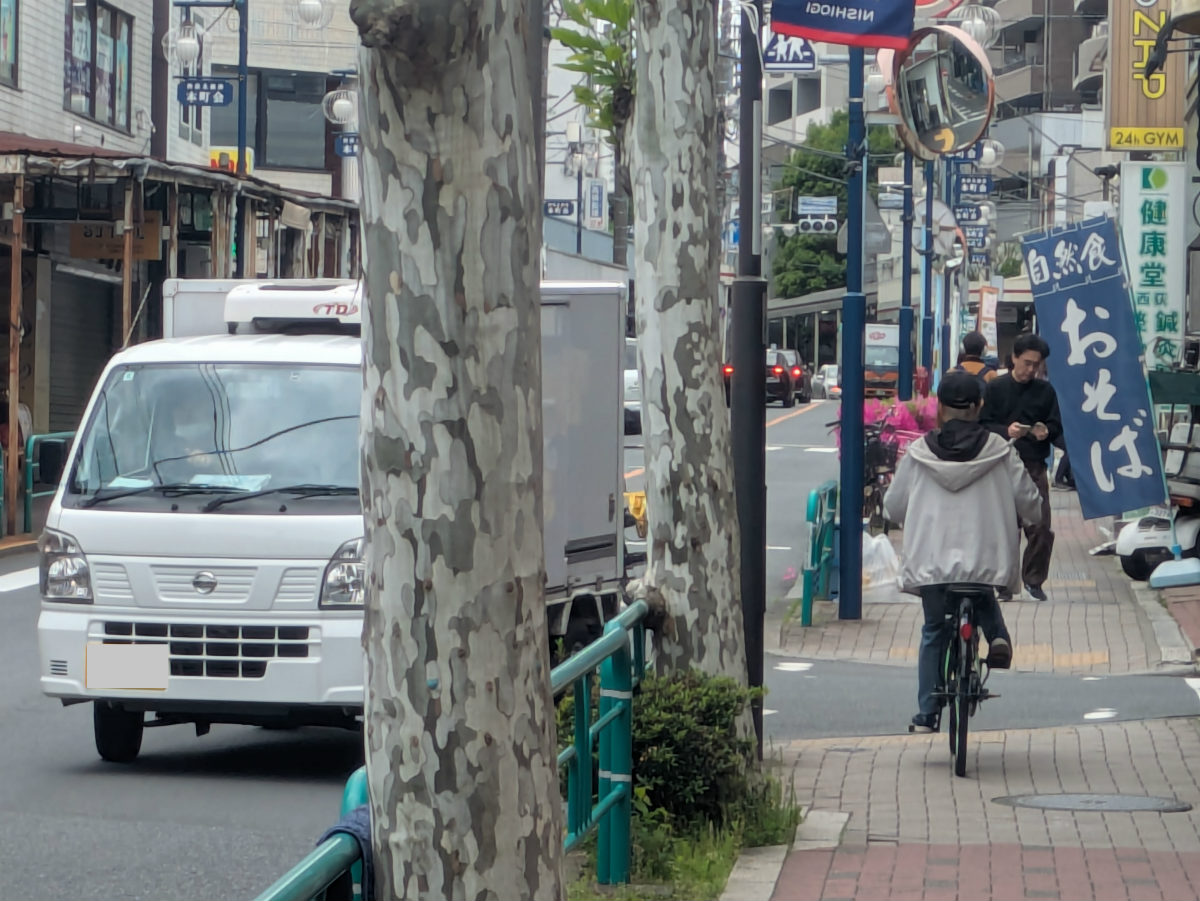
One participant pointed to a specific intersection where a quiet residential street meets a major artery. “Technically, I should stay on the road here,” she said. “But when I merge, the sidewalk is crowded with pedestrians, and car drivers don’t expect a bicycle to emerge. I feel invisible to the traffic.” Another common complaint was the lack of “micro-parking.” In our local shopping districts, there is virtually no space to park a bike for a quick errand. “I want to support my local greengrocer,” a participant explained, “but if I stop for even a minute, I’m blocking the narrow sidewalk or risking a ticket. It’s easier to go to a big supermarket with a parking lot—but that’s not the kind of neighborhood I want to live in.”
What our mapping project revealed is that Tokyo’s bicycle network is currently held together by the mental resilience of its riders. By visualizing these “danger spots” and “missing links,” our team is working to create a new kind of urban strategy—one that doesn’t rely solely on wide bike lanes, but on small-scale, surgical improvements.
We are advocating for “Street Design from the Bottom Up.” This means implementing changes such as widening a specific corner to improve visibility or designating small pockets of underutilized space for short-term bicycle parking near shops. These are low-cost, high-impact changes that prioritize the “human scale” over the “car scale.” By utilizing the “tacit knowledge” of residents, we can invent a Tokyo-specific cycling strategy that respects our unique urban density.
But our work isn’t just about maps; it’s about changing the mindset. “For too long, the bicycle has been viewed by many—both drivers and pedestrians—as a mere nuisance, its social value largely unrecognized. Even cyclists themselves rarely see the value of their own mobility; they often pedal apologetically, squeezed into the narrow gaps between cars and people.” We are planning to organize community dialogues to help all residents—including those who don’t cycle—understand that a bike-friendly street is a people-friendly street.
The “Blue Ticket” system and the threat of fines are a wake-up call for Japan. We can no longer take our unique cycling culture in Tokyo for granted. If we want to preserve the vibrant everyday rhythm of Tokyo’s streets—the businessman racing to the station, the grandfather with his dog, the children discovering their independence—we must recognize that mobility is a social value, not just a technical problem to be managed with fines.
In our neighborhood, we are showing that the solution doesn’t always come from the mayor’s office. It comes from the residents who use the streets every day. By turning our “invisible infrastructure” into a visible priority, we aren’t just saving cycling; we are reclaiming our neighborhood. The future of the sustainable city is already here, pedaling right in front of us. We just need to give it the space to breathe.