Dear Reader,
I apologise! My first letter to you assumed more knowledge than the average person overseas has, and that’s why I’m devoting this second missive to sharing experiential context, so you’re up to speed and ready for all the other letters I’m planning to send to you.
Firstly, we need to define what the West Bank includes, because my first letter left some of you scratching your heads about whether Jerusalem is in the West Bank. According to international law, the ICJ, and the World Court, yes. The 1947 United Nations partition plan was for Jerusalem to be separate from the State of Israel, a kind of ‘Vatican-esque’ city-state under UN administration, along with the Jerusalem suburb known as Bethlehem, which has since been chopped off by the concrete wall.
My first letter to you, from Jerusalem, was indeed a letter from the West Bank.
And now the insights that aren’t googleable, like the fact that I feel electric sparks under my skin whenever I’m in Jenin, from where I’m writing to you today, in the north of the West Bank. There’s an imbalance in my nervous system that I suspect may be from nerve agents that we’ve been exposed to, or from residues of bullets, bombs, and exhaust fumes from warplanes and rockets. Maybe it’s simply being downwind of the bunker busters and white phosphorous dropped on Lebanon, or the coastal breeze gently wafting in the dust and Iron Sting residues from Gaza. Maybe a cocktail of it all, with added asbestos, pollen, and mold spores.
I never saw insects in Jenin Camp, despite Jenin enjoying a Mediterranean subtropical microclimate that’s full of insect life outside the camp’s gates. Even with one step outside, there are the bugs you expect in a hot, humid place. Inside Jenin Camp, nothing. Maybe I’m wrong, maybe I’m not, but I’m correlating the lack of bugs with the use of toxins and weird feelings inside my nervous system. We’ll never know, as the camp is emptied now and re-occupied by soldiers, so the opportunity to test the air, water, and soil has passed. Whatever I was exposed to inside the fence is a problem for the conscripts now. Also it’s olive pollen season, meaning nasal dryness and sinus issues on top of that, but on the upside, that means olives in autumn.
Draped and hidden under cheap synthetic fabrics, my body is often too hot, in long sleeves, whatever the weather, layering any physical signs that might offend a conservative community. Yet I was cold over the winter. There’s not enough electricity or gas, with the instability in supplies buffered by the West Bank to bolster the availability across the wall. Our houses are often damp and moldy, meanwhile, 10 new settlements are being built close to Jenin City to house Israelis in new, clean, illegal homes. There’s also luxury housing here for the municipality’s Palestinian leaders, brash totems of corruption. All of this elicits emotions.
In addition, I have similar emotional burdens as anyone else. Your marriage issues/lack of partner/kids playing up, etc., are equally here, which is easy to forget for folks overseas. We have busy lives and complicated relationships, too. I ran into my ex on the street, with all the mixed feelings that you’d have running into yours, but additionally in sweaty nylon on a hot day, and needing to pretend everything is normal, because we don’t express private things in public spaces. We faked mild familiarity and a relaxed demeanor, not to expose our intimacy.
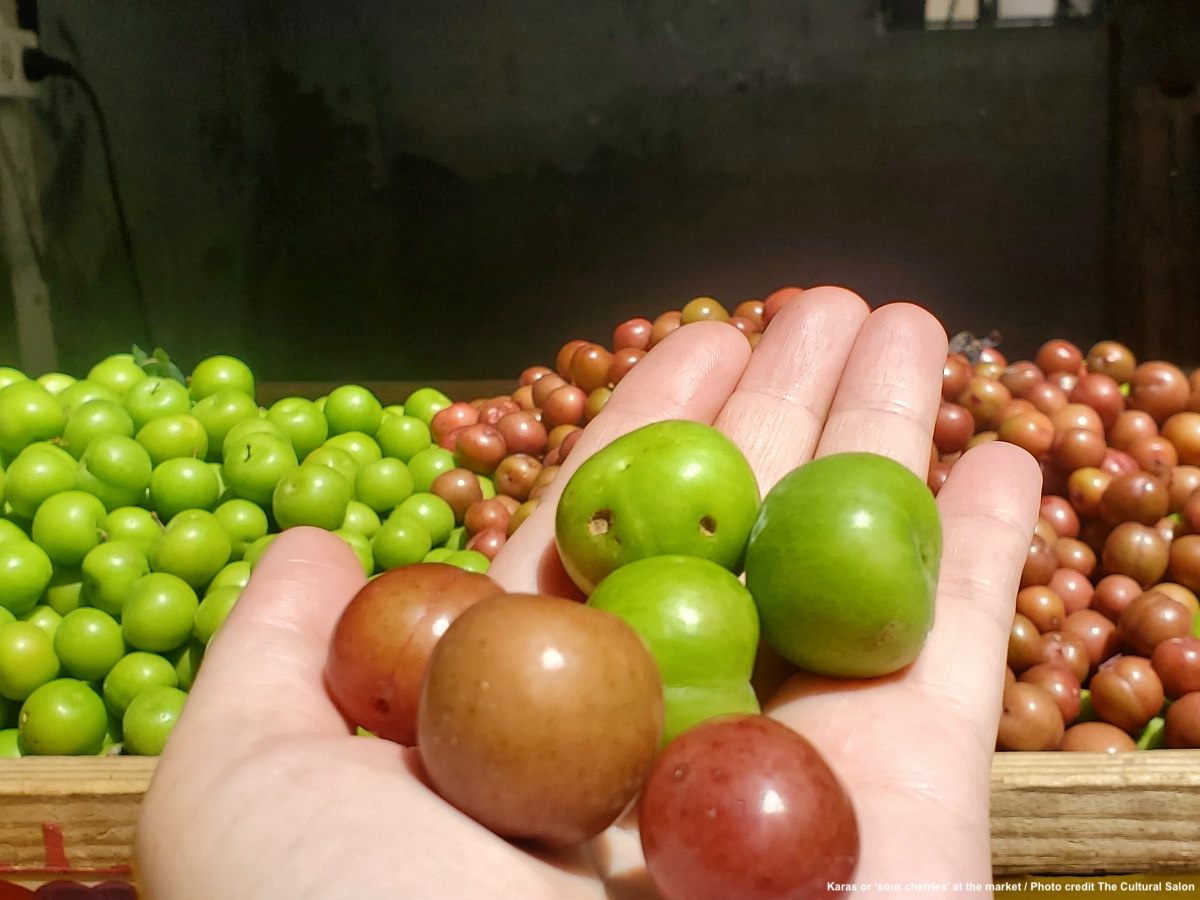
On the bright side, stone fruit is starting to appear! We have short seasonal windows when fruits are ready, and then are replaced by the next. My peaches were tart today; the first week is always a little underripe. Also, a tiny plum known as ‘sour cherries,’ we eat dipped in salt. My tongue curled under the acidity in a pleasing reflex while sharing them with a friend who hasn’t worked in four years; his family eats from philanthropy and NGOs.
Eating these balls of sourness, I learned that he’d stopped climbing the wall into Israel in an attempt to find work because there’s a new fine of 5,000 shekels (roughly 1,500 Euros) plus 3 months in jail for anyone caught. And basically, everyone’s caught, as the border guards work overtime, and Israeli police regularly check IDs. The death penalty for incarcerated Palestinians makes risking jail insane, even if there’s no food and no way to earn cash in the West Bank. My friend is a fully-qualified doctor, so he’s hoping to go somewhere else and seek asylum. Before the new fines were imposed, he used to find work painting houses in Israel, but now they’ve imported low-wage labour from India so it’s pointless taking the risk, and potentially losing his life, when the work is already been done by a replacement workforce.
As I write this letter, my body feels heavy. A man was shot dead in Nablus, in broad daylight. Nayef Sammaro had been with his wife in the hospital, as she was in labor with their first baby. He’d popped out to get baby clothes, but soldiers shot him in the head, and his blood is now smeared on the pavement outside the hospital while his wife is giving birth. It’s 3 May 2026, and you can see his corpse on social media. Nayef’s life was erased at the age of 26, as a brutal response to the actions of the few being paid for with the blood of an innocent bystander, to deter militants. Nayef was a totally innocent guy, as described in the newspapers, from Haaretz to The National. His crime was his residence in a city where people take up arms. A victim of collective punishment, as were 25 Palestinian men in the West Bank whose lives have ended under similar circumstances since the start of 2026.
I send this letter to share a fraction of the physical experience of our daily lives. A body with a nervous system, and a head and a heart just like yours. But under pressure, and as a result, either more reactive or slower to respond. I am more risk-averse than you at times, and sometimes quite the opposite, as my sense of what’s risky and what’s not is out of whack. I run anxious one moment, and bold the next, as we all do here in this cauldron.
The gentle breeze lifts with the scent of orange blossoms and maqlouba. Our hearts are full of human connection, as daily life passes with open doors and authentic greetings, with hands held, and glasses of sage tea or Arabic coffee laced with cardamom, and barazek cookies encrusted with sesame seeds, rose petals, and pistachios. The deliciousness of the culture compensates for the blows and burns, an immersion of rich experiences that are more intense than where you’re sitting, dear reader, both good and bad. It’s all of the above, and more.
Please be primed to read my column with this in mind, and understand that my perspective is infused with warmth, sunshine, smells, sweets, and sounds that are distinct, specific, and visceral. Hard blows and sweet caresses all wrapped up in one incredibly ancient place.
From Jenin with Love,
Afaf