
Listen to the audio version of this article (generated by AI).
In Tehran, public concerts are fierce. A thirty-eight-year-old woman named Yas owns a café in central Tehran, where she occasionally hosts music concerts. “Invitations are word-of-mouth, only trusted people invite trusted people,” Yas explains to The Urban Activist. “Everyone knows what happens if word gets out.”
Yas’s music sanctuary is tucked away inside a sprawling 80-year-old mansion, its high ceilings and brick arches whispering stories of a bygone era. In Tehran, many old mansions with vast interior spaces have been converted into cafés and offer plenty of space for less visible gatherings, insulated from the outside.
While a musician strumming a guitar in the corner has become a tolerated routine in Tehran’s café culture, transforming the space into a venue for a full-blown underground gig is a different beast entirely. Once the music gigs kick off, Yas says, it’s transcendent. “Seeing people in stunning evening wear, dancing, crying, lost in the music… It’s pure joy. These nights don’t make much money for cafés because of the small, vetted crowds. What gets us through the risk is love for music and love for freedom.”
“We close the heavy wooden doors and calibrate the sound system with surgical precision,” Yas continues explaining. “It has to be crystal clear for the audience but practically a whisper to the outside world.” There are no posters, no Instagram stories, no digital footprints, nothing that could alert the authorities.
The paranoia is justified.
Just last November, police forces raided a private party attended by prominent Iranian actors, where music and alcohol were flowing. The arrests sent shockwaves through the capital, delivering a chilling message: not even fame offers immunity from the state’s rigid moral codes.
For Yas, the calculus of risk is terrifyingly simple. “If we slip up,” she says, her voice lowering, “it’s not just a fine. They could seal the café indefinitely, dragging me into interrogation rooms, courts, or even prison.”
Then there are those who operate even deeper in the shadows.
Amir, a 29-year-old civil engineer, leads a double life. By day, he navigates the concrete realities of Tehran’s construction sites; by night, he navigates a different kind of structure, one built of beats and frequencies.
As an underground DJ, he is frequently sought out to perform at secluded villas on the city’s outskirts or inside soundproofed wedding halls during off-hours, zones of temporary autonomy where the lack of police patrols offers a fragile sense of security.
“The reality is, nowhere is completely secure,” Amir points out to The Urban Activist, pausing to light a cigarette. “Four years ago, one of our locations was compromised. They raided the place and rounded us all up. I was incredibly lucky in the chaos; they mistook me for a regular guest. If they had realized I was the DJ, the one controlling the crowd, it would have been a different story.”
While Amir escaped with detention and a fine, his turntable and mixers were confiscated and never returned. The host of the party, however, bore the brunt of the law: he was sentenced to lashes.
Despite the danger, Amir returns to the decks time and again, driven by his obsession with Melodic Techno. It is a genre that mirrors the mood of his generation perfectly, driving, industrial basslines that reflect the city’s grit, overlaid with haunting, ethereal synthesizer melodies that speak to a collective yearning. “It’s a hypnotic loop,” he describes. “When the drop hits, you see people close their eyes and transcend. For those few hours, the inflation, the politics, the fear. It all dissolves into the rhythm.”
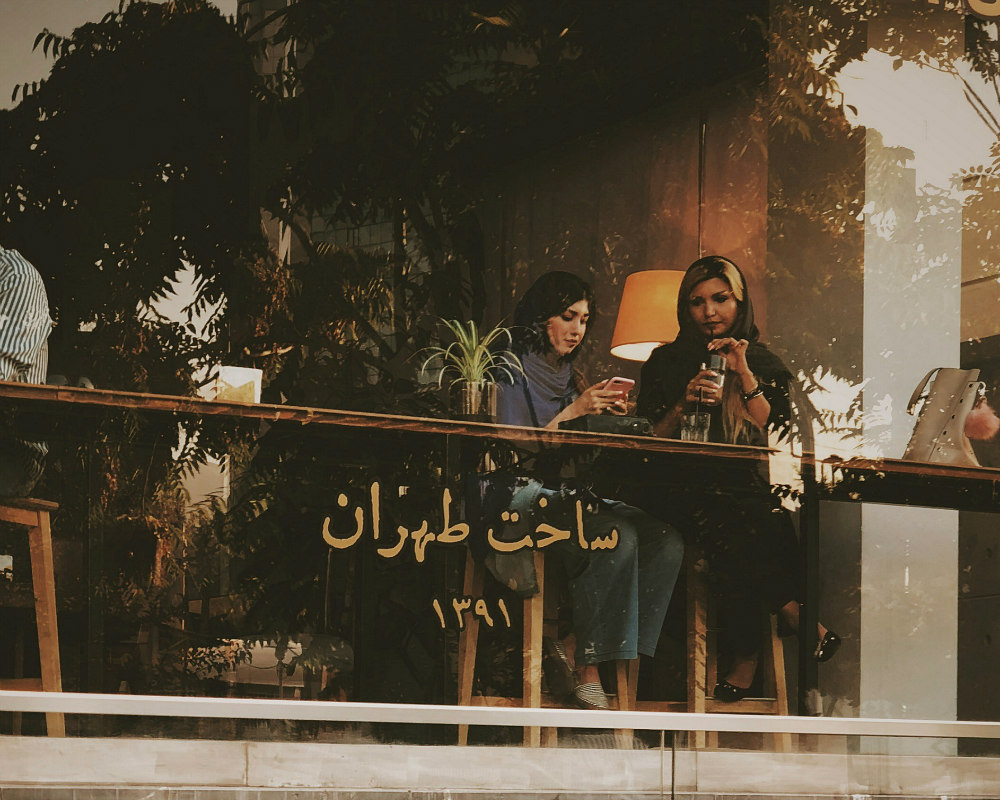
In the past three years, since the beginning of the Women, Life, Freedom movement, the government has attempted to prevent women without hijab from entering cafés, shutting down any establishment on the pretext of “hosting unveiled women”. Yet neither the cafés nor the women surrendered. They persisted in their presence. The same is true for music. Inevitably, many artists in Tehran have been forced underground, as obtaining permits for public music concerts is a significant struggle.
In 2025, Iran’s Ministry of Culture and Islamic Guidance, then led by deputy minister Nadereh Rezaei, began issuing permits for several open-air concerts in public spaces in Tehran and across Iran. Among these public concerts was Sirvan Khosravi’s at Niavaran Palace in northern Tehran, displaying his signature blend of pop, rock, and electronic music, which took center stage. The dancing and exuberance of the crowds, especially from women, evoked the spirit of the third anniversary of the Woman, Life, Freedom uprising. Another standout permit went to Western-style band Bomrani, which performed a series of open-air gigs in Tehran in September and was planning a tour across other provinces in Iran.
Twenty-seven-year-old Sahar (not her real name) attended Sirvan Khosravi’s concert. To brave the freezing temperatures, she explains with a smile that she mastered the art of avant-garde layering. She wore a deconstructed, oversized coat draped over textured knits, anchored by a pair of heavy chunky boots. She painted her face with bold, heavy makeup, framed by long, intricate African braids that cascaded down her shoulders.
“Anyone who’s been to a lot of concerts knows how it used to be,” she says. “In closed halls, there were always these overseers hovering, telling women not to dance or to cover their hair. They’d point lasers at you in the dark and even kick you out if you ignored them.”
Recommended Read: Saudi DJ Baloo in Riyadh: “We Still Think It’s Our Woodstock”
State-sanctioned concerts typically have checkpoints at the venue entrances where, in addition to checking concert tickets, the attendees’ hijab was strictly inspected. In some cases, bags and backpacks are searched, and water bottles are opened to ensure they don’t contain alcohol. “If you were not wearing a hijab, you were denied entry to the hall,” says Sahar.
I also met Mahmoud, a veteran concert organizer who preferred not to use his real name. In his mid-50s, Mahmoud has salt-and-pepper hair loosely tucked under a grey cap. The son of a well-known figure in concert circles, Mahmoud has been part of Iran’s music scene for decades, and his eyes still spark with energy when he talks about music.
“Things have opened up a bit in the last three years, but the road to true freedom is so long that we can’t even imagine a free future in the short or medium term,” he says. “The barriers are huge for musicians and organizers,” he says, despite contending that the worst era is behind him.
Between 2022 and 2024, Ebrahim Raisi’s administration led a religious conservative government that presided over an atmosphere of repression that stifled all cultural spheres, including music and art. But Iran’s current President, Masoud Pezeshkian, described as a reformist, had raised hopes of a thaw in Iran’s relations with the West — although all seems to have been dashed by Israel and the US’s military attacks and Iran’s vocal support for Palestinian independence. Outside foreign relations, Pezeshkian’s administration has taken a more lenient approach to cultural issues, offering greater cooperation with artists in Tehran to issue concert permits for public spaces.
However, non-governmental actors, religious leaders such as the Friday Prayer Imams, and hardline parties and factions, such as the Paydari Front (Front of Islamic Revolution Stability), wield significant influence and control within certain non-governmental sovereign institutions. These groups are culturally conservative and advocate for a restricted atmosphere.
After brief runs by musicians Sirvan Khosrav and Bomranii, their tours were curtailed on the grounds of “local complaints about noise” and “norm-breaking” behavior, as cited by city officials.
Also, Homayoun Shajarian, one of Iran’s most celebrated singers and the son of the legendary Mohammad Reza Shajarian, announced on September 1, 2025, that he had secured a concert permit. After eight years of pursuit, he could finally hold a music concert in Azadi Square in Tehran, and for free. The news ignited a firestorm of reactions. Some hailed the decision as signaling an opening up of political and social spaces, while others dismissed it as a cynical ploy by Iran’s ruling regime to stem rising discontent, especially in the wake of the June 2025 Twelve-Day War with Israel.
But just as the debate was starting to heat up, the concert was canceled 48 hours after the announcement. Within a few weeks, Naderah Rezaei, the deputy minister of Iran’s Ministry of Culture and Islamic Guidance who had approved all these permits, was fired.
Ali B., a service worker whose monthly earnings are roughly 260 million rials ($186), was looking forward to Homayoun Shajarian’s concert. “I’ve been listening to Homayoun’s father since I was a kid,” he says. “When Homayoun started singing, I became a big fan, but I was never able to afford a concert ticket. I was hoping this time I could finally go.” Tickets for state-sanctioned concerts in Iran typically range from 5 million to 20 million rials (approximately $120-450), excluding lower-income audiences in a country where the minimum wage hovers around 103 million rials (about $72).
Concert organizer Mahmoud points out that Homayoun Shajarian’s public concert could have drawn tens of thousands, maybe hundreds of thousands, into Azadi Square, one of Tehran’s iconic urban symbols. “It would have been a historic event. But radical factions outside the administration wield a lot of influence.”
The backlash on public concerts, compounded by the economic pressure on the government in Tehran since September, when the United Nations reimposed sanctions on the country over its atomic program, may have backfired. In the last weeks, people have gone out to the streets of Tehran and across 26 of Iran’s 31 provinces to face a brutal response by authorities, with the death toll of protesters rising and more than 990 arrests.
For me, having lived through decades in Tehran, the surge in music in public space, the underground concerts, all of it, embodies the people’s civil struggle for freedom.
It’s a fight in which the warriors may not advance at breakneck speed toward their goals, but they’ve moved steadily, inch by inch, ensuring today’s urban Iran bears little resemblance to the decades before. The struggle for change is tough, but let’s see how the music plays out.
This article is published in collaboration with Egab.