
Listen to the audio version of this article (generated by AI).
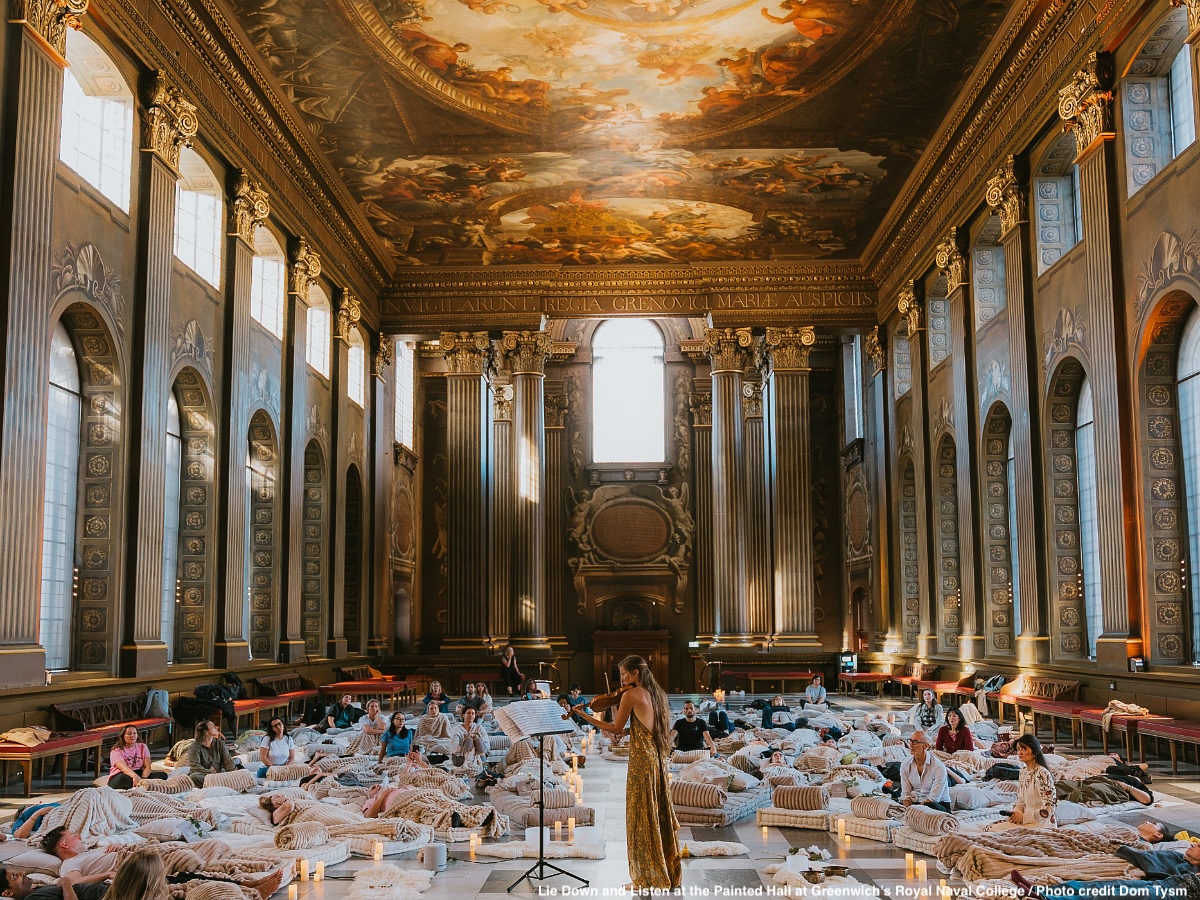
In London, the Painted Hall at Greenwich’s Royal Naval College is a mesmerising space, often nicknamed “Britain’s Sistine Chapel.” Sir James Thornhill completed the Painted Hall in 1726 after 19 years of work, and since then, it has welcomed countless visitors. Originally designed as a dining hall for retired Navy members, it later served as the setting for the lying-in-state of Lord Nelson in 1806 following his death at Trafalgar. However, tonight, it is the container for a totally different experience: sound healing in the heart of London.
Across its immense walls and painted ceilings, celestial beings share space with symbols of British maritime power. Ships strewn with the Union Jack float above heaving bodies of angels, clusters of cherubs peep from behind vast painted columns, and British monarchs stand alongside allegorical figures of Liberty, Victory, Peace, and Justice.
As I arrive in the hall, cushions and light mattresses are lined up in rows on the hall’s chequered floors, interspersed with gently flickering candles. People of all ages drift into the space, gradually reclining under the blankets. Once the crowd settles, a lady in a long flowing dress walks up to a stand in the centre of the room and plays a heavenly rendition of Heinrich Biber’s Guardian Angel on violin. As she plays, the crowd lies silently — some with their eyes closed, others calmly contemplating the Baroque interiors around them.
This is Lie Down and Listen, a classical music concert experience founded by pianist and composer Christina McMaster that uses sound healing, particularly in prominent spaces, to reduce stress in bustling cities like London. For 90 minutes, visitors are bathed in a blissful soundscape of hypnotic Tibetan sound bowls and uplifting classical instruments. As Christina McMaster describes it, “It’s an invitation to lie down and feel the awareness of music and sound within your entire being.”
Sound healing is an ancient therapeutic practice that employs specific tones, frequencies, and vibrations to balance and restore the mind, body, and spirit. It is based on the principle that all matter vibrates at specific frequencies, and sound waves can positively influence brainwaves, promoting deep relaxation.
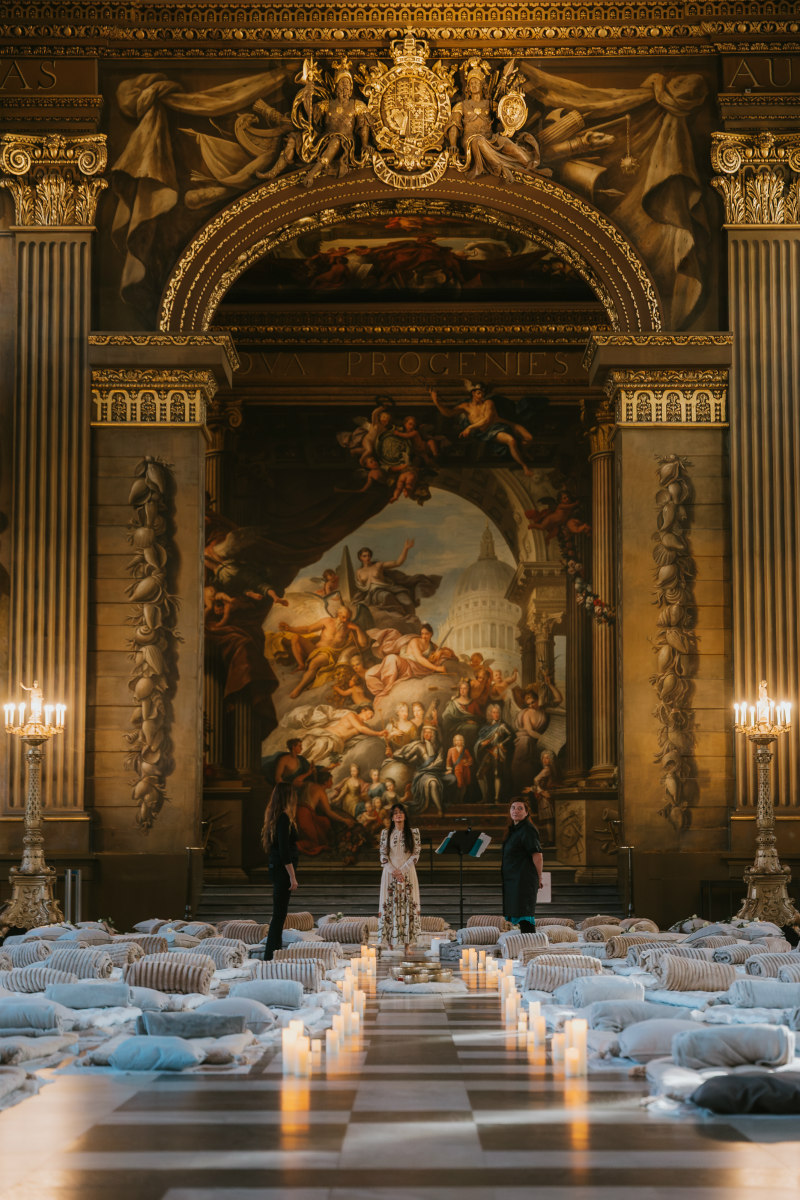
McMaster has long believed that the simple act of listening can have profound healing qualities. “My grandmother used to tell me the story of how her grandfather, when he was feeling down or unwell, would go to the opera to feel healed and uplifted,” she explains. As McMaster developed her career as a pianist and composer, she noticed an absence of connection in how classical music is typically experienced live. By combining training in sound healing with her musical background, McMaster decided to fuse elements of wellness with classical music to create Lie Down and Listen in London. The spaces are meticulously selected. “We’ve worked in a great variety of spaces, but we tend to choose heritage destinations because they command a sense of reverence,” she says.
The first location she chose in London was Fitzrovia Chapel, which is surrounded by the Middlesex Hospital. It’s a chapel long used by doctors, nurses, and patients, with stained-glass windows that pay tribute to medical figures. From there, Lie Down and Listen has expanded to many different spaces in London and across the UK and beyond, including Oxford’s Bodleian Library, Trinity Hall Dublin, and The Gibbes Museum in Charleston, South Carolina, to name a few.
Throughout the evening, led by violinist Phillipa Mo, the audience is treated to a programme that spans from the 17th century to the present day. Beginning with Johann Bach’s Suite no.6, the performance moves through Astor Piazzolla’s Tango Études before arriving at The Wounded Angel, Marcus Paus’s three-movement contemporary composition. McMaster introduces each piece, guiding listeners through the stories and emotions behind the music.
The act of lying down and listening sounds simple, yet in a city like London, it feels almost radical. Here, the urban soundscape is often experienced as something to be endured rather than noticed: revving engines, wailing sirens, the rattle of buses, and the clatter of Tube carriages. In some parts of London, noise levels regularly exceed 86 decibels — well above the World Health Organization’s recommended threshold of 53 dB. Over time, many Londoners learn to tune it out altogether. “I’ve lived in London so long that I genuinely no longer notice it,” a friend remarked to me recently.
At Lie Down and Listen, McMaster invites Londoners to overcome this desensitisation through the practice of deep, attentive listening. She is inspired by American composer Pauline Oliveros, whose theory of Deep Listening distinguishes between hearing as an involuntary act and listening as a conscious act. She argues that by listening deeply to our environment, not only to music or the sounds of life around us, but also to our internal worlds, we can achieve a heightened sense of consciousness.
Recommended Read: Urban Shamanism, Ancestral Wisdom for Dwellers of Everyday Life
This doesn’t mean tuning into only what sounds beautiful, but also observing the elements that might feel like an intrusion on the listening environment: “In the Painted Hall, if someone sneezes, the sound can carry. Other times, someone might get distracted and go on their phone. “Personally, I like to listen to those different elements, and allow them the space to breathe,” says McMaster. “Rather than viewing these moments as a background noise or annoyance, it becomes part of the tapestry of the experience.”
At its core, the practice of deep listening through sound healing is about observing whatever arises — be it the sound of someone coughing or an intrusive thought — without judgment or attachment. When you listen in this way, argues McMaster, your awareness extends beyond just what is physically audible, and you become conscious of sound throughout your entire being. This enables a sense of presence, enabling the brain to reach a deeply restorative state that reduces stress.
As she gently moves throughout the Painted Hall playing a Tibetan bowl, I can see what she means. The looping, hypnotic vibrations of these metal bowls are experienced less as a sound and more as a physical sensation: a slackening of the jaw, a tingling at the base of my neck. The sound of gentle snoring from somewhere nearby confirms I’m not the only one experiencing deep relaxation.
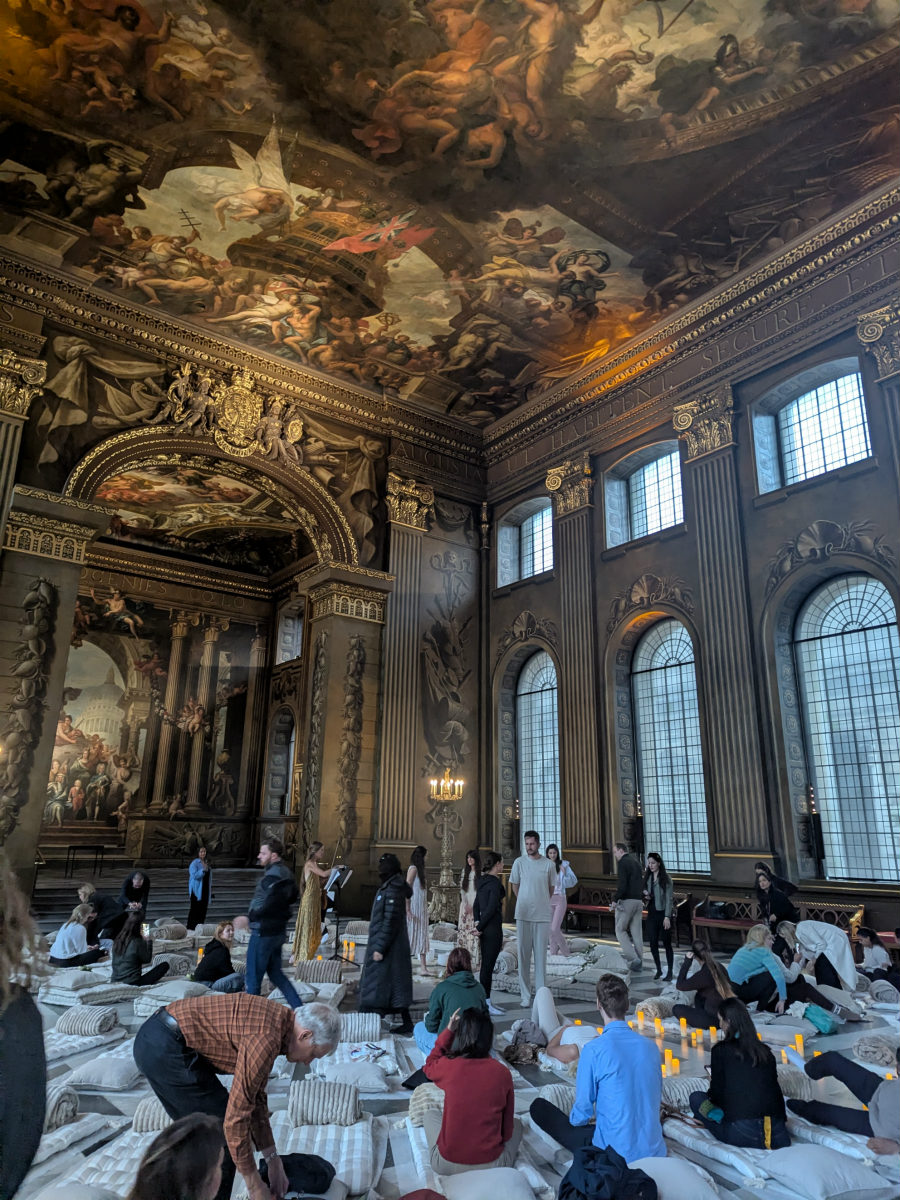
People come to McMaster’s sound healing sessions in London for all sorts of reasons. One woman I met on the way in is a history of art graduate, eager to use the session to get lost in Thornhill’s masterpiece. A couple I speak to are hoping for a relaxing experience at the end of a busy week; meanwhile, one woman came for a restorative evening as she undergoes cancer treatment. “Everyone carries something different into the room,” says McMaster. “And everyone takes something quite different from the experience, too. Some leave feeling relaxed, while others might have a more profound experience.”
McMaster describes how people who have attended her sessions over the years have reported experiencing something quite difficult to define. In this state of deep listening, she says, awareness can sometimes expand beyond the immediate room, leaving people aware of a presence that some describe as spiritual, whether that is interpreted as God, memory, or loved ones who have passed.
Even for those who don’t experience anything quite as profound, dedicating time to deep listening feels like a worthy exercise in a world that constantly overstimulates and clamours for our attention. “Listening, at its core, is about where you put your focus, and where you put your attention,” says McMaster. “I think that if we were all able to listen a little deeper — to ourselves, to people around us, to our environment — we might experience fewer of the challenges we have today.”
After 90 minutes, the session draws to a close, and McMaster invites the room to sit up. Gradually, the audience returns to the room, as though surfacing from somewhere deeper. Normal life resumes: Groups of friends quietly chat about the experience, phone screens turn back on, and people capture photos of themselves and the Painted Hall. As I step outside onto the wide gravel pathways of the Old Royal Naval College, I’m struck by an unexpected wall of emotion: suddenly moved by the beauty of the experience, and a new perception of the beauty of my surroundings.