
The Aylesham development case:
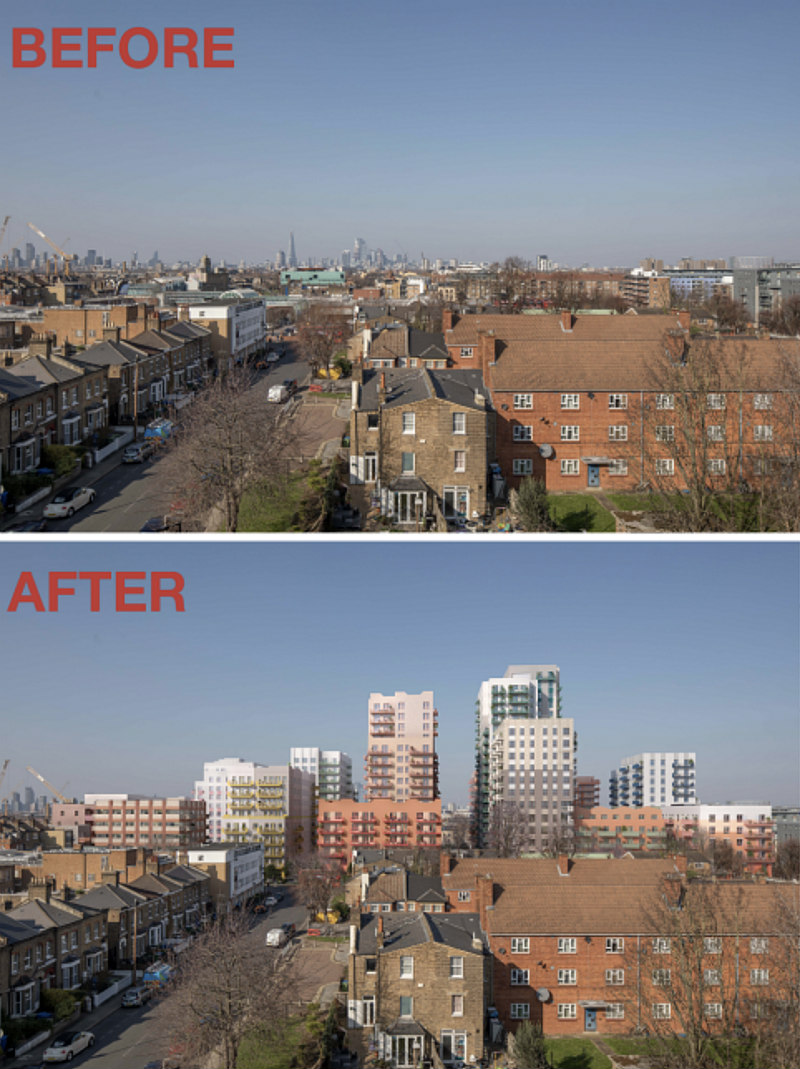
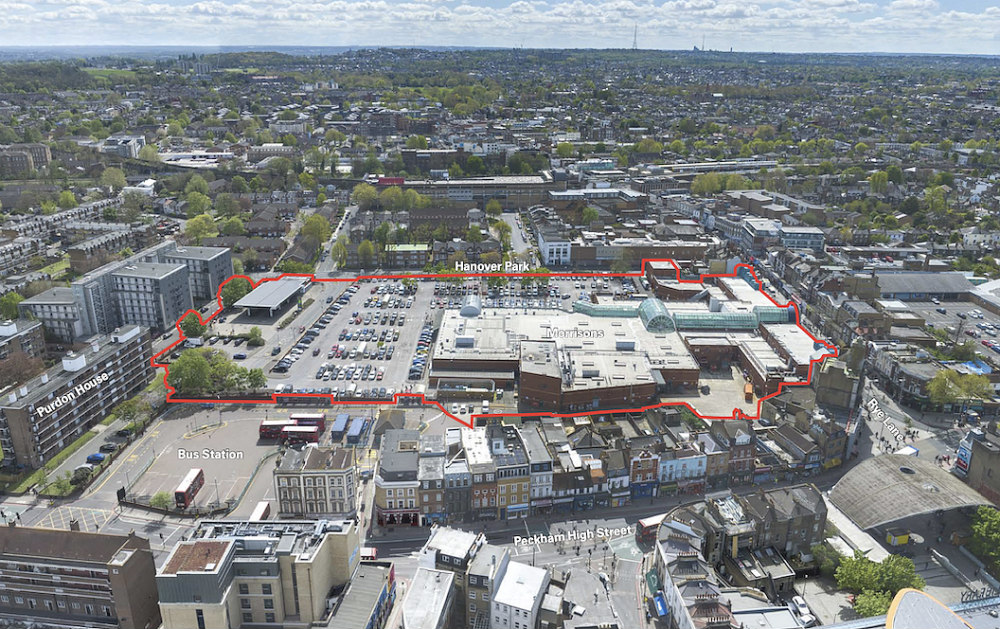
Peckham needs housing. The Aylesham development in Southeast London, a working-class neighborhood, would have seen the old 1980s shopping center demolished to make way for 867 new homes spread across 13 tower blocks up to 20 stories high — originally providing 35% affordable homes. It is considered a prime location for its proximity to the city center. After several planning applications, the latest developer of the Aylesham, Berkeley Homes, reduced the minimum affordable housing provision from 35% to 12%, leading to the planning application being refused by Southwark Council. Due to non-determination, the developer had already decided to take the matter to the national Planning Inspectorate — an arm’s-length body of the UK government, sponsored by the UK Ministry of Housing.
Last year, at the Greater London Authority level, Sadiq Khan agreed with the housing minister, Steve Reed, to drop the affordable housing provision from 35% to 20%. This was already a big blow to housing campaigners. Furthermore, developments across London, such as Canada Water, were allowed to drop the provision to 9%. Given all these political decisions on housing, in addition to the mantra of “build baby build,” local campaigners in Peckham weren’t expecting a win. But, after two years, they did. On Tuesday this week, the national Planning Inspectorate has rejected developer Berkeley Homes’ controversial plans to redevelop the Aylesham Center in Peckham — “an enormous wall of development, thus resulting in harm”. It would have changed Peckham’s community and London’s skyline forever in exchange for 12% affordable housing. The Aylesham case does set a precedent for developers and policy makers under pressure to deliver housing in London: “You can’t build Peckham without Peckham.”
Six Questions to local campaigner Andreea:
What was the determining factor to win the Aylesham development case?
I believe it was significant that more than 2,400 people recorded their views on the Southwark Planning Portal. These were individuals who took the time to log into the council’s platform and articulate their well-reasoned objections. This clearly demonstrated that the development proposal was not suited to Peckham and was overly generic—it could have been situated in any part of London or even in other European cities. We are not against development or density. We want to see this site developed in a way that works for Peckham and its diverse communities.
How do you manage to mobilize over 2,400 people to participate?
We advocated for the integration of two campaign streams—housing and planning—to significantly increase our impact in Southwark. Beyond our Aylesham Community Action group, we helped establish SHAPE (Southwark Housing And Planning Emergency), a broad coalition of campaign and community groups across Southwark (not just Peckham). We regularly took to the streets to inform people about the Aylesham planning application, distributing leaflets and flyers. It was a true solidarity campaign, as we supported and were supported by various other campaigns in Southwark.
Recommended Read: London’s Housing Voices Offer Solutions for Whitehall
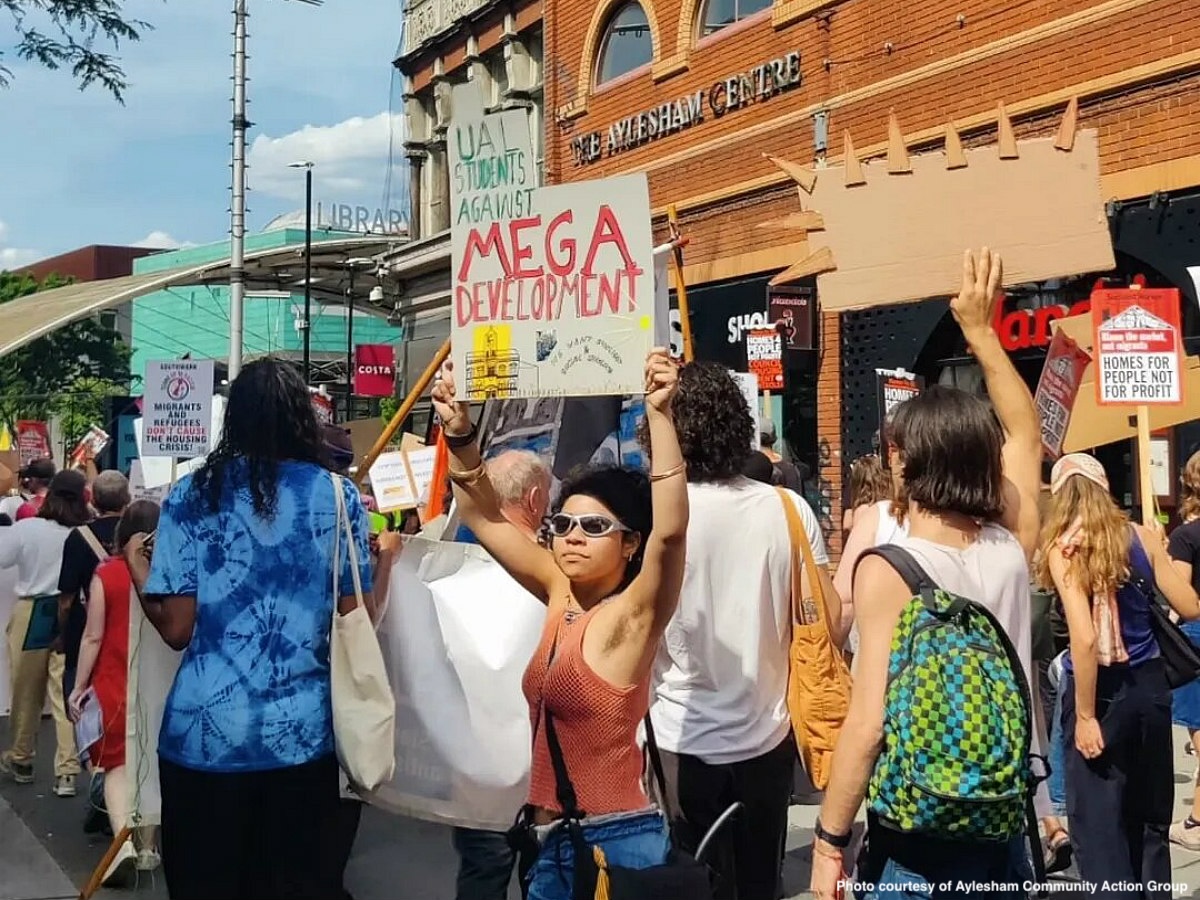
Each month, Aylesham Community Action group held meetings at Peckham Levels, an accessible venue open to everyone. We also organized Zoom meetings. Additionally, together with SHAPE, we organized several protests, gathering over 600 people in Peckham Square in March 2025. We marched all the way to Borough Triangle, passing by Elephant and Castle (a development that has gentrified the community), shouting, “Homes for people, not for profit,” to say, in essence, “We know what happened in Elephant and Castle, to the Shopping Centre and the Heygate Estate; we don’t want that to happen again to us.”
How important is it to engage a lawyer?
From the beginning, we have had the support of a local lawyer, Jed Holloway, from the Southwark Law Center, which is part of a network of law centers across the UK providing legal assistance to individuals and groups who may otherwise be unable to afford legal help. Jed has been instrumental in guiding us through the entire legal process.
When Berkeley Holmes appealed on the grounds of non-determination, we collectively decided to register as a Rule 6 party. This designation allows a community group to participate formally in the legal proceedings. To do this, we had to hire a barrister. Alongside our local lawyer, we shortlisted Hashi Mohamed from Landmark Chambers. He was an excellent choice, as he understands the intricacies of ethnically diverse communities and housing.
How have you been able to afford a lawyer, presumably against the developer’s expectation?
One of our lessons learned is that people really come together in unexpected ways. We managed to raise over £50,000 to pay for the legal team. That’s a lot of money for a community group, and it only happened thanks to an amazing fundraising team, local businesses, local artists, comedians, raffles, and events we have organized, like the Open House events in September. We were really ingrained in the neighborhood on different levels and had many allies. Different people contributed whatever they could to help us pay for this barrister, even though not many people gave us a chance to fight against one of the biggest developers in the country and actually win.
This has proved that, even if national politics is pushing a generic 1.5 million homes, with the drop in affordable housing at the London scale from 35% to 20%, a strong local community can have a say. It really shows that people have power — and this case shows that, objectively, this wasn’t the right development for Peckham.
Why didn’t the council provide financial support for the legal process after the developer’s appeal?
Initially, the council refused the planning application on a single heritage ground. However, by the end of the planning committee, with the help of our community group, Aylesham Community Action, and a few other allies, we managed to convince the planning committee to add two other reasons for refusal: affordable housing and retail space. But our Aylesham Community Action group had several other reasons for objections. By constituting ourselves as a Rule 6 party independently, we could add nuance to the 3 reasons for the council’s refusal and also push some of the Aylesham Community Action group’s objections. We ended up working closely with the council’s barrister to support each other on those 3 reasons. Yet, we had our own expert witnesses and our own legal team, which was strongly pushing the arguments the community actually wanted.
Do you think the heritage argument carried a lot of weight for the Planning Inspectorate’s decision?
According to the documents from the Planning Inspectorate, even if the minimum affordable housing quota had been respected at 35%, the proposal would still have been refused on heritage grounds because it would have altered London’s landscape.
Through this process, as a Rule 6 party, we had our own expert witnesses, specifically our heritage expert, Claire Hegarty. She was fundamental in adding more flesh to the argument of tangible and intangible heritage. She was really saying that heritage is not just the physical part; it’s the lived-in experience, the intangible part, the socioeconomic factors, the rich, diverse mosaic of traders and shops of different ethnicities serving different ethnic groups and communities living together. She argued that Peckham’s diversity should be taken into consideration when planning a development of this scale, rather than something generic that could be in any city.