Listen to the audio version of this article (generated by AI).
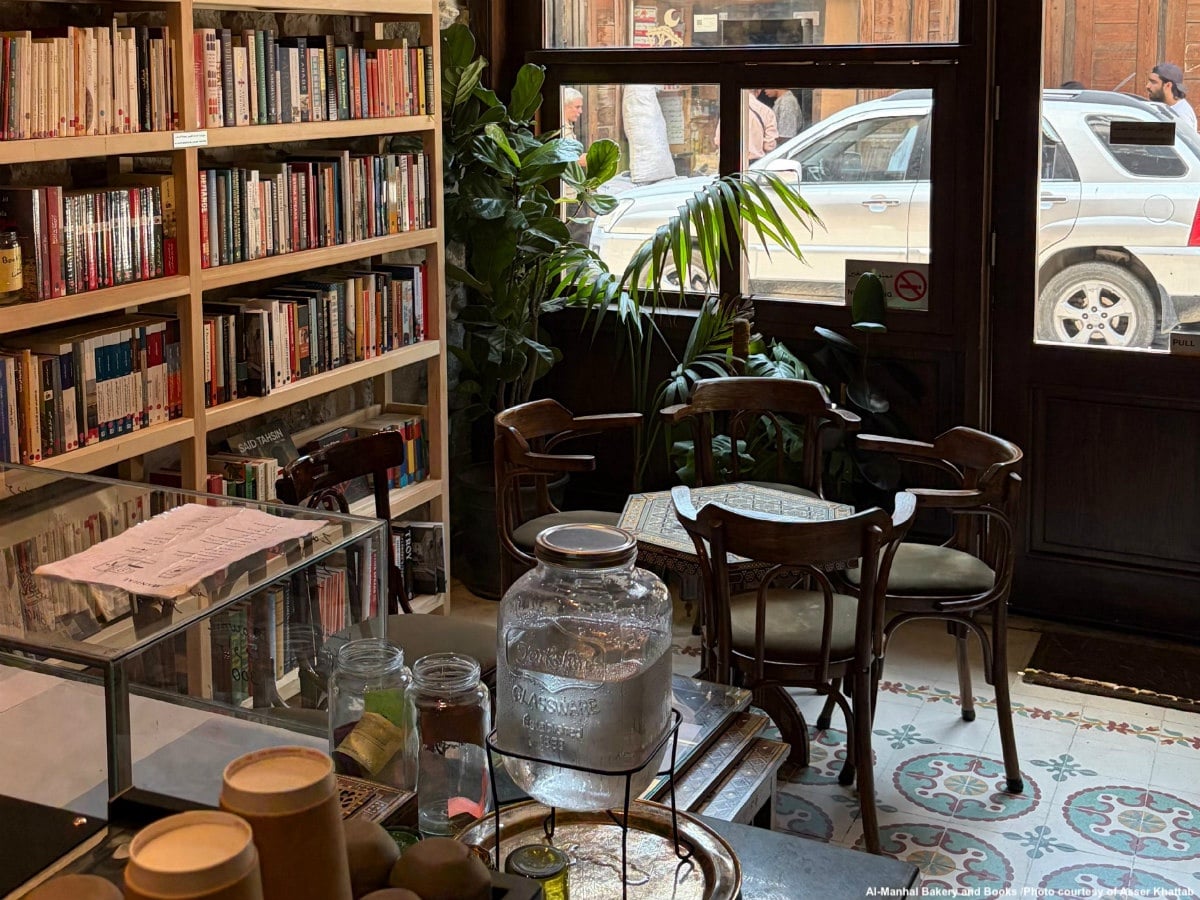
Every book on the shelf lining one wall of a bakery in Damascus’s Old City has been painstakingly selected. When friends of the bakery’s owners, Asser Khattab and Brant Stewart, visit from abroad, they bring a book from the bakery’s wish list to add to the library because shipping goods to Syria is still difficult. The idea is deceptively simple: encourage people to read books that challenge their thinking, while tempting them through the door with the aroma of freshly baked bread and pastries.
Al-Manhal Bakery and Books is on Straight Street, Damascus’s most iconic avenue, named in the Bible’s New Testament. The street runs through historic Sunni, Shia, Jewish, and Christian neighborhoods. It connects two of the city’s historic gates and is always bustling with Syrians and visitors alike, with restaurants, cafés, antique and artisan shops, and people buying spices and soaps.
A bookstore or library can sometimes intimidate people, either because they are not interested, are afraid of what they might find, or feel they don’t belong in that social space. But Al-Manhal Bakery and Books successfully attracts people inside. As they sit with a coffee listening to Kurdish, Armenian, or Syriac music, they browse the shelves and discover books that might pique their interest. This often leads to questions and, ultimately, to borrowing a book that might free their minds.
Everything at this bakery symbolizes freedom, from the act of reading to the intentional choice of locally-sourced ingredients to the selection of staff, who are former detainees in Assad-era prisons and disabled people, across all ethnicities. Syrian wheat and local ingredients from all regions of Syria, grown and collected by people of all ethnicities and religions, represent the country’s agricultural diversity and richness, united under one oven at Al-Manhal Bakery and Books, which dates back at least to the eighteenth century.
“We try to work with people from all ethnicities who are confronting systemic issues that could prevent their reintegration in the workforce. We hold on to them. This is an ongoing commitment because we’re dealing with people who faced so much trauma during their lives. But we’ve succeeded so far. It’s been wonderful to experience the coexistence of diverse people in this tiny space every day and working together,” explains Asser Khattab, co-founder of the bakery, over a virtual call from Damascus.
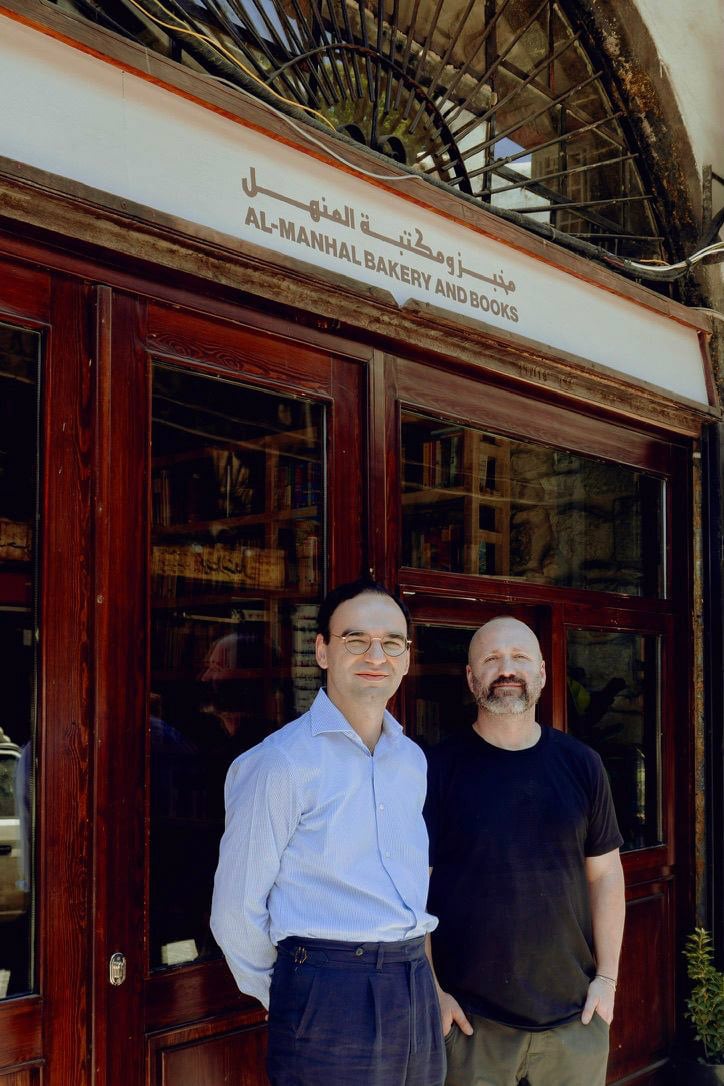
This is not my first encounter with Khattab; we connected shortly after Assad’s regime fell, when I read his December 2024 article, “Assad’s Fall Brings Joy and the Call of Home.” One month later, he was back in Damascus; over a year later, in March 2026, he opened Al-Manhal Bakery and Books with co-founder Brant Stewart, an American baker, entrepreneur, and photojournalist.
Khattab worked as a journalist with international media during the war until the risks became too great, forcing him to flee Syria to Sudan and then to Lebanon. For three years, he lived illegally in Beirut, where he met his co-founder, before finally reaching France with an asylum visa in early 2020.
It’s taken almost a month to arrange this virtual meeting with Khattab. He greets me warmly with a soft smile. It is not always easy to reach him. He has been traveling around Syria for a while. After our meeting, he has to run to the next one. And when we met, he had just been at a respectable publishing house that offered to donate 20 of its publications to the library. Its collection includes 55% Arabic and about 45% English books. “A lot of the best books about Syria and the region were written in English and have not been translated into Arabic,” explains Khattab.
On the Al-Manhal Bakery and Books website, there is an English-Language Wishlist of the books that they would like to get a hold of—from The Bible in Arabic: The Scriptures of the “People of the Book” in the Language of Islam by Sidney H. Griffith to The Yezidis: The History of a Community, Culture and Religion by Birgül Açıkyıldız.
Recommended Read: The Urban Activists of Damascus, at Last
“We think every cultural component of Syria is worth celebrating, and that’s what we try to do actively, even with the book collection,” he notes. As an avid reader since childhood, Khattab explains that he has been on this journey, looking for answers. “When you grow up somewhere with so much complexity and at the same time so many challenges and different perceptions, a lot of them coming from outside of this region about us, it is difficult to understand your country. Often, people oversimplify us as people, our history, and our conflicts. Everyone wants to boil it down to Sunni-Shia or religious or civilizational conflicts and all that sort of thing.”
The focus at Al-Manhal Bakery and Books is critical reading, not just reading what Syrians agree with or what resonates directly with them, but reading that expands their horizons and their capacity to think, analyze, and understand the other; something very necessary, especially today when the world is so divided.
“I hope to be able to convey that a little bit to those who now are teenagers, or in their 20s and have all of these questions about Islam, Christianity, Ottomans, Arabs, our identity today as Syrians, or things that happened in Syria, in Lebanon, in Iraq, in Albania, in Kosovo, anything that can help us understand our country through other countries’ history and experiences, and provoke critical thinking, even when we disagree with them.”
Khattab adds that the library has books he vehemently disagrees with in some respects, but he thinks they’re still important for combating the urge to view things in black and white. Books that confront conspiracy theories, which, sadly, according to Khattab, are very prevalent and dangerous in Syria as well. “Books can perhaps elevate the speech a little bit,” he smiles. “To read more is to understand more, and to understand more is to be able to forgive, to realize that there’s so much complexity in this world that we might understand our place in it and what we can do to make it better.”
In Damascus, reading has seen a resurgence recently. In September 2026, the Roya lil Fikr Foundation launched the “Reading Club” at the Arab Cultural Center in Mazzeh in Damascus, as a call for community-led reading clubs and initiatives in Damascus, in particular for communities of young people, to collect books that their owners no longer need and make them available to other readers in social spaces. Also, The Story Corner Library in Damascus is an interactive nonprofit lending library with a welcoming environment for children and adults alike.
However, the legal environment for starting community initiatives or social businesses in Damascus and across Syria is, according to Khattab, “not very hospitable.” The country has inherited complex laws and regulations from the previous regime, and changing these will require time and effort.
Recommended Read: In Aleppo, Women Clear Landmines Before Rebuilding
Additionally, purchasing power poses a significant challenge for starting a business. An estimated 90% of Syrians live below the poverty line, making it difficult for many to afford items like baked goods and coffee. Khattab and Stewart can only increase their prices to a certain extent, even though their locally sourced ingredients may cost more. “If you raise the price too much, you exclude people, and you become viewed as a place that is catering to the 10%,” Khattab explains.
His paternal family is originally from a neighborhood very close to the bakery, and he feels a deep emotional connection to having a shop on that street. He expresses concern about gentrification, stating, “When you do something in a place like that, you walk the line between renovating and working with artisans and doing something nice and proper that still pays tribute to tradition, without also really affecting the area and the way everyone is using it.” Their thoughtful approach has yielded results, as Khattab and Stewart often hear from neighboring shop owners expressing gratitude for the significant increase in foot traffic, which benefits everyone in the area.
“I won’t lie. It’s a tough environment, and it takes a lot of courage to start a project in Syria,” Khattab admits. “But I believe that anyone who chooses to do so is paving the way for others and fostering societal change—the kind of movement that we really want to create in Syria where people are relearning how to be citizens again.”