
Listen to the audio version of this article (generated by AI).
This article was produced independently with support from the non-profit organization Nobel Women’s Initiative.
Since August 10, 2026, a permanent encampment, largely run by women, has occupied a park across from the Supreme Court in Tegucigalpa, the capital of Honduras. Those maintaining the encampment share a common goal: to defend the land rights of the Garifuna, an Afro-Indigenous people with deep ancestral ties to Honduras’s Caribbean coast, where their communities took root in the late 18th century.
Although their struggle remains largely unknown beyond Honduras, what is at stake extends far beyond the country’s borders. The defense of indigenous land rights challenges a development model driven by large-scale tourism projects and real-estate speculation—a model that is reshaping everything from urban neighborhoods to coveted holiday destinations, often making it increasingly difficult for local communities to remain in the places they call home. At the heart of the Garifuna struggle is the right to collective land ownership, asserted in the face of mounting pressure from international capital.
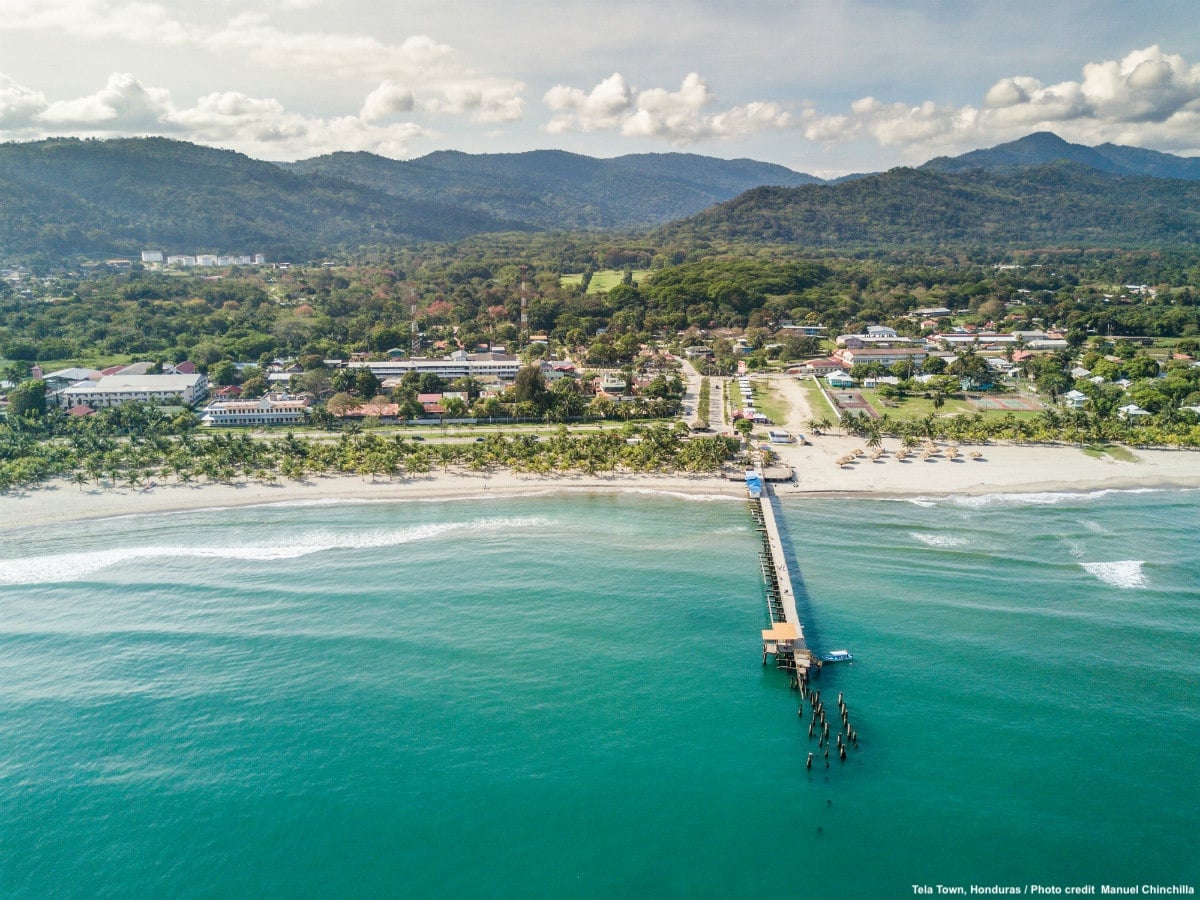
The Garifuna territory borders the crystalline waters of the Caribbean Sea along Honduras’s Atlantic coast. In 1885, the government of Honduras granted land title when it awarded the first ejido (communal land) title to the Garifuna people of Punta Icaco (Santa Fe), San Antonio, and Guadalupe. Since then, these resource-rich lands, known for their pristine beaches, have seen frequent conflict, as they are the Garifuna community’s everyday home but outsiders see them as a lucrative opportunity.
One of the most high-profile conflicts was an international ruling by the Inter-American Court of Human Rights in March 2026. This ruling protected the Garifuna communities of the Cayos Cochinos archipelago off the Honduran coast from filming “Supervivientes,” one of the most-watched reality shows on Spanish television. The court ordered the State of Honduras to return governance of Cayos Cochinos to its ancestral inhabitants after two decades of exclusion and intimidation.
Garifuna women have emerged as some of the most visible leaders of the struggle to defend their people’s ancestral lands and collective rights. According to the Business and Human Rights Resource Centre, there have been at least 15 attacks against Garífuna women – a figure that only represents the tip of the iceberg – including police intimidation of participants in the “Viva Berta” feminist camp, set up in 2021 to accompany the justice process for the murder of Berta Cáceres.
The pressure on the Garifuna’s indigenous land rights has continued to escalate in 2026. In June, the government of conservative President Nasry Asfura approved a new law to strengthen and protect Honduras’s agro-industrial sector, including energy projects, tourism, livestock, and small agricultural producers, to promote investment in the country. This law empowers both the Public Prosecutor’s Office and the National Police to act immediately in cases of “invasions” that threaten businesses.
While the law exempts Garifuna territories—Article 346 of the Constitution of the Republic of Honduras recognizes the rights of indigenous peoples—this recognition has not been upheld in practice. Five members of OFRANEH, a grassroots Garifuna organization advocating for their ancestral territories, are facing criminal charges after being arrested during a police operation in the Garifuna community of San Juan, Tela. They were accused of “aggravated usurpation” for uprooting palm trees needed biannually for their ceremonial houses, located in areas that have been seized.
Amnesty International has urged Honduran authorities to end the criminalization of Garifuna people and has highlighted that this case occurs within a broader context of discrimination and racist rhetoric against Garifuna communities.
“The difference now is that there is, and I say ‘now’ because before there wasn’t, an intention to displace us,” activist Miriam Miranda, a prominent voice in this movement and the general coordinator of the organization OFRANEH, tells me. She is currently on the ground, far from the Honduran capital, and we are speaking thanks to a Wi-Fi connection powered by the solar energy that often blankets the area’s beaches. In the past, Miranda has received death threats in relation to her work defending Garífuna land and ancestral culture. In 2014, she faced a kidnapping with attempted murder, along with Karen García, also a member of OFRANEH. Criminalization processes are a particular issue for garífuna leaders, including a 2017 case opened by the owner of a tourism and hospitality company, accusing garífuna leaders of land usurpation.
The tourism potential and the desires of many powerful, wealthy businesspeople—who arrive at their villas by helicopter and never step foot in the streets of Garifuna villages—have sparked conflict over a territory many want to own, as Miranda explains.
However, she cautions, “It’s very important to understand that this doesn’t mean we don’t want to share the territory. This misunderstanding has been exploited to generate not only confusion but also racial hatred against the Garifuna people, suggesting that we don’t want to welcome others. People have the right to come from Tegucigalpa, the capital, and from those places where people are tired and stressed, but they must respect what it means to live in a Garifuna community.” The issue revolves around governance: who decides how the territory is used, which economic activities are compatible with community life, and how benefits are distributed.
***
The Garifuna people advocate for legal protection of collective ownership of their ancestral territory, granting the community the final say over the land and aiding in the preservation of their culture and identity.
The distinction of collective ownership is crucial. Miranda explains why she believes individual land titles are a trap: “When the State initiates a campaign with Indigenous communities—be it the Garifuna or any other culturally distinct peoples—to prioritize individual land titles, it opens the door for the community to lose its rights to the land, allowing it to be placed on the market,” she says. According to her, there is no evidence worldwide of Indigenous peoples who have eradicated poverty through the individualization of land ownership. Instead, this individualization typically leads to land sales and migration to urban centers, resulting in cultural loss and increased hardship.
Within the Garifuna community, a family inheritance system regulates individual land rights for everyone, with both written and verbal records of who inherits the land worked by their ancestors and the right to use it for life.
“The problem arises when you place a price on that right to land. This creates conflict within the community,” Miranda points out. “At the end of the day, for us, the land is priceless. While they might offer you a few cents that you could spend quickly, your land is worth much more. That’s why we insist that community land titles be respected, as this creates balance within the community.”
Recommended Read: Can a Community Own a Design? Mayan Weavers Say, ‘Yes’
In principle, Indigenous land rights should not conflict with legal security and the protection of private property—conditions necessary to attract investment and generate employment. The contradiction emerges when investment policies fail to acknowledge ancestral rights or when private interests and corporate economic activities take precedence over the communities’ claims and their right to determine what happens on their territory.
This pattern can be observed not only in the Garifuna ancestral community but also in local communities around the world. Sazan Island in Albania is another example: Jared Kushner wants to transform it into an exclusive tourist destination, despite massive protests to prevent it. Another high-profile case in Honduras is the crypto-libertarian city project called Próspera, which other media outlets have linked to technology investors such as Peter Thiel, Marc Andreessen, and Sam Altman.
Court rulings favor indigenous peoples, including the Garifuna, but the problem remains the same, says Miranda: the State, even after receiving a ruling, doesn’t guarantee enforcement in practice. Furthermore, it should be seeking ways to foster corporate social responsibility. However, the opposite is true. In Honduras and other countries with fragile rule of law, institutions are shaped to prioritize private-enterprise interests under the guise of economic development.
Miranda urges us to question what development means, a term she describes as a magic word introduced about 70 years ago that seems to put people on the defensive when community members demand consultation on enclave tourism megaprojects that displace them. “Because of course, that’s not going to help us develop,” she remarks with a smile. “We’ve witnessed this in cities when they come and tell us they’re going to build shopping malls where people used to sit and enjoy the fresh air. Then it becomes a space for wishing for something imaginary, because what they see and want to buy, in the end, they don’t have the money for.” She adds, “There’s also an urgent need to recognize the territoriality of the urban environment.”
“Right now, we realize that the economic crisis, alongside civilizational, moral, social, and environmental crises, is compelling us to make an enormous effort to be psychologically better within our community. There’s a crucial phrase in the Garifuna culture: aura buni amoru nuni, which means ‘you for me, I for you,’” explains Miriam. The struggle of the Garifuna people is rooted in something as profound as humanity itself.