
Listen to the audio version of this article (generated by AI).
Recently, the public administration of the small German state of Schleswig-Holstein released the open-source code for one of its new digital tools and uploaded it to the platform where it hosts its public-sector software projects. Soon afterward, a resident of the state capital, Kiel, got in touch.
“Send me the link—I can fix that quickly,” he wrote after spotting a few bugs. He then submitted the corrections himself.
In Kiel, a city of roughly 250,000 on the Baltic coast, stories like this are not unusual. For decades, the city has nurtured an ecosystem of activists, open-source advocates, civic technologists, and independent developers committed to technological self-determination and open-source software. Many know one another personally, and the distance between civil society and public administration has become remarkably short.
That ecosystem helps explain why Schleswig-Holstein has become one of Europe’s most ambitious experiments in reducing the public sector’s dependence on US tech companies. The state’s transition did not emerge overnight, nor was it triggered solely by recent concerns about digital sovereignty. It existed long before an International Criminal Court judge in The Hague, Nicolas Guillou, made headlines after reportedly being cut off from services provided by US companies. Following the court’s arrest warrants for Israeli Prime Minister Benjamin Netanyahu and former Defense Minister Yoav Gallant over alleged war crimes in Gaza, his credit cards, hotel reservations through Booking.com and Expedia, and even UPS deliveries were reportedly canceled at the touch of a button.
It also predated the case of the German nonprofit HateAid, whose executives had their accounts shut down, drawing renewed attention to the risks of dependence on large digital platforms.
Kiel’s ecosystem grew out of years of collaboration, experimentation, and advocacy by people long before the issue of technological dependence entered the mainstream. “Why is digital sovereignty such a major topic in Kiel? I think it is important to point out that there were key forerunners in the city engaging with technology—often with a critical eye,” explains Steffen Voss, the founder of WebMontag, an informal and regular gathering of digital enthusiasts that has been going on in the city since 2006.
For example, a Bulletin Board System called TopPoint originated in the 1980s and still operates today as an association. This early generation of technology enthusiasts experimented with building their own internet services, including influential figures like Chris Köhntrop and Boris Erdmann, who contributed to the development of PHP. Additionally, the Linux Days, a sort of reunion for the local Linux community, have been hosted in Kiel for many years.
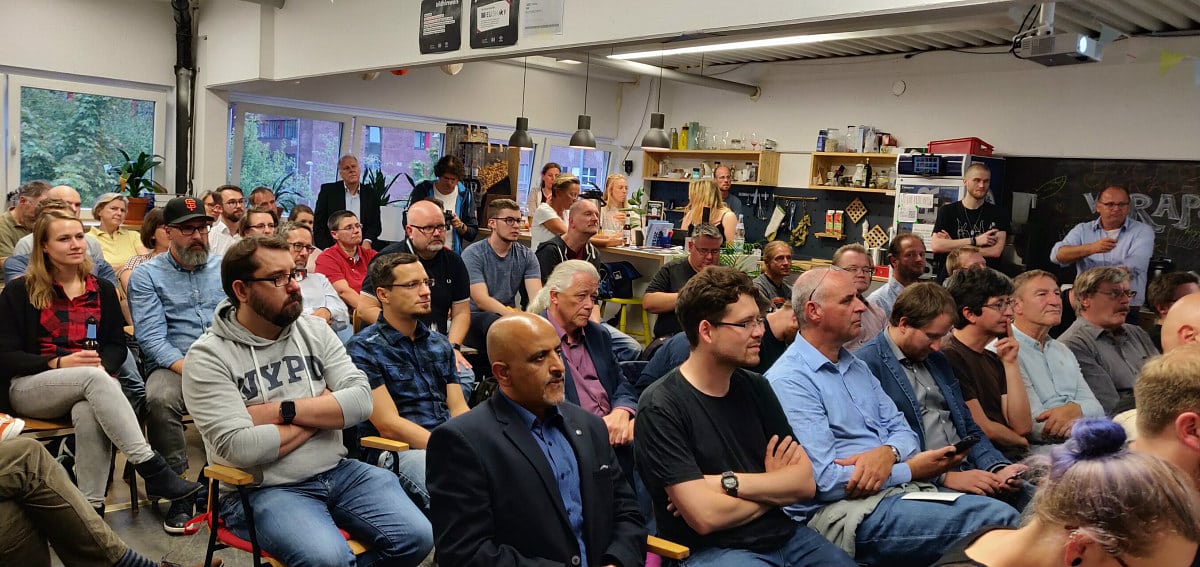
Kiel was the first city in Germany to introduce a community-oriented festival called Digitale Woche (Digital Week). This festival aims to engage the public in discussions about digitalization and, as its leader, Kathrin Reinicke, told me, focuses on finding solutions. This concept was introduced by former mayor Ulf Kämpfer, who brought the idea from Copenhagen ten years ago. Kämpfer presented his vision to a group of 90 people at WebMontag, leading to the inaugural Digital Week festival, featuring over 150 events organized by local businesses, passionate individuals, and the local administration. It was a bottom-up approach to designing the sessions that continues to this day.
Another key initiative is Freifunk Kiel, founded in 2013. Freifunk is a community-led effort to create a public Wi-Fi network using open-source technology. Among the driving forces behind this initiative is Sven Thomsen, a regular attendee at Steffen Voss’ WebMontag. Thomsen is currently the Chief Information Officer of Schleswig-Holstein and has spearheaded the state’s efforts to reduce reliance on US technology.
***
In 2020, the state of Schleswig-Holstein adopted its initial resolutions to transition to open-source systems with unanimous support from all political parties in the state parliament—no one opposed it. “But we’ve had to learn the hard way that it can’t be done that quickly. The dependencies—for instance, on Microsoft products—are deep and extensive. That means it will take us three years to break free from them,” explains Jonas Dageförde, Chief Digital Officer from his office for the City of Kiel.
Coming from the startup world, he knows taking risks is unavoidable. In his opinion, what matters much more, though, is examining the specific risk involved and determining whether I am prepared to live with the consequences should that risk materialize. Therefore, in general, he prefers to speak of “reducing” Europe’s dependence on US tech corporations rather than “completely decoupling.” But he adds, “When it comes to public administration, we simply cannot take the same level of risk that private companies or startups do.” Digital sovereignty, for him, means that the state should master its digital tools and infrastructure, retaining control over when to switch them off, modify them, update them, and determine how they are used. Currently, public administrations allocate taxpayers’ money for licenses for large Microsoft packages at near-monopolistic prices, often for features that go unused.
To foster innovation and build capacity, Dageförde’s team has developed a centralized, high-quality infrastructure that ensures digital tools are well integrated and user-friendly in a decentralized manner. They invite all public administration employees in the City of Kiel to participate in several hackathons. In recent years, they’ve even organized joint inter-municipal events involving various local authorities across Schleswig-Holstein. “You end up with over a hundred people in one large venue, working together in a really creative and cool way. It’s the kind of working style people wouldn’t normally expect from a public administration,” Dageförde shares enthusiastically.
In the last AI hackathon, participants went from scratch to building nearly 50 AI assistants in just two days. Now, those 100 employees have a solid understanding of concepts like RAG pipelines, how they function, and what vectorization entails. “I think that’s an approach that works well for us in Kiel. We stay close to the people. This is how we bring major changes and innovative technologies together with the departments’ actual needs, becoming solution-oriented. Because people are multipliers—they share their experiences, whether good or bad,” says Dageförde.
Whenever someone complains that something isn’t working in the public administration processes, the local newspaper in Kiel publishes a report, often questioning whether the decision to “decouple” from US tech dependence was the right approach. “However, when civil society—and even companies—acknowledge that there will be challenges during the transition but that we are on the right path, it makes things much easier,” Voss explains.
Unquestionably, Kiel’s path to digital sovereignty is at a high ebb.
Last week, the European Commission finally proposed a tech sovereignty package to strengthen Europe’s digital autonomy and resilience, essentially reducing dependence on US Big Tech. When I met with Alexander Rosenthal, Head of DigitalHub.SH, in a virtual meeting, he expressed that it was a step in the right direction. However, he chuckled at one statement in that European proposal, which read that an open-source network needs to be established. “Without revealing any secrets, I can say that such a network already exists at the European level. We in Schleswig-Holstein are already part of it, collaborating with colleagues from Munich, the Netherlands, the Czech Republic, and elsewhere. What matters now is that we are ultimately judged by our actions,” he points out.
Alexander Rosenthal, a political scientist, also comes from Kiel’s digital scene, having previously worked with Steffen Voss and others at the open event Barcamp Kiel (focused on digitalization and society). Today, he works for DigitalHub.SH, a publicly-funded institution that operates in the public sector at the state level but is deeply rooted in Kiel’s local ecosystem. It is part of WTSH, the Economic and Technology Transfer Agency of Schleswig-Holstein, which covers the digital economy, sustainable business practices, and startups. “We receive many delegations and individuals coming to Kiel, asking us to showcase what we’re doing in Schleswig-Holstein. I am a firm believer in open source, as are many others—so let’s collaborate on an open solution. Otherwise, everyone will end up creating their own small-scale solutions, and we won’t be competitive,” says Rosenthal.
Recommended Read: She Took the Web Back at Schools. Can She Do the Same for Democracy?
DigitalHub.SH is actually developing a targeted open-source economy, ensuring that there are companies capable of developing open-source software, knowledgeable about it, and able to offer specific products from Schleswig-Holstein. “I believe what the state of Schleswig-Holstein is doing with the DigitalHub.SH is effective,” says Voss. However, he points out that there are still very few IT service providers or system houses available to assist companies in transitioning to open source and managing their IT, which is the type of service that Microsoft offers.
“My advice is that IT service providers need to make the switch to open source themselves first. They must transition their own operations to open source, which poses a significant economic risk for companies. However, only after they have successfully made this transition will they be equipped to implement it effectively for their clients,” says Voss. Additionally, there needs to be funding available for this transition. “We need economic players who will support this initiative all the way up to the EU level,” Rosenthal states.
The question is how the open source technology market will change if substantial investments are made. This issue often sparks debate, as public officials tend to protect and secure patents. Kiel’s Chief Digital Officer, Jonás Dageförde, notes that the city’s ecosystem focuses on sustainability and startups that benefit society rather than simply chasing “unicorns.” The Kiel School of Sustainability at the University offers a unique degree program in sustainable economics and the environment, attracting students from all over Germany and also Europe. This connection fosters interest and momentum not only in open-source approaches but also in other initiatives that prioritize societal benefit over profit.
Ultimately, this shift points towards improvements in governance and democracy. By reducing our dependence on US tech giants and actively using open source technology, we can collaborate more effectively. For instance, when citizens can report bugs or suggest improvements, the barrier between the administration and the public diminishes, fostering collaboration. “If I have a suggestion for improvement and 75 other people agree it’s important, then it gets implemented. That’s already a significant impact, and I believe this collaboration can be expanded even further,” says Voss.
According to Rosenthal, making administrative processes more transparent can greatly enhance our democracy. He believes people often underestimate public administration, which manages large volumes of data—ranging from birth and death certificates to everything in between. “Not everyone is a software developer who can code, but let’s be honest: how many citizens in Germany engage with parliamentary debates every day? Probably not many,” he smiles. However, if public administration functions effectively and citizens are satisfied with what the state provides, Rosenthal believes they will also be more satisfied with our democratic system.