Listen to the audio version of this article (generated by AI).
Two weeks ago, at 2 AM, around 200 people showed up outside a hospital in New York City. A Nigerian citizen was brought in after federal officers badly tased him during Immigration and Customs Enforcement (ICE) operations in New York City. The incident immediately prompted a crowd of concerned New Yorkers outside the hospital to demand his release.
Some days earlier, locals of the Norwood section of the Bronx gathered in a press conference to seek answers after federal immigration agents mistakenly detained a 20-year-old American citizen, injuring him before releasing him shortly thereafter.
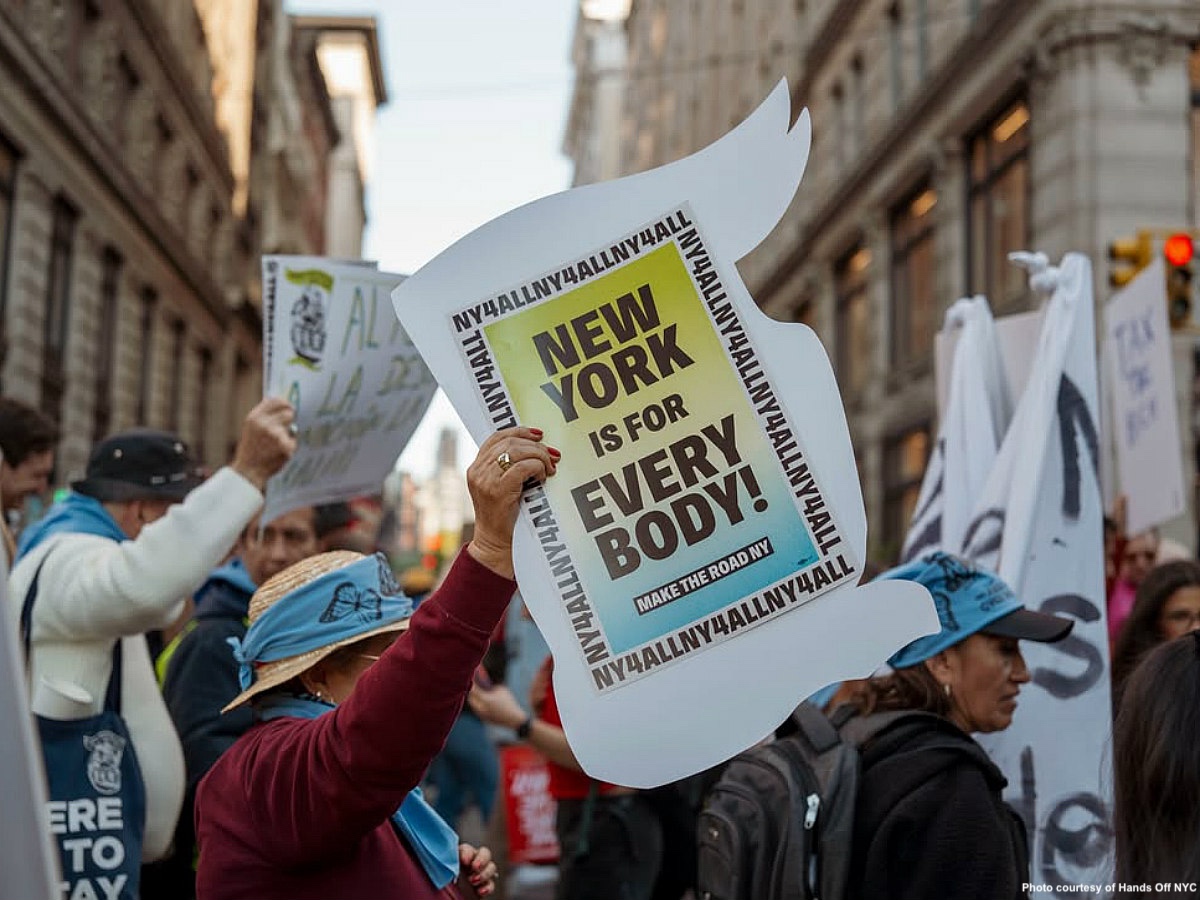
In New York City, there have always been grassroots groups dedicated to defending the rights of immigrants, well before the Trump administration and ICE operations took center stage. However, in recent months, the number of people showing up at immigration incidents has notably increased.
Those New Yorkers who are typically not politically engaged and do not closely follow the news have felt galvanized to protect the rights of everyone in their city. This momentum is fueled by an unusual coalition of activist organizations spanning the entire spectrum of activism in New York City, from progressive gentry and conservative faith-based groups to grassroots organizations of various kinds. Groups as diverse as the Buddhist Coalition for Democracy, Climate Families NYC, Downtown Nasty Women Social Group, Grassroots Comedy, Muslim Advocates, New York Jewish Agenda, NYC Poets Afloat, the New York State Nurses Association, and the Women’s Action Group of Forest Hills are just a few examples.
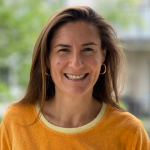
“This united front reflects a pivotal moment where we must look beyond our differences because we are facing a significant threat,” says Hae-Lin Choi, co-founder of Hands Off NYC. She, along with Molly Sandley from Indivisible and Hannah Stauss from 50501 Movement, played a vital role in organizing the No Kings rally last March. What started as a one-day protest has grown into a coalition of over 150 organizations that have signed a statement committed to responding peacefully yet firmly in the event of a potential immigration crackdown by the military in New York City.
Choi noted, “That’s not to say that we don’t currently have ICE operations in New York, with brutal arrests certainly happening, but detentions occur differently here.” She pointed out that ICE has been detaining individuals as they leave their court appointments, “which is particularly cruel because no one wants to miss an opportunity to attend their citizenship appointment.” Last week, a federal judge issued a ruling banning ICE arrests at immigration courts in Manhattan. This ruling undermines a controversial aspect of President Donald Trump’s immigration enforcement strategy in New York City.
There is a common misconception that ICE is no longer active, Choi explains, and that the operations against migrants are over, simply because we are not witnessing in New York City what occurred in Minneapolis. However, comparing Minneapolis to New York City is misleading. For instance, Staten Island has a population slightly higher than that of Minneapolis, where the presence of 4,000 ICE agents made them noticeable in everyday places like supermarkets, gas stations, and coffee shops. This level of visibility is difficult to replicate in larger cities.
***
“We haven’t seen the worst of the immigration crackdown yet. We’re really worried about what’s happening after the midterms. Because then there’s very little that will hold them back,” says Choi. But Hands Off NYC has developed a plan, one detailing responses from day zero to day ten should such an event occur.
Many signs indicate that ICE is adopting a quieter strategy for its operations in New York City. In such a high-density area, they may opt for a so-called bureaucratic blitz, which involves the mass denial of immigration claims. A Supreme Court decision is expected in June regarding mandatory detentions, allowing expedited processes to deny immigration claims and bypassing several steps in immigration proceedings. Additionally, the Supreme Court will determine in June whether to revoke the administration’s cancellation of Temporary Protected Status (TPS) for Haitians. If this cancellation stands, approximately 40,000 Haitians in New York City could find themselves illegally residing in the country overnight, as losing TPS would prevent them from applying for asylum or any other relief.
Recommended Read: Kyiv Mayor Vitali Klitschko: “It’s not Easy—but No Fight, No Win”
Meanwhile, the administration is significantly expanding its infrastructure capacity for mass deportation, including building detention centers. This year, ICE’s budget has risen from $10 billion annually (it never surpassed that amount in the last several years) to $75 billion to be spent in four years. Although there have been two attempts to establish a detention center in New York City, Choi explains, both have faced strong opposition from activists and have ultimately failed. But there is a large detention center located in New Jersey, just 30 minutes from Manhattan, where some detainees have reportedly staged a hunger strike against poor conditions and denial of medical care. Just yesterday, Kim, a senator for New Jersey, said to the press that ICE pepper-sprayed him outside the site where he was to speak with relatives of some of those detained.
“If the administration implements a large-scale crackdown, they would encounter significant resistance,” says Choi. Her analysis draws on 30 years of experience building power with workers in the labor movement in Europe and the United States. That resistance in New York City could set a precedent against the administration’s immigration crackdown.
***
This wouldn’t be the first time New York redefined the country’s political fabric. From the labor uprisings that fueled the American union movement to the civil rights and anti-war mobilizations centered in Harlem and Greenwich Village, the city has repeatedly incubated social movements that reshaped national politics.
Difficult periods have always produced new, powerful coalitions. For instance, the city’s labor movement brought together Jewish, Italian, and Eastern European garment workers across ethnic and linguistic divides, while later civil rights and tenants’ movements forged alliances among Black, Latino, and progressive white communities.
“I don’t want to create the impression that everybody works together. And there are still many organizations out there that don’t want to work with Hands Off NYC,” says Choi. There are definitely familiar fault lines within the movement: very progressive unions, either apolitical or more mainstream, alongside traditional faith organizations—it’s not perfect. The situation in Gaza and the war in the Middle East are also significant issues. However, Choi insists that they are clear on the scope of Hands Off NYC and what it does. “We’re not a movement that addresses all the world’s problems. We are specifically focused on building a movement to respond to the federal government’s attacks on our city. The mass marches, trainings, and community organizing are what bring us together.”
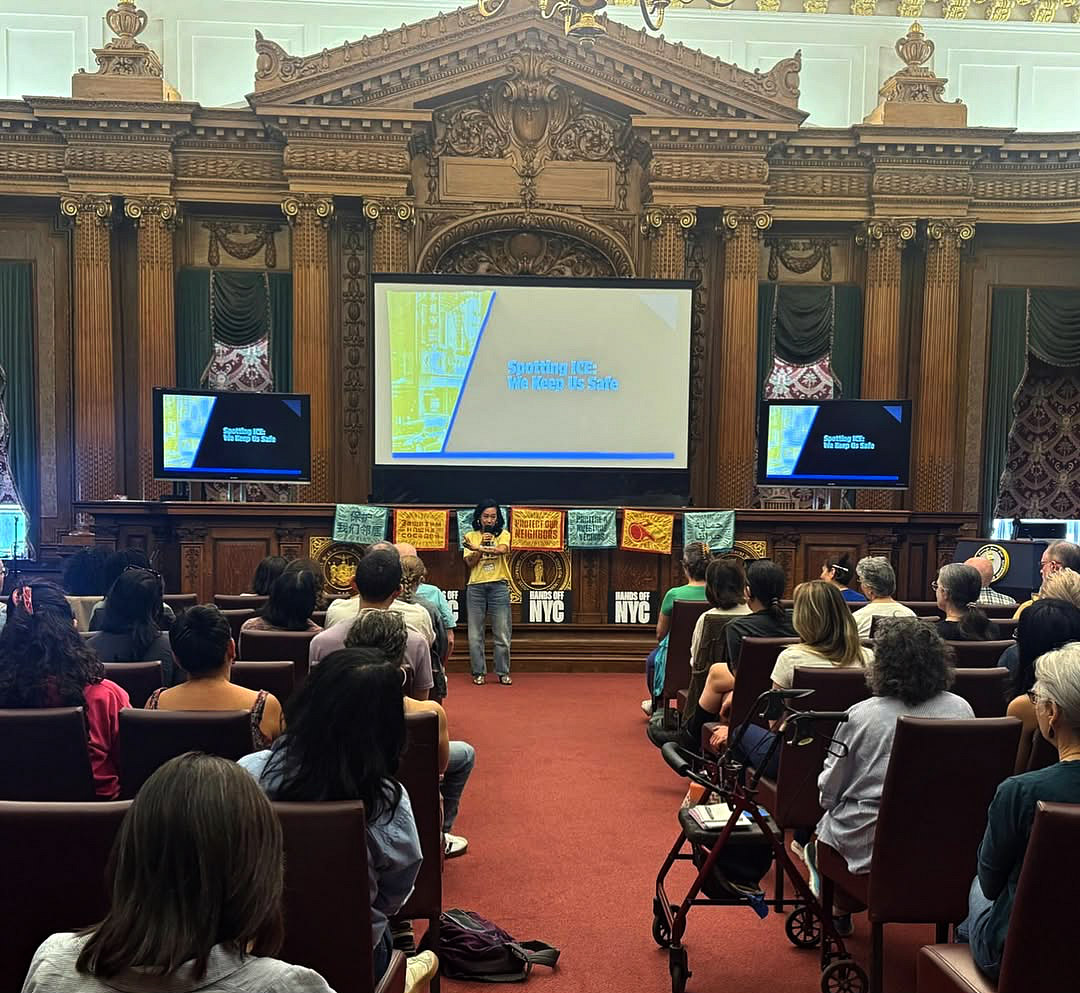
Hands Off NYC has established a decentralized structure in which people organize in their neighborhoods. They train ordinary New Yorkers to be rapid responders and document all with video. About 90% of those who attend their trainings have never participated in anything like this before, nor have they been involved in activism. This gives Choi hope and inspiration to continue. “Many people come to us feeling helpless and wanting to make a difference at this moment. At Hands Off NYC, we always say, ‘the widest container, the lowest barrier to entry.’” In other words, “start with where you are; bring what you have and do what you can.”
Some training sessions include explanations of how ICE can pose as local police because “they’re legally allowed to lie,” says Choi. There was a notable incident in which ICE pretended to be campus police. They had a picture of a child and rang the bell, claiming, “Campus police, we’re looking for a missing child.” That’s how they gained entry to a building at 6 AM, knocking on one student’s door. This student happened to be an influencer with over 117,000 followers on Instagram and was recording the incident for everyone to see. It was well-documented, and hours later, she was released.
Another training focuses on “how to have conversations with people we might sometimes disagree with.” Choi explains that this course encourages stepping back to understand how we got to this point in the first place: the extreme polarization and isolation within the country. One person might say something that offends you, or you may disagree with someone’s religious beliefs, while they might have issues with the LGBTQ+ community, which could be a significant concern for you. “Fundamentally, if we want to organize with our neighbors, we must understand and accept the need for conversations, rather than retreating into our respective corners,” says Choi.
And she adds, “Ordinary New Yorkers understanding their rights and being ready to take to the streets to document these rights will be the most effective and essential action.” Throughout history, New York has consistently demonstrated the power of its people to reshape power and enact change.