
Dear Reader,
Islamic New Year recently arrived when the crescent moon appeared, and the Hijri calendar flipped to 1448. It was marked by a Sufi parade wafting clouds of fragrant incense, while men marched with animal-hide drums and brass cymbals, creating trance-inducing rhythms in Nablus’s tiny streets.
Watch the parade here.
Pretty much everyone in the video is local, their families extending back to the Ottomans, Islamic dawahs, Romans and earlier to the Canaanites, often with family names reflecting Nablus’s ancient urban geography. But there are also two foreign visitors within the crowd, John and Thomas (not their real names).
John is from Michigan in the United States. In his country, land acknowledgements are common. However, the acknowledgement for the land of the Ojibwe people, where he grew up, felt like lip service to him. In response, he did unpaid work for the Ojibwe cultural space. Now he is here, giving back to a place where the lack of access to a decent education is acute. As an American taxpayer of British ancestry, he came to volunteer in Palestine to balance how the US government spends his hard-earned tax dollars.
John’s training as a TEFL educator and life coach made him perfect for a kids’ summer camp near Balata refugee camp. They’re offering Arabic literacy and storytelling classes, as well as English language classes. John chats with kids about their lives in English, leading to genuine connections. His life coaching experience is as valuable as his teaching qualifications in this environment. He’s encouraging curiosity and confidence in these children.
One of the older kids, Nimer, is 17, and he is recognised as the leading calligrapher of his generation in Nablus. He dreams of sharing his calligraphy with people around the world. Nimer is a kind teenager and loves to teach marginalised children to improve regular handwriting skills, who might otherwise grow up unable to read and write, or only able to do so on their phones. Learning the craft together, Nimer’s hand guiding theirs, simultaneously raises a sense of pride in their ancient Arabic culture.
The other foreigner in the Sufi parade crowd was Thomas. He comes from Linz in Austria. His great-grandfather was employed at Mauthausen concentration camp. In Austria, people are still processing its Nazi history while the Holocaust informs the public discourse on Israel-Palestine, usually skewing it into a Zionist position. For Thomas, his family’s history led him to volunteer in Palestine, as the descendant of people who enabled a genocide. He couldn’t bear the way history is repeating itself. Instead, he responded by coming here to lend a hand.
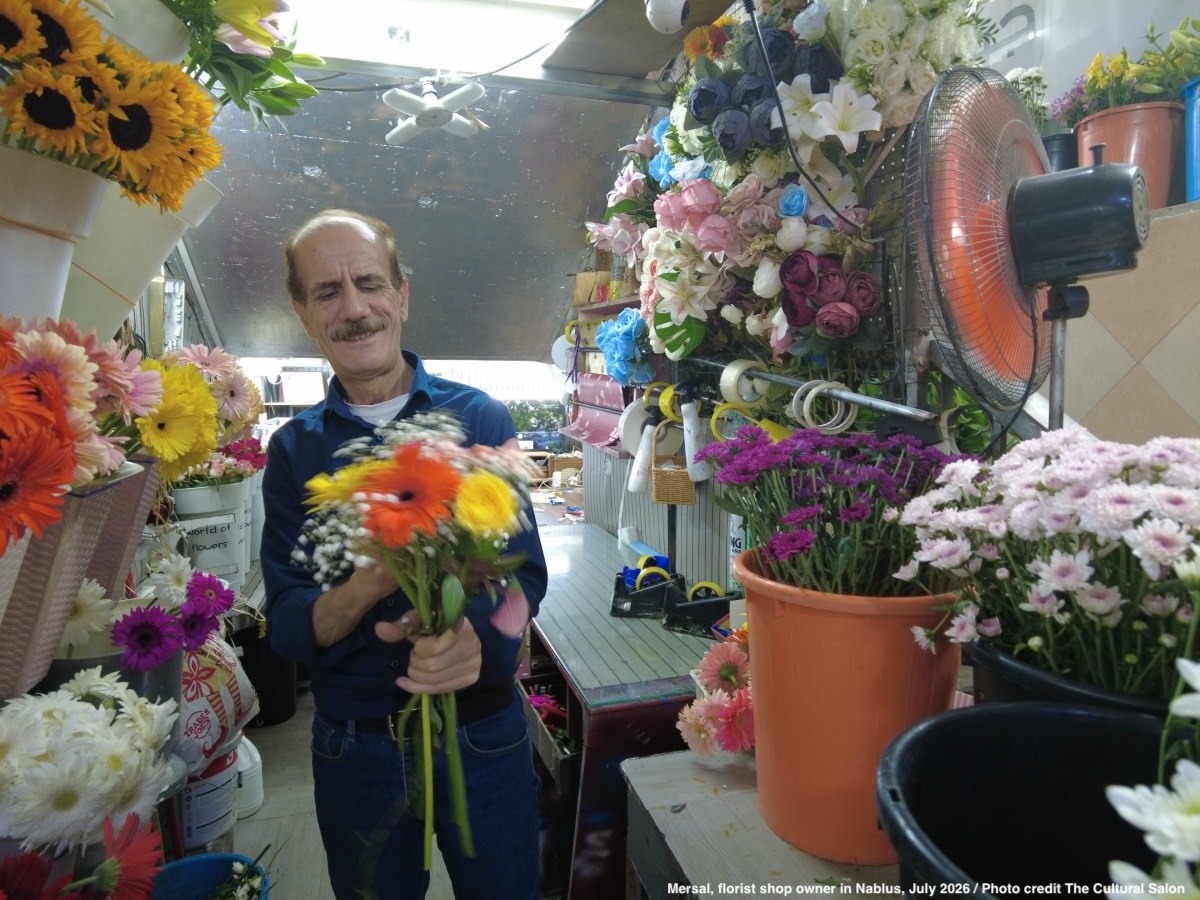
He was introduced to Mersal, a flower arranger whose florist shop in Nablus is a little local gem. Mersal is a stoic, old-fashioned, and elegant gentleman navigating many challenges, including the demolition of his ancestral family house in Nablus by the occupation. Yet he is doing it with love, laughter, and flowers in his tiny florist shop. He is emotional. He cries freely, with Fairouz songs playing loudly. He has a big heart and doesn’t like to be alone, perhaps because that’s when this injustice feels too great.
Recommended Read: #3 — A Shopping Trip Through Tubas
Thomas’s experience in retail and his willingness to learn new skills were a good fit to help Mersal fulfill a large order for the inauguration of Nablus’s first woman mayor, Anan Al-Atira. Mersal showed Thomas the ropes, and he learned quickly. The flower arrangements reflected Mersal’s vision, creative direction and artistic flair thanks to Thomas’s practical work soaking the Oasis foam, cutting blooms to length, and similar tasks. Thomas would have never imagined that supporting Palestinians would look like a florist’s shop, but he’s satisfied that he’s helped maintain a fragile small enterprise that will continue to employ local people long after he’s returned to Linz.
Many people watch videos on social media of injustice in Palestine, but only a few jump through their screens onto our streets and offer to help. These are the urban activists I wanted to tell you about today. John’s and Thomas’s stories share something obvious to us in Nablus: there are a lot of organisations and individuals in the West Bank who welcome volunteers, but international volunteers don’t know about these opportunities.
Visitors hesitate to come here, under the false assumption that the West Bank is inaccessible or dangerous to visit. Others worry that it’s insensitive to come, but this isn’t true. Indeed, many international people have volunteered for extremely dangerous frontline activism, often experiencing settler violence firsthand, but for people who volunteer teaching or arranging flowers or working at an animal sanctuary in Palestine, the perils are tiny.
While every traveller makes their own informed decisions about the reality here, Palestinians love volunteers who come with respect, humility, realistic expectations, and skills to share, from coders to crafters. In exchange, they’ll experience Palestinian hospitality, a sense of purpose, and either low-cost or free accommodation.
For anyone wondering how to volunteer in Palestine, there are ways to support communities on the ground. Locals seek volunteers, and volunteers look for placements – and that’s why we created The Cultural Forum.
We evaluate each volunteer’s skills and hopes for their trip, and match them with opportunities that fit. For John, it was teaching English, and free accommodation to make his extended stay realistic. For Thomas, it meant finding a volunteer job where his retail experience could be useful in Palestine, and where he could meet local people.
We’re matchmakers. We draw on our relationships and knowledge to match volunteers with placements, ideally in advance of arrival, but also on the fly here on the ground. We evaluate skills, strengths, and practical needs so they’ll arrive with their accommodation and placement organised, and with flexibility for personal interests, such as sightseeing, Arabic classes, or a thousand and one ideas for their time in beautiful Palestine.
If you’re curious about volunteering in Palestine, reach out!
From Nablus with Love,
Afaf