
Listen to the audio version of this article (generated by AI).
On a scorching day in Madrid, during a June heat wave that swept across Europe, I found myself sitting under the shade of the trees near Plaza Roja in the working-class neighborhood of Vallecas. It was late afternoon, yet the temperature was still too high for any children to be outside playing in the large plaza.
Two teenagers hung out on a bench, glued to their mobile phones. I asked one of them if kids typically came down to play football, and he disdainfully replied, “Yes, but they are really small kids,” and bent his head back toward his mobile phone.
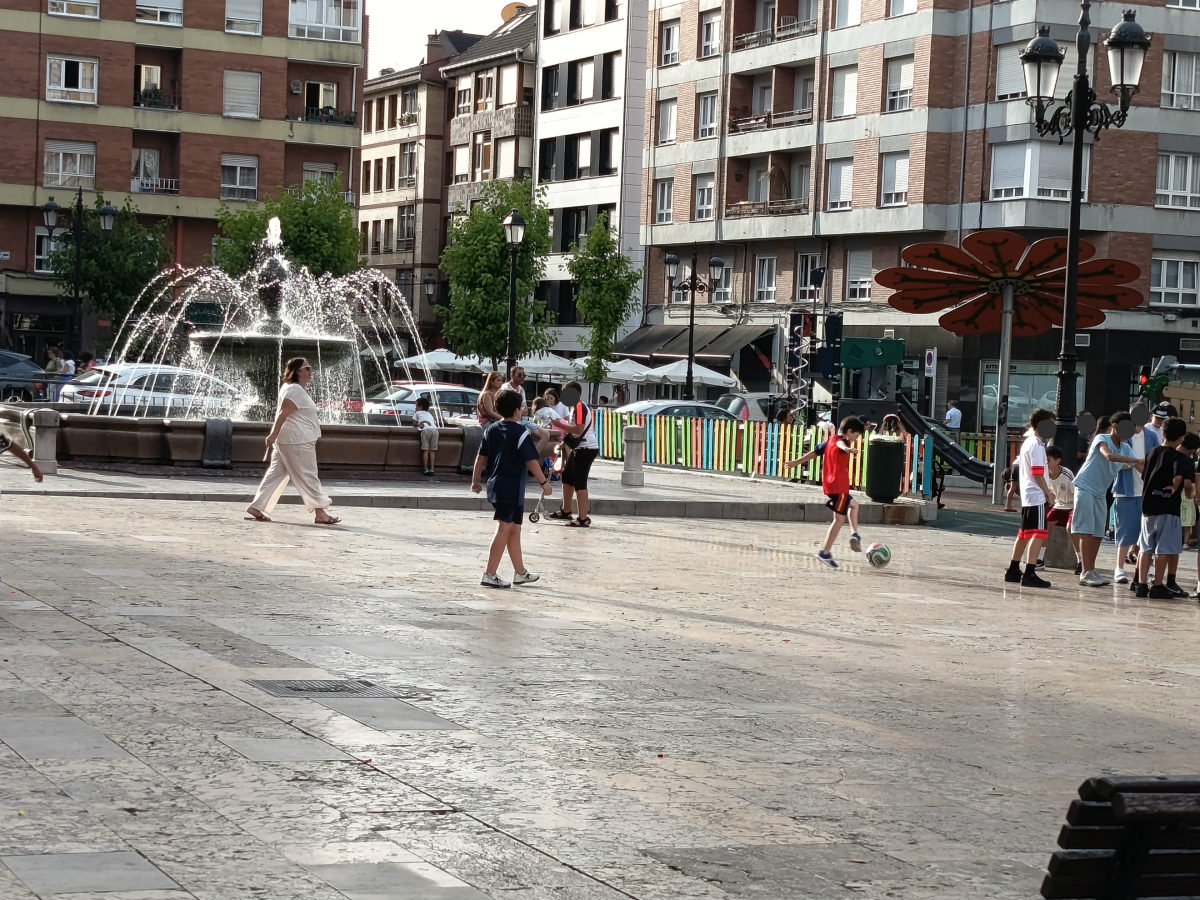
As the heat abated later that afternoon, I saw kids showing up in designated football courts at the Plaza Lavapiés in Madrid’s most multicultural neighborhood—a dense patchwork of immigrant communities and lifelong madrileños.
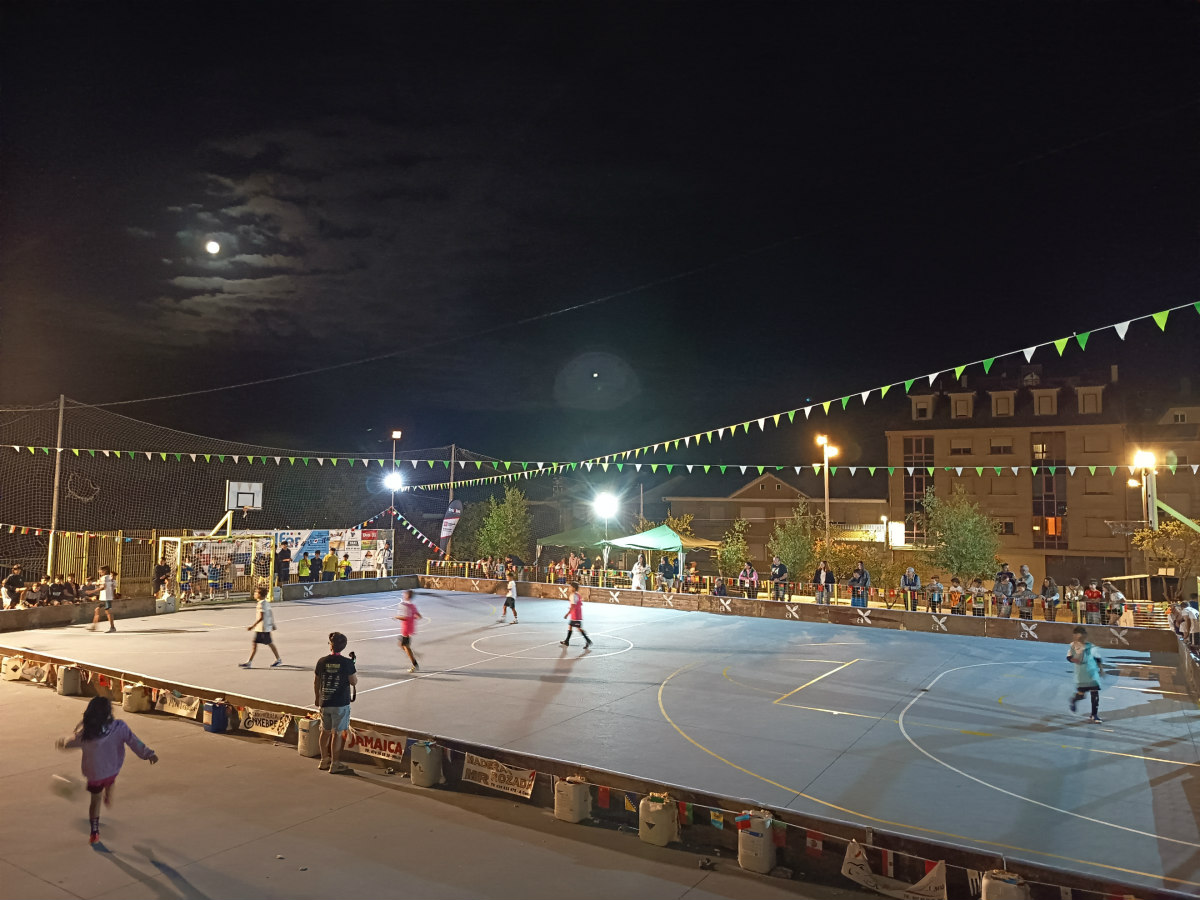
Four days earlier, during the same heat wave in Spain, I witnessed a football competition held on an improvised court in a public park in a small town in Galicia. The match began at 10 pm and concluded at 2 am the next morning, with teams made up of groups of friends, both boys and some girls, aged 12 to 14. Parents gathered in the park and around the court, enjoying drinks and socializing. In one corner, the World Cup match Uruguay-Spain was being shown on a large TV, attracting the attention of several viewers. That night, these kids likely hit the bed at 3 am at best.
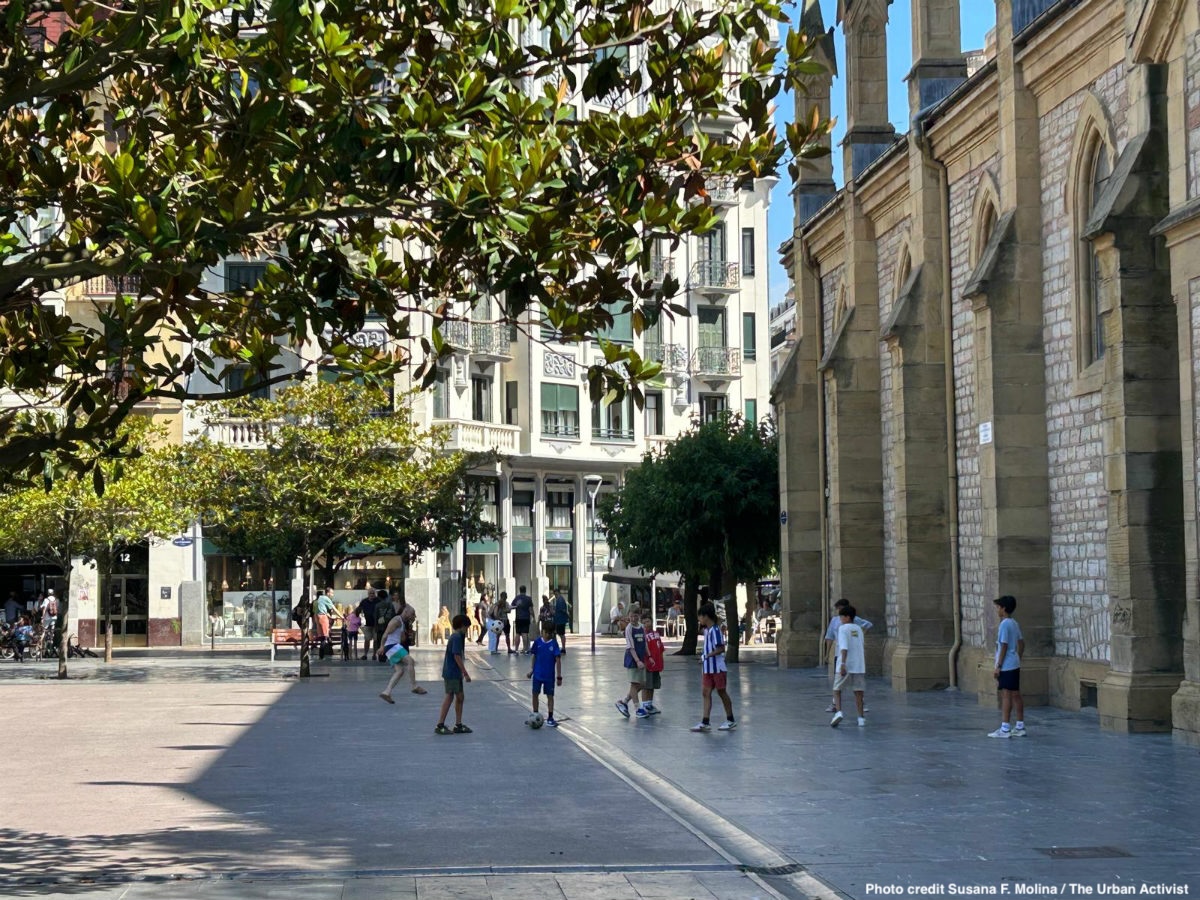
One week later, on Plaza Cataluña in San Sebastian, kids played football in the shade of a church where cars couldn’t stop the game. “The owner of the ball chooses the teams,” whispered my son, who was with me on a day trip to the Basque city, as he asked to play with a complete group of strangers. After 10 minutes, we had to leave; the other players complained that it was way too early. The speed with which football creates connections is hard to beat.
At the playground in front of the Guggenheim in Bilbao, spontaneous street football unfolds regularly among tourists’ kids hanging around and locals, governed by unwritten rules like “last goal wins.”
Back in my hometown Oviedo, the same scene plays out again. I can name at least three places where you will never miss street football: Plaza Miñor, Plaza del Fontán, and the La Losa promenade. In the latter, on an improvised pitch, trees become goalposts as kids reclaim the street for play. Strollers often complain, and might even show kids a red card if the ball accidentally hits them. Overnight, a table tennis table appeared in the area, but the kids have managed to play their way around it. This ongoing struggle has turned street football in Spain into a rebellious act.
On one occasion, I saw a dad sitting next to a game, talking on the phone. As the ball rolled toward him and kids ran behind, one child asked another to translate what his dad was saying in Moroccan Arabic. Another time, I met a dad who praised the street football scene, as he explained that they had to leave Venezuela for Spain due to rising insecurity on the streets. “We are the United Nations team,” my son often smiles, referring to the many nationalities involved in the game. Mostly, kids play unsupervised; they negotiate with their parents to hit the streets alone, without mobile phones (another upside of continuous running in football), and play until darkness falls.
For generations, Spanish children have played sports and learned football in public spaces. Today I can honestly say that cities in Spain still breathe informal street football. But the game survives mainly in neighborhoods with strong community ties and in many working-class and immigrant districts, where children tend to spend more time outdoors and continue to claim the city as their playing field.
Elsewhere, however, the sight has become increasingly rare. Public parks and plazas—cleaner, safer, and more carefully managed than they were forty years ago—are no longer the spontaneous playgrounds they once were. What was once an everyday feature of Spanish urban life is gradually becoming an endangered practice. In Northern European countries, it is almost nonexistent. Increasingly, football in public space takes place on municipal pitches purpose-built for the game, such as those in Madrid Río, rather than in the improvised matches that once transformed squares, sidewalks, and quiet streets into playing fields.
Recommended Read: Growing Up in the City: What It Was, What It Can Be Again
Many urbanists and parents attribute this decline to safety concerns due to traffic—an urban environment that prioritizes cars and has been redesigned for consumption rather than play. There is more playground equipment and decorative landscaping, but fewer open surfaces that don’t necessarily need paving. Many new developments focus more on aesthetics than on providing flexible play space.
Others say that screens compete with outdoor play. But Lenore Skenazy, founder of the US movement Let Grow, told me in an interview over two years ago that children’s independence began fading long before it was even possible to give them a smartphone. “It’s time for parents to be brave and allow them a little independence,” she wrote in a recent op-ed in The Guardian.
Spain has experienced a gradual decline in per-capita conventional crime rates. Even as the population has grown substantially, Spain remains one of the safest countries in Western Europe by most international measures. However, public perception often differs from these statistics. Many parents have decided that all children are in constant danger. Highly publicized violent incidents receive extensive media coverage, and social media amplifies isolated crimes. In addition, political debates, particularly around immigration and public security, often emphasize selected categories of crime rather than overall trends.
“We live dominated by fear,” said renowned education expert Francesco Tonucci. He believes that overprotection is distancing children from what they need most to grow. Childhood has become increasingly scheduled and organized by parents, and Spanish children now spend far more time in extracurricular activities and supervised sports. Instead of engaging in free play for three hours every afternoon, many children train twice a week, playing primarily in football academies, federated clubs, and organized leagues.
Football coaches are no longer holding back in voicing their suspicions about football academies or youth clubs. Many argue that while today’s children may be better trained than previous generations, they are becoming less imaginative because they are given fewer opportunities to develop this skill through unstructured play.
Spanish football historian Martí Perarnau has argued that Spain’s technical generation emerged because children accumulated thousands of play unstructured hours before entering organized football. Coaches in Spain frequently point out that academy training cannot fully replace the decision-making learned when children organize games themselves in the streets and play football collectively. Although most kids eventually joined youth academies early, almost all describe street football as where they developed their creativity, first touch, dribbling, scanning, improvisation, and ability to play against older children.
Before the World Cup final, Spain football champion Lamine Yamal wrote on his Instagram account: “For you and for the street.” He has often praised his neighborhood, Rocafonda, for his success. This working-class area on the outskirts of Mataró is significantly impacted by immigration and poverty. Although for some, the neighborhood seems like an extremely troubled one, the actual statistics say something different, with isolated and almost one-off events (such as the attempted stabbing of Lamine Yamal’s father in 2024). Despite all this, many remember Lamine as a kid who was always with a ball on his feet on the street.
When speaking to the BBC upon his retirement, football star Andrés Iniesta reflected on his childhood: “When I was a kid I was basically playing in the streets of my hometown or in the school playing yard, and that environment helps you evolve.” He added: “Nowadays kids are maybe practicing football in more well-prepared fields… Each environment helps you get better.” Other former great players in Spain have all spoken about the importance of informal street football as an important part of player development and football intelligence.
Coach Jose Manuel Lucas Garcia trains children who, in Spain, start learning football around age 6. He has coached 40 young players, including Fernando Torres, into professional players who have progressed to first leagues. Lucas Garcia, who grew up in the Simancas neighborhood of Madrid, recalls playing football in the streets and the competitive spirit among neighborhoods. “It forces you to focus on dribbling and precision in tight spaces with an opponent constantly on you. You come up with more ideas. Kids receive vital motor learning from a very young age, which, unfortunately, has been lost,” he explained as we talked over the phone.
He describes these informal games as the first stone of the foundation of football education. However, he says for exceptionally talented kids who shine in the neighborhood plaza, the next step is usually a football academy or youth club. To advance on the professional footballer ladder, players must excel in three key areas: strength, speed, and precision. If they don’t meet the required levels in the corresponding category, they cannot progress in an extremely competitive football environment.
Other educators and football coaches in Spain will tell you that street football teaches children to negotiate rules, resolve conflicts, adapt to unpredictable situations, create friendships across ages and cultures, and make decisions without adult supervision. “The essential debate on youth football addresses the devastating impact of hyper-professionalism on children,” claims Pedro Marcet, specialist in sports training based in Barcelona. Experts in Sport psychology, such as Alberto Martín Barrero and David Llopis Goig, criticize the obsession with results and the ego of adults who turn fun into pressure and turn football into a “hammer for the child.” Coaches and clubs are urged to redefine competitiveness, prioritize individual development, and adopt a model grounded in process, patience, and care to ensure a sustainable and ethical youth football system.
The decline of street football could reshape not only the game itself, but also the kind of childhoods—and ultimately the kind of cities—we choose to build. Urbanists often describe spontaneous street play as one of the purest forms of “self-organized public life” and a catalyst for diversity and social cohesion.
In Spain, that culture has not disappeared—you can still find it if you know where to look. The future of Spanish football, and perhaps of society itself, may depend not only on what happens inside elite academies, but also on whether cities and parents continue to leave room for children to invent their own games.