
Listen to the audio version of this article (generated by AI).
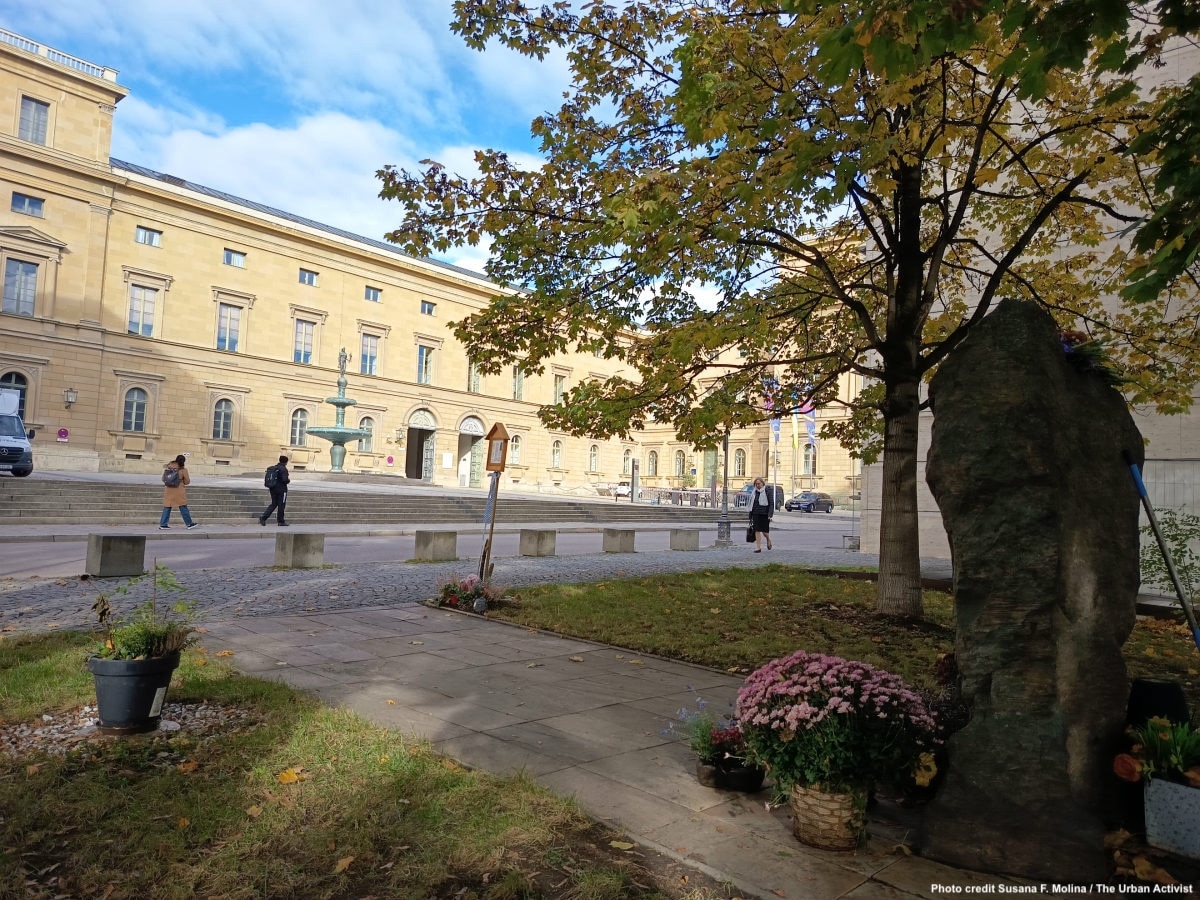
A dolmen-like stone stands on the only green corner of Marstallplatz, a dreary concrete square near the theater of the same name, behind Munich’s opera house. Whenever I pass, I notice fresh flowers left at its base, yet I have never seen anyone place them there. Buses carrying tourists stop just 50 meters away, but the monument rarely seems to catch anyone’s attention. An inscription reads: “To the women who cleared the rubble and the generation that rebuilt the city, with gratitude and recognition. Munich after 1945. Mindful of the responsibility.”
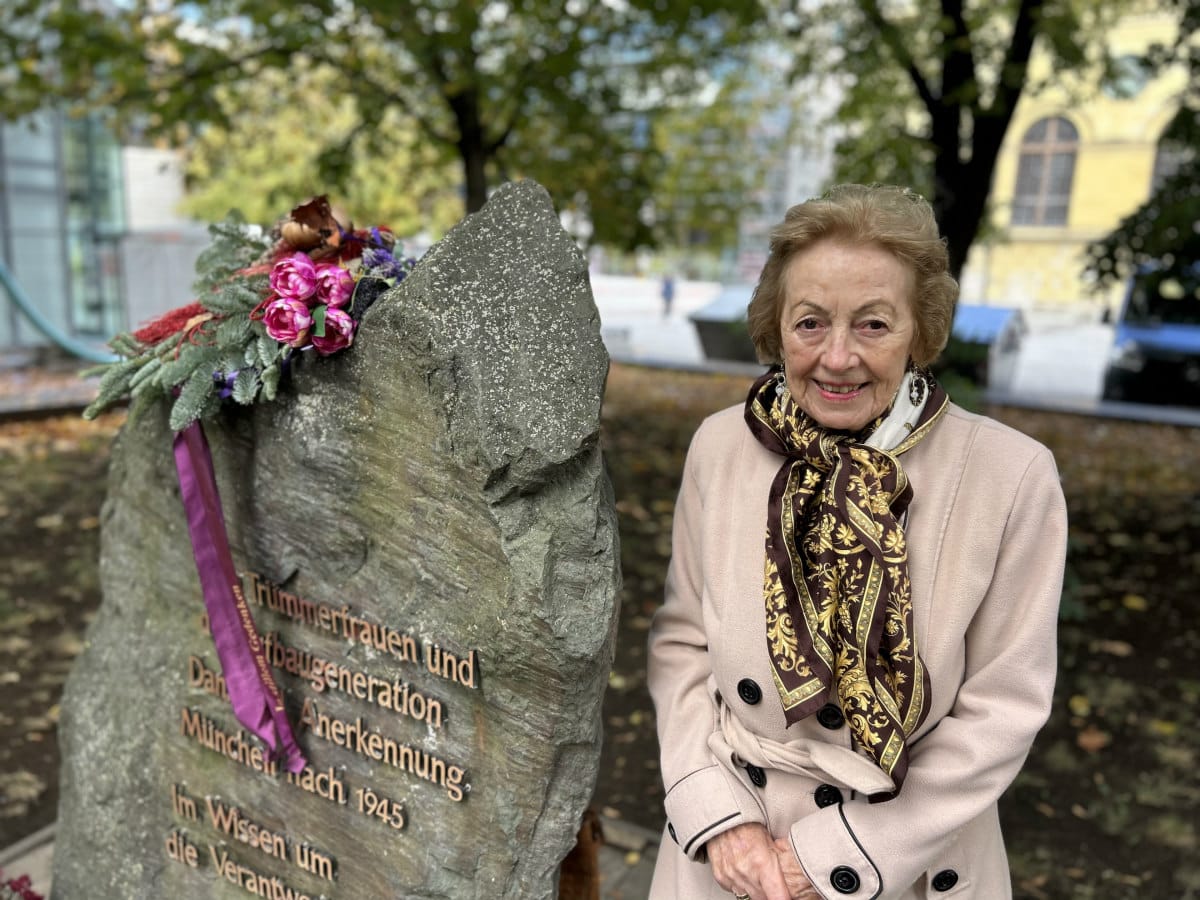
The monument is the result of a private initiative by Margot Günther, a woman born in 1937, who witnessed a decimated post-war city.
At a time when many cities lay in ruins, the monument’s solitude, contrasted with the continued care it receives, raises questions about present-day Germany and the collective memory, ultimately reflected in its public monuments: What transpires when the struggles endured by Germany’s past, particularly those of women, are left unacknowledged, while remaining mindful of the responsibility associated with the Nazi era? Will these silences become available for far-right movements to exploit?
Among Germans, many of these thoughts are often in private. Not for Margot Günther; her bold campaign for the monument arose from long-standing trauma, vivid memories, and a sense of responsibility she feels toward her mother and all the women who fought to keep their families alive and rebuild their lives after the war. A small board close to the monument describes the horrors of the war and national socialism and calls for “Never Again”.
Every year, fewer people remember Margot Günther, who, through hard work, took over the legendary Cafe Schmid in Munich in 1966 and turned it into a magnet for artists, journalists, and politicians, supporting many creatives as artistic expression and modern art flourished in Munich. After years of civic engagement, she couldn’t understand why no one was taking action to honor her mother’s generation. Thus, years later, she created an association to support the monument. In 2013, she received the city’s permission to place it in a public space; it was inaugurated on September 9 of that year.
However, shortly after the inauguration, a heated debate erupted in Munich, quickly politicizing the monument. Since then, it has faded from public attention; yet occasionally, flowers, a Ukrainian flag, or a letter can be seen at the monument, while Margot Günther has faced insults, with some labeling her a Nazi. Green Party state parliament members draped a cloth over the stone, embroidered in white letters that read “A monument to the right people, not to the old Nazis,” while members of the conservative party supported the monument.
The press spilled plenty of critical ink too. Journalist and historian Jakob Wetzel wrote in the Süddeutsche Zeitung that “these volunteers did not do the bulk of the clearing work, and certainly not by the so-called ‘Trümmerfrauen’ (rubble women).” Instead, he noted, German prisoners of war and members of the Nazi Party (NSDAP) mainly cleared the streets under the supervision of the US occupying forces. The Munich City Archives indicate that no more than about 1,500 people participated in a city-initiated rubble-clearing call, of whom only about 200 were women.
However, many female eyewitnesses like Margot Günther disagree. Most women initially cleared rubble at home in the years after the war: “We had other worries in those years than registering on some kind of list,” a woman later stated, referring to the article. She also confirmed that former National Socialists helped clear the rubble: “That was only right: Why should they have just sat around?”
***
In November 1948, American photographer Tony Vaccaro captured a woman with this camera, apparently sewing, sitting on the terrace of her bombed-out apartment in Mannheim. Had she cleared rubble? Perhaps she had, simply to secure shelter and some measure of comfort. Had she been a National Socialist? We will never know.
Women frequently recur throughout Vaccaro’s photographs: mothers with children, women supporting amputee men, women flirting with American soldiers. The postwar demographic imbalance was stark. In Germany, the ratio of men to women aged 15–45 fell from about 96 men per 100 women in 1939 to 72 per 100 in 1946. Millions of men had been killed, captured, or were still missing. “And some of the men available couldn’t help with the rubble because they were either injured or had lost some limbs,” Margot Günther recalls.
When the war ended, Margot Günther returned to Munich with her mother and sister, only to find their house destroyed. Two years earlier, they had fled to the mountains in Austria because their situation had become very dangerous. Her mother was born under the name Stern, a non-Jewish family, Günther says, but they were constantly monitored even though her father was employed by the state. Her mother had to show her papers every time she went out. In 1943, her father had hidden a Jewish citizen in their three-room apartment in Munich. “We’re not allowed in the room,” she remembers.
By the end of the war, around half of Munich lived amid ruins, and many went hungry. Gas, water, and electricity lines were cut, and the tram system was severely damaged. In the historic city center, the destruction was even more severe. Hundreds of thousands found themselves homeless. Margit Günther’s family moved into an apartment shared with two other families, occupying a single room on Schwere-Reiter-strasse in northern Munich.
“Under these adverse conditions, it was often women—widows and wives of missing or captured soldiers—who ensured their families’ survival, regardless of whether they were clearing rubble or not,” Günther explains.
She shows me an old newspaper clipping that she keeps in her apartment. In the photo, a woman in short sleeves holds a filled basket and a pan lid in one hand and a bag in the other. Behind her, rubble looms, and four women in coats stand with bags in their hands; one has a bike. “It was a very difficult time. We walked to school along the tracks of the Bocklerbahn tramway in Schwere-Reiter-Strasse, which transported rubble to a site in today’s Olympiapark, but also body parts from bombed-out houses,” she reckons.
Recommended Read: Open Houses #1: Monacensia Hildebrandhaus, Munich
Meanwhile, the day for the mothers revolved around finding food for the family. For little money, some women painstakingly removed bricks from broken walls and scratched their surfaces so they could reuse them in construction. No one would believe this without the numerous photos of women doing this arduous job.
In desperate times, “bread for bed” sometimes made it onto the menu. The extortion and rape of an estimated 2 million women at the hands of the Russian army remained a taboo subject in Germany for a long time. Only through books like A Woman in Berlin did this issue begin to enter the public consciousness. Many women died as a result of the torture inflicted upon them, or they took their own lives.
Antonia Meiner’s book We Rebuilt: Women’s Stories from Germany’s Zero Hour captures the struggles and experiences of eyewitnesses from that time.
Given the complexity of the collective memory, it is striking that the debate surrounding this public monument in Munich has focused primarily on who cleared the rubble after the war, rather than on the widespread hardship faced by women. Recognizing their hardships does not require overlooking possible complicity in Nazism, just as acknowledging that complicity does not erase their experiences of postwar hardship. Yet, the city’s recognition of these women’s efforts has been half-hearted, hard to believe in a city that has debated, during this year’s Oktoberfest, the light-dressed four papier-mâché figures on one of its famous rides, the Devil’s Wheel, and decided to dress them in cycling shorts and high-necked dirndl blouses. Yascha Mounk, a German-American political scientist, might be right in saying that Germany is engaged in “a psychodrama over its own history.”
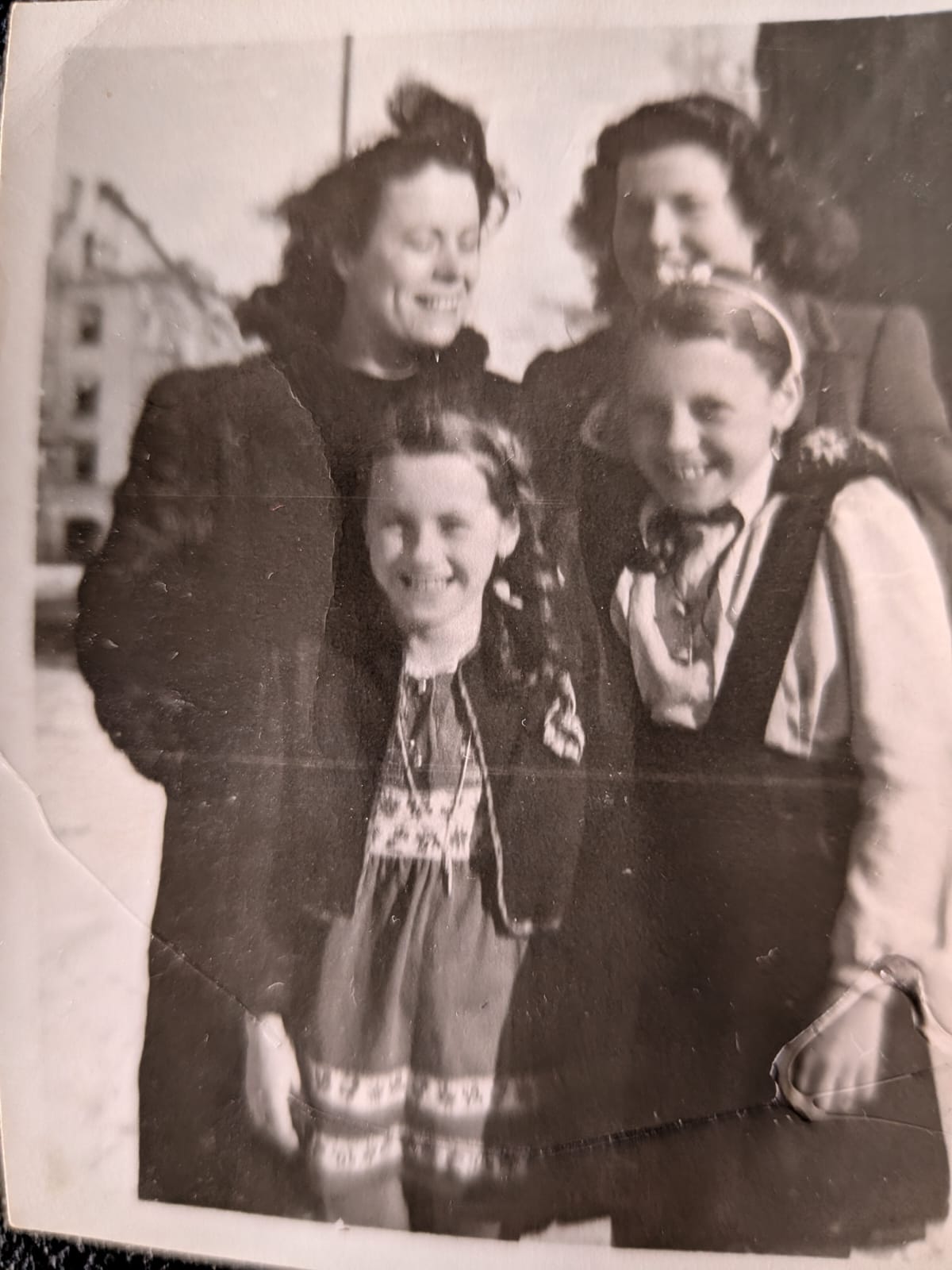
Some academics argue that enforcing silence, like opposing public monuments or neglecting collective memory about the post-war reconstruction of a country, can heavily backfire, in particular fueling the rise of far-right politics. When mainstream democratic societies fail to institutionalize or actively honor the historical efforts, sacrifices, and diverse contributions of those who rebuilt a nation, it creates an empty space—a so-called “memory vacuum.” Far-right political entrepreneurs excel at weaponizing these vacuums.
According to a report by the Berghoff Foundation, when the labor, hardships, and contributions of working-class individuals or specific regions—like the US Rust Belt, post-industrial Northern England, or East Germany—are omitted from the triumphant national narrative, people often feel invisible. Far-right parties capitalize on this sentiment by validating feelings of resentment. They tell these communities, “The liberal elite has forgotten you and erased your parents’ sacrifices to promote globalist interests or new immigrant populations,” effectively transforming historical neglect into a powerful grievance narrative.
“The pride people felt in their own lives was not honored, and people deprived of their pride are very easily tempted by political parties that start to talk about pride, grandeur and greatness,” political scientist Ivan Krastev remarked once.
Collective memory politics is a zero-sum game; neither silence nor public monuments are neutral. If democratic institutions fail to shape an inclusive, fact-based collective memory regarding who contributed to and sacrificed for the country, extremist movements will fill that void with an exclusionary, nationalistic myth. From this perspective, there is nothing wrong with Margot Günther’s public monument, which, without downplaying German guilt, emphasizes the hardships women faced and their achievements after the war—a small sign of pride, if you will, and of collective memory and identity, but important nonetheless. It seems more dangerous to overlook the contributions these women made for their country.