Listen to the audio version of this article (generated by AI).
“People are much more politicized than ever, but it hasn’t produced any major political change,” noted political scientist Ivan Krastev bluntly after the opening of this year’s Ars Electronica festival. At the same time, increasingly complex digital information ecosystems have become a defining force of our time, reshaping social and political life while deepening conflict and fragmenting public discourse.
Now, as the race to develop artificial intelligence accelerates, these social dynamics will inevitably shape how AI evolves—and, in turn, the future it helps create. But that future is not inevitable. That is why Ars Electronica has deliberately turned the urban fabric of Linz—particularly its main public square—into the space for human negotiation: democracy depends on precisely this —the ongoing, imperfect work of negotiating our shared future.
In 2025, global military expenditures hit an unprecedented 2.9 trillion US dollars, marking the eleventh consecutive year of increases, according to the SIPRI Military Expenditure Database 2026. Meanwhile, hard-won advances in equality, climate initiatives, and social infrastructure face mounting challenges.
This sets the stage for Flood the Zone with Courage, which happens in Linz’s main square, where innovative forms of protest, rooted in artistic endeavors, intersect with civic engagement. They confront us with contemporary fears, ask us to consider our responses, and invite us into concentrated moments of action. While people debate AI, algorithms, power, democracy, and our future inside museums, churches, and other buildings across the city, public art serves as crucial infrastructure for democratic negotiation in a public space that genuinely belongs to us all.
This might have been bad news for those who prefer to discuss ideas in isolated cultural bubbles, but Flood the Zone with Courage has left more oxygen for democratic negotiation with the public – and greater space for respectful disagreement and collective courage.
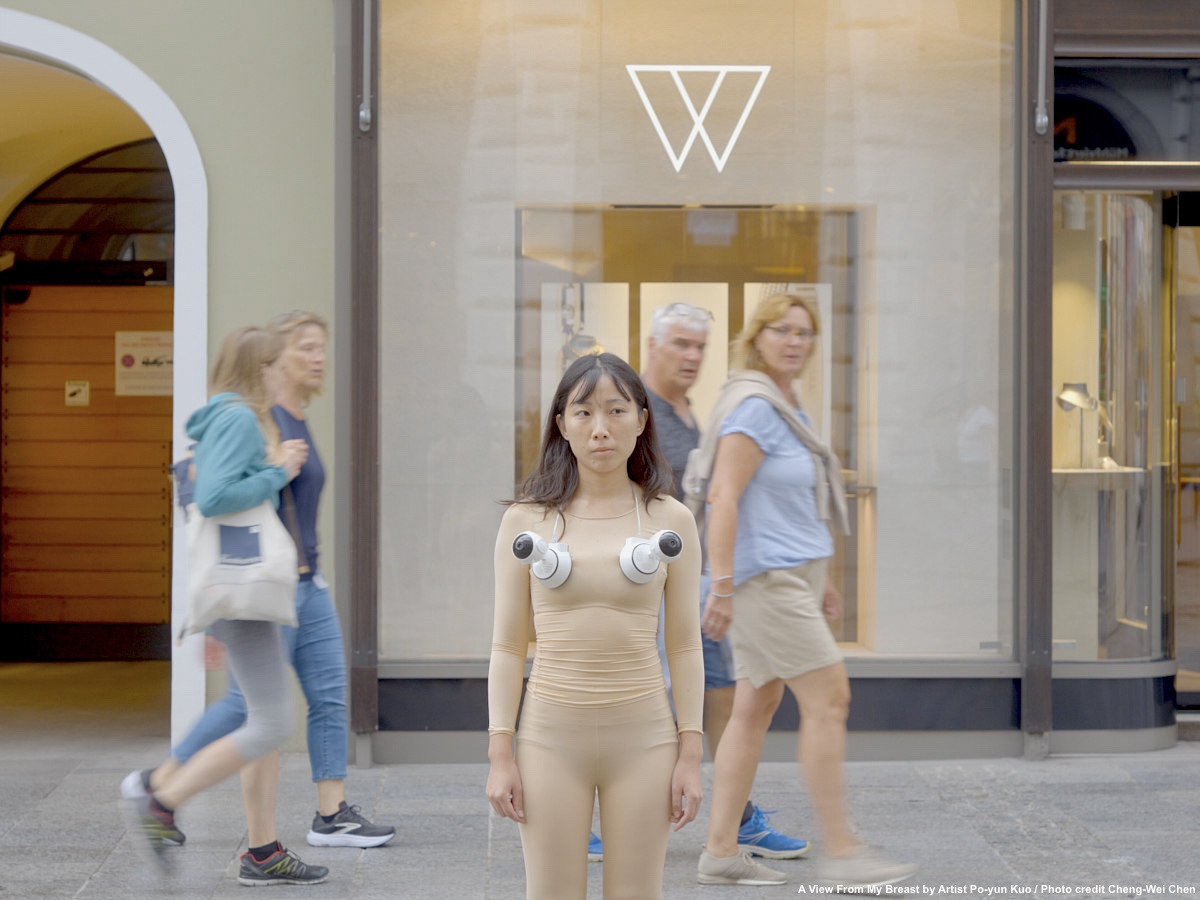
Perhaps the biggest act of courage has been A View From My Breasts, a deeply provoking surveillance exercise with cameras at the breast level of Taiwanese artist Po-yun Kuo. Dressed in skin-tight, nude-colored clothing that exposes the female body, she invites the audience to follow her on a 15-minute walk throughout the city, pausing to engage with passersby in public spaces.
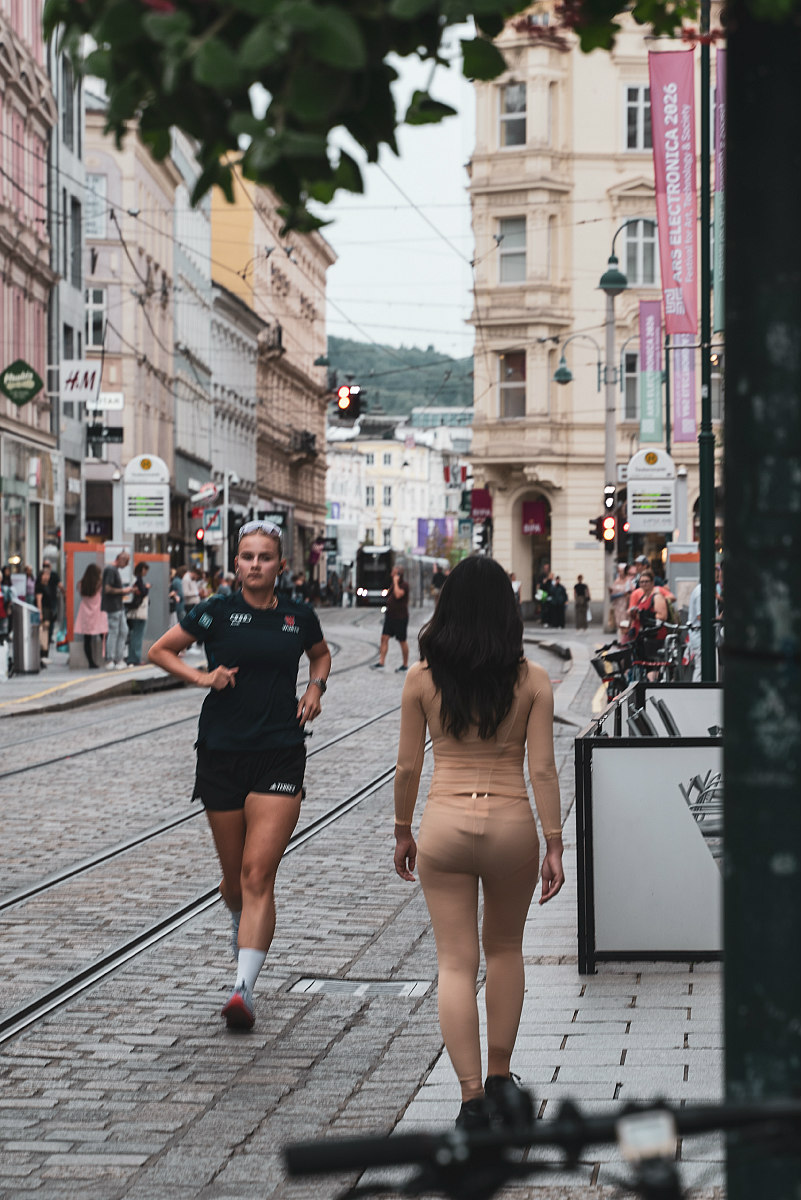
By using a body part traditionally subjected to a gendered gaze, especially in Taiwan, Kuo transforms this experience into an interface of looking, rendering the female body both a surveillance apparatus and a site under surveillance. The work responds to everyday imbalances of viewing, exposure, and power, blurring the line between the passersby she records with the cameras and the human gaze that scrutinizes her, ultimately revealing a delicate balance of who holds power in such interactions.
Alongside her artistic practice, Kuo is a documentary and experimental film director who tells me she wanted to break the boundaries of the screen and use her body in public space to provoke reaction and expand the concept of democracy. She observes that the responses to her work differ between locations: “In Linz, people feel curious and amused, while in Taipei, they tend to be offended when confronted with a critique of the male gaze, often asking, ‘Why do you want to film me?’” Kuo intends to create discomfort, drawing attention to how shifts in space reflect power dynamics and social hierarchies.
Recommended Read: Kiel’s Quiet Revolt Against Big Tech
The theatre collective Electrico28, based in Barcelona and Graz, provided one of the most captivating experiences: a connection with the mundane in public space while confronting us with a broader reality. In their performance Reality Screenshot, participants sit in a cinema-style arrangement inside a narrow street that opens into the main square, which acts as the big screen. This screen presents a “Human Artificial Intelligence” made of flesh and bones that observes and interprets everyday behaviors, curiosities, and social tensions present in public spaces. The audience becomes immersed in a unique experience characterized by radical simplicity and presence: a static audience, fragmented dramaturgy, performers without defined characters, and a nearly impossible mission: capturing the “constant present of the everyday” as a silent (and somewhat forgotten) political gesture.
These observations are enhanced by continuous data provided in collaboration with Domestic Data Streamers, which audience members listen to through headphones provided by the crew. For example, a person wearing jeans passes by, and the narration explains, “This pair of jeans used the same amount of water that this person will drink in ten years.” Sometimes the data evokes awe; other times, it elicits laughter, leaving passersby wondering why a group of people with smiles is sitting in chairs on the street staring at them.
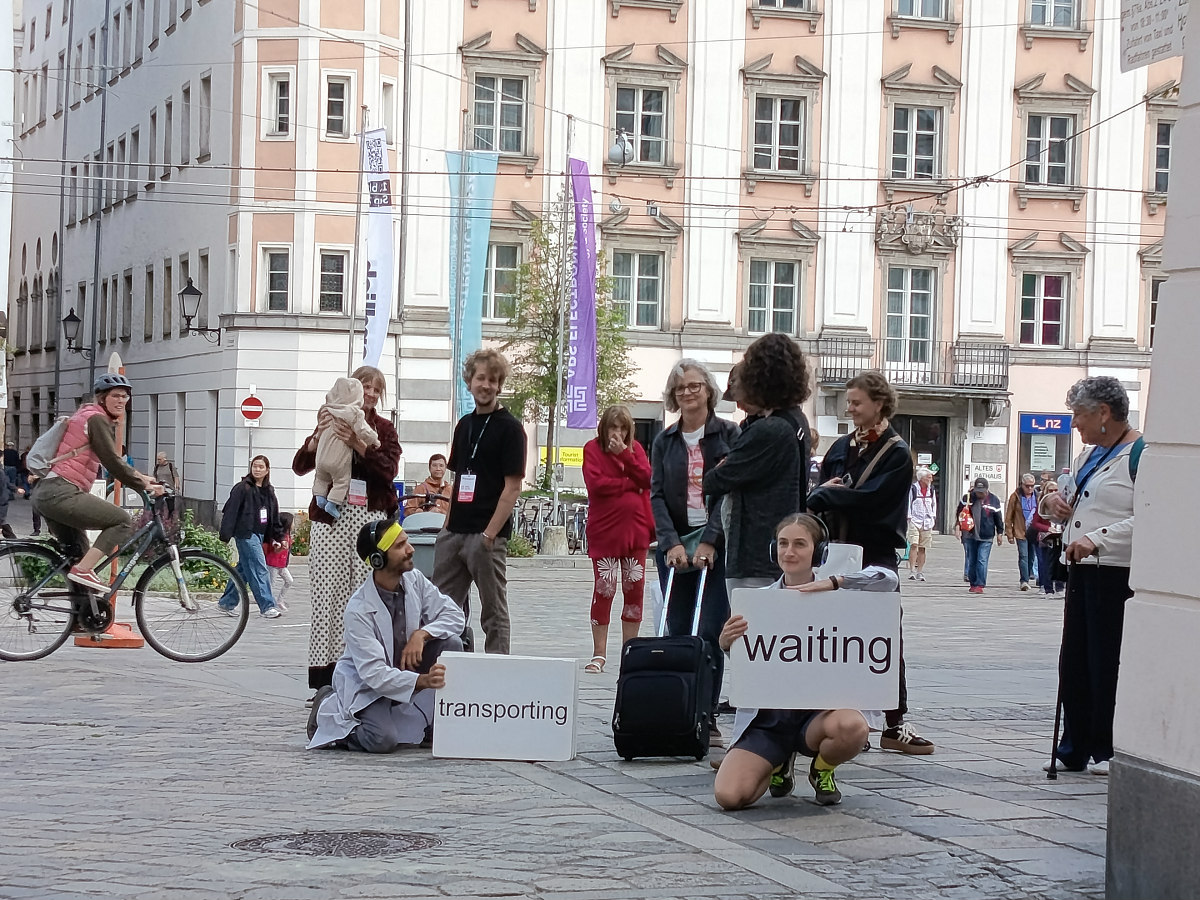
“We always create in and for the street, with humor and love,” says Josep Cosials, founder of Electrico28. “The street is our source of inspiration and connection. This translates into a perspective centered on lovingly observing our surroundings and integrating them into our dramaturgy. We are interested in launching our projects from what we find inspiring in public spaces, including their dynamics and stories.” By blending street theater with data visualization, their performance encourages audiences to reflect on perception while transforming the city into a living stage for emotion, participation, and discovery.
“Through the lens of Domestic Data Streamers, we’ve uncovered nuances and new layers to deepen our understanding of the everyday,” adds Josep Cosials. “We live surrounded by data that should help us understand reality. Yet, when we are overwhelmed by information, there’s little room for comprehension or empathy. Reality Screenshot seeks to bridge the tangible reality with everything we know about the world—much of which, for many reasons, we struggle to accept.”
Indeed, this information overload has left many people unable to “distinguish an opinion piece from a factual one,” says Alexander Sängerlaub, CEO of a think tank, referring to a study conducted in Germany. In this context, disinformation is increasingly used to deepen social divides, undermine trust, and advance geopolitical interests. The dangers of separatism grow more pronounced when our world knows not one truth but many, all claiming validity at the same time; the spaces for thought and action narrow as well.
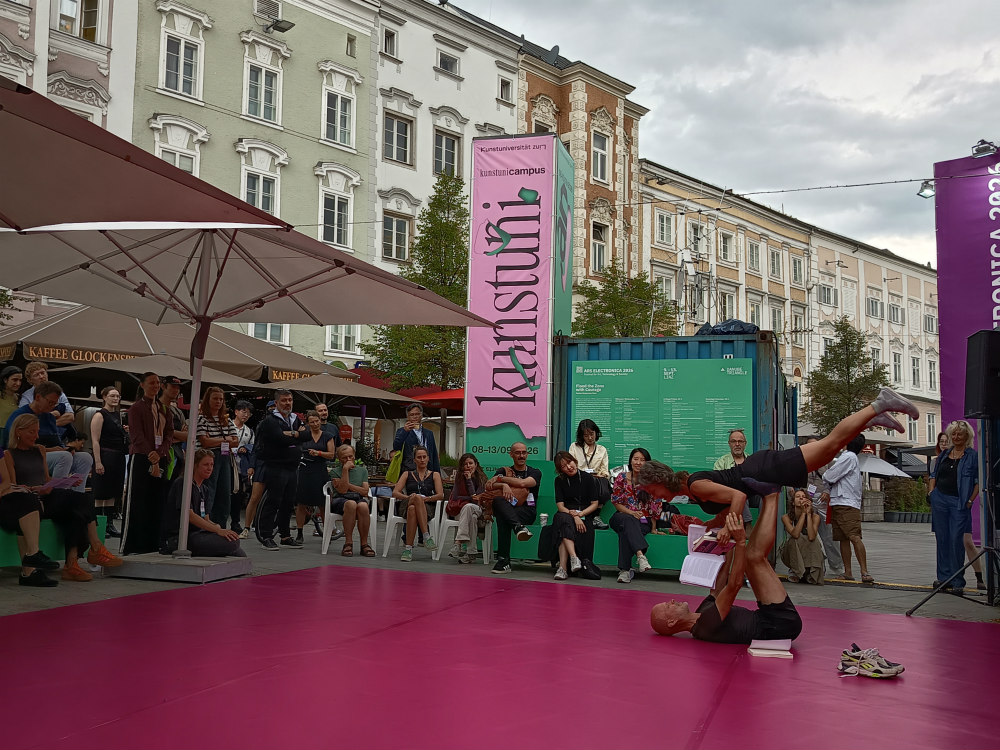
Greek artist Lia Giannakou engages audiences in her performance Simple Human, which explores the act of reading in public spaces. As she moves around with two books, she struggles to manage them both at once, readjusting her movements in search of a comfortable position. At times, the books feel heavy, and she experiences extreme heat, using them as makeshift fans or letting them fall across her face in an act of near suffocation.
Recommended Read: We Reported on Tehran’s Defiant Djs and Artists. Now, at War, They’ve Fallen Silent
Audience members are invited to join Giannakou in reading or to witness it. However, when one person in the audience deeply engages in reading alongside her, the boundaries of connection become apparent, rendering conversation impossible. Today, many such reading encounters happen online, in digital spaces filled with emotional comments on social media. In these environments outside the public space, disagreement can easily lead to polarization and fragmentation that undermine our democracy. As political scientist Ivan Krastev notes, “The more you discuss with people who share your opinions, the more radicalized they become. Changing minds becomes really difficult.”
In the interactive installation Hello Futures Manifesto, located in the main square, personal visions of the future are transformed into vivid posters. I observed numerous young participants entering a container equipped with a large screen and a machine. They are invited to discuss what kind of humanity we aspire to become and what responsibilities arise as AI increasingly influences society. The conversations were recorded, transcribed, summarized, and then converted into posters using generative AI, which the participants hung on the walls.
The colorful posters, each conveying a unique message, illustrate that the future is not a fixed prediction but rather a shared process shaped through encounters, collaboration, and negotiation. One poster reads: “Effective altruism: Everyone’s responsibility to give,” while another states in German: “AI as a destroyer of creativity and lived realities.”
Recently, AI leaders have called for a pause as systems begin to act autonomously at a pace that may surpass the conditions necessary for democratic life. Meanwhile, some Big Tech companies that hold the infrastructure have shown that they do not always align with our interests and can dominate our worldview. Look up Lake Ontario on Google Maps and there (in parentheses, admittedly) are the words: “Lake America.”
As Ivan Krastev points out, “The democracy discussion has always been a conversation in crisis.” Now, it’s time to negotiate our relationship with technology and the vision of humanity we desire. In light of a bleak future described by author Douglas Rushkoff during the “Tech-Bro-Topia” symposium at Ars Electronica, he also offered a glimmer of hope: “Let tech bros have the virtual world; we still have each other,” urging us to reclaim our humanity in this digital age.
Democracy has always relied on spaces where differing perspectives can converge; the public space has been, and continues to be, vital in this regard—and it belongs to all of us.