
Listen to the audio version of this article (generated by AI).
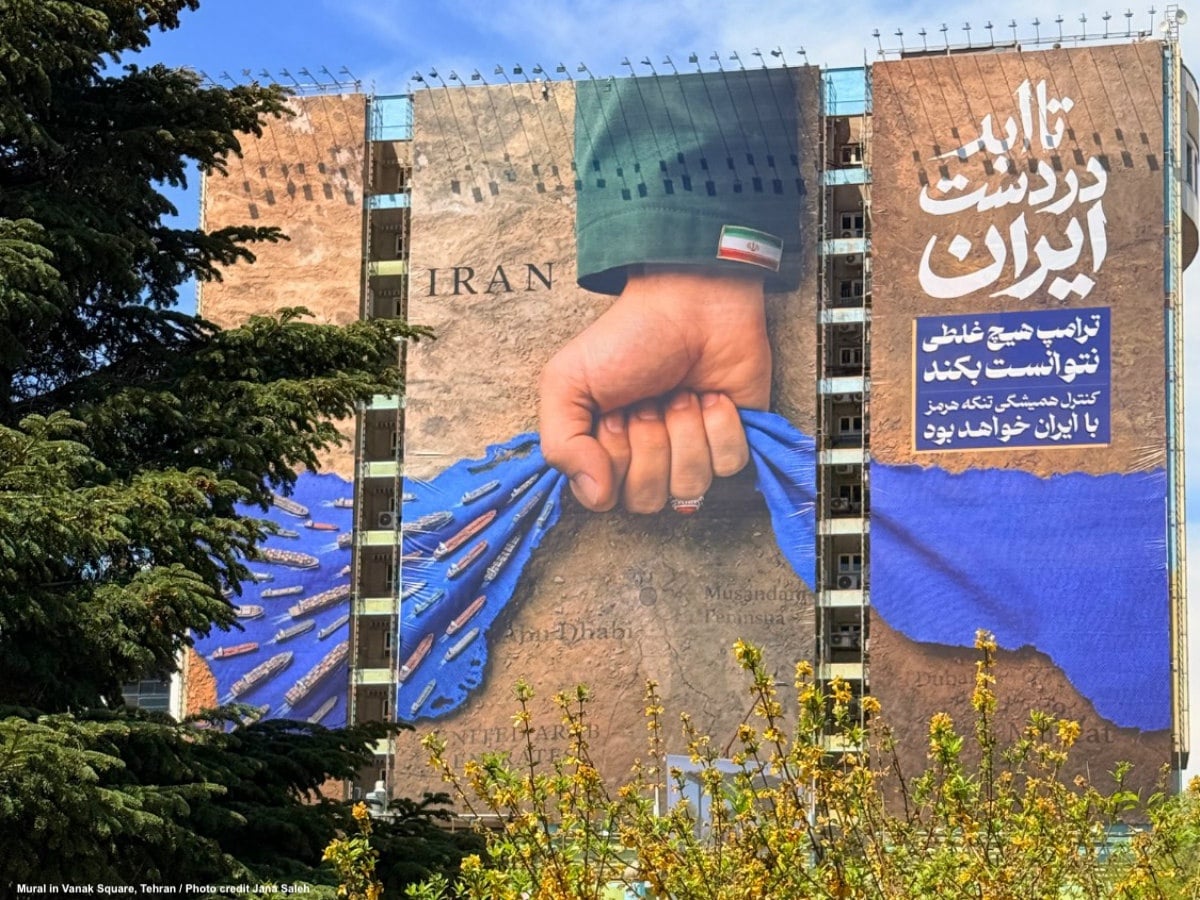
At Valiasr Square in central Tehran stands one of Iran’s most closely watched printed murals, changed so often overnight that it functions less like a propaganda tool and more like a running commentary on the political temper. When American drones were shot down over the Strait of Hormuz during the recent war between the United States and Iran, within days, a new mural appeared showing an Iranian fisherman casting a net over an aircraft as prey caught over Iranian waters. Above the image, the words read: “The hunter who was hunted.”
When Iran’s women’s national football team returned from Australia rather than stay abroad, their portrait went up on the same wall. “We feel a real sense of pride seeing national events show up on that wall,” said Arezoo, 38, whom I interviewed near the square. She added that, unlike in past years, women now regularly appear on the mural as well.
Often photographed for mainstream media political reports on Iran, murals across Tehran reveal a far more complex landscape of the national mood. While some promote pro-government propaganda, others convey political messages that can provoke thought—and sometimes surprise—among Western observers. Some invoke controversies such as the Epstein files, while others depict Trump taking orders from Israel. Others challenge the political establishment, as street art might be expected to do.
If we assume that street art is necessarily anti-establishment, and so are the artists behind it, Tehran complicates that distinction. The contrast between the two worlds is stark: one operates through institutional approval, identifiable artists, and planned production; the other can emerge anonymously after dark and disappear just as quickly. Yet both strive for the same thing: visibility on the city’s walls—only under radically different conditions of permission, permanence, and risk.
Together, they raise a set of questions: Who are the artists behind these murals? And what does the delicate balance between commissioned murals and clandestine graffiti reveal about the ways visibility, memory, and control are negotiated between the state and the public?
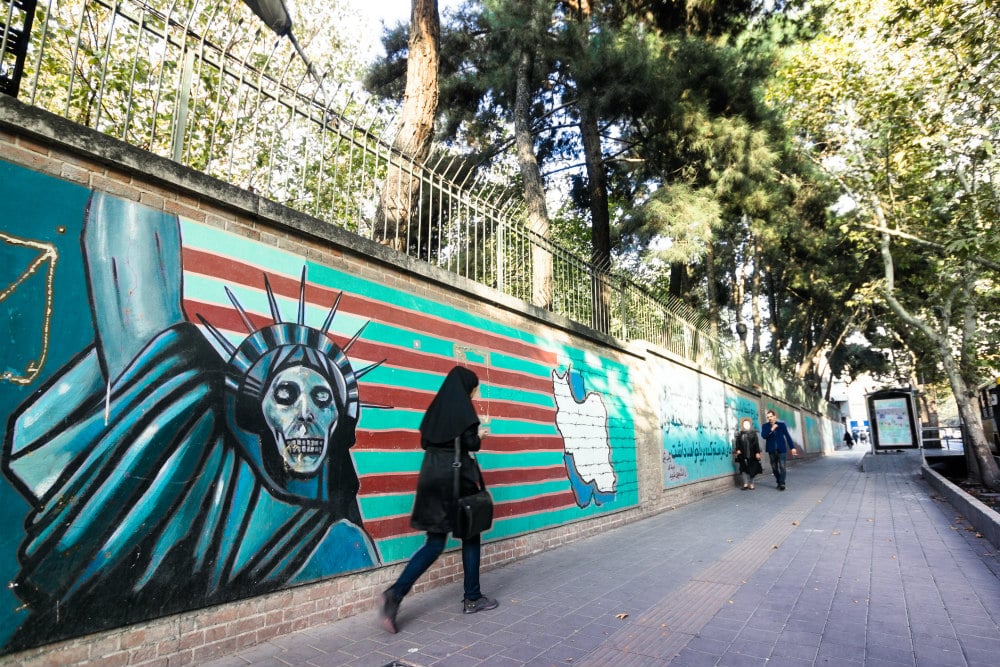
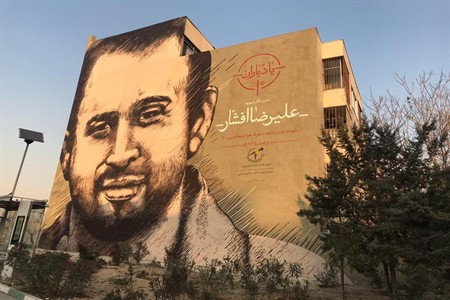
The Valiasr Square mural has been in continuous production since Bahman 1391, or early 2013, according to an official at Tehran Municipality’s Urban Beautification Organization who spoke on condition of anonymity. More than 50 designs have been created, printed and installed at the site since then, the official said, describing the wall, which measures 18.5 by 47.5 meters, as the largest printed mural in Iran. Content changes as fast as institutional approval allows. Five specialists work on each design from initial concept through execution, and every design goes through several rounds of quality review before approval. The work continues through the House of Designers of the Islamic Revolution, a body largely staffed by young designers.
“When we’re doing our own design work, we usually do it during the day,” said Amirhossein, a designer who works officially with Tehran Municipality. “But when a piece needs to be printed, we send it to a print center. They take a design that’s already been finalized and print it, and then we install it on billboards or on the city’s main murals, Valiasr Square and Enghelab Square.” Amirhossein noted that officially commissioned murals in Tehran do not necessarily reflect the personal political views of the artists involved. “It’s part of our job,” he explained. “I’m not a political person myself, and I don’t follow much of what is said in the media about politics. Some people on my team have criticized economic policies, cultural issues and other things, but that doesn’t mean we have to leave our jobs.”
For Amirhossein, disagreeing with certain policies does not automatically put an artist in opposition to the state or compel them to pursue unauthorized work. “This is the art we know and the work we do,” he said. “Even if someone disagrees with many of the rules, that doesn’t necessarily mean they are in opposition or that they have to work outside the system. We work within the law. Nowhere in the world can everyone simply do whatever they want. When you work with an official institution, naturally you have to follow the laws of that country.”
Recommended Read: Music Gigs in Tehran Defy Iran’s Cultural Red Lines
Recommended Read: We Reported on Tehran’s Defiant Djs and Artists. Now, at War, They’ve Fallen Silent
The municipality draws a distinction between large official murals and billboards under its control and smaller, independently painted works found elsewhere in the city. According to the official, artists working on major murals and billboards in Tehran must receive approval, and the Urban Beautification Organization keeps their professional records in its system. However, when individuals independently paint street art on other walls, the municipality typically does not intervene unless the work violates the law or societal or cultural norms.
This institutional role is not limited to deciding what can appear on a wall. Mehdi Mazhabi, head of Tehran Municipality’s Urban Beautification Organization, has described the organization’s broader approach to public space as an effort to develop an Iranian-Islamic model of urban culture and citizenship, using public spaces to strengthen the city’s identity. He noted that murals and sculptures should draw on national culture and religious values, allowing Iranian identity to be reflected in the physical fabric of the city. According to him, Tehran, as Iran’s capital and largest metropolis, should function as a “living exhibition” of Iranian culture, civilization, and Islamic values.
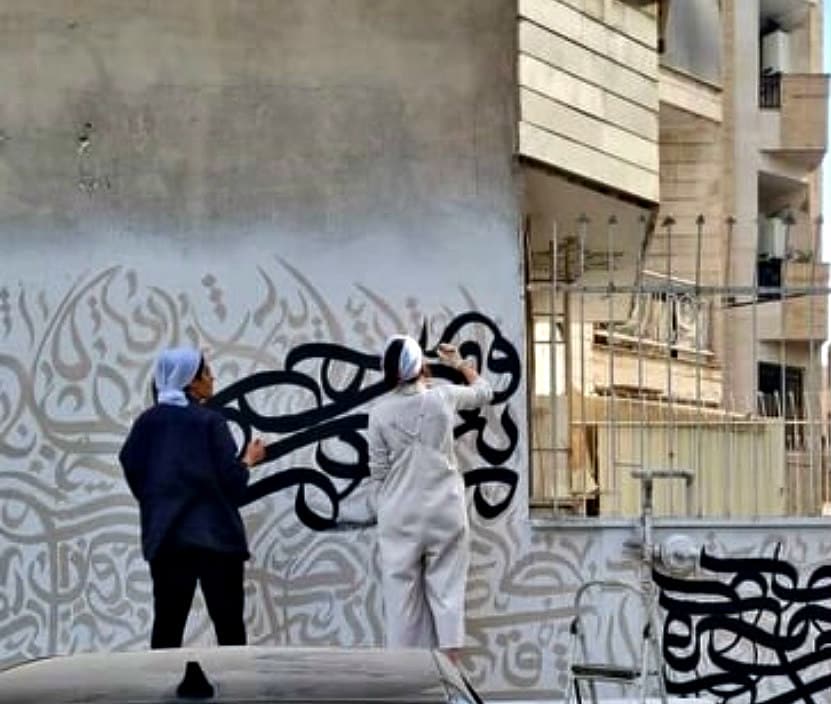
Outside the two flagship squares, freelance artists working on houses and large walls across Tehran described a process that sits somewhere between official sanction and open improvisation. One freelance graphic designer said such work is usually coordinated directly with the manager of the residential area where the wall is located, or requires a permit and a proposal with a preliminary design from Tehran’s Urban Beautification Organization.
“Everything is done on a freelance basis,” said Ali, one such artist, “but whatever gets painted has to be consistent with the country’s laws.” This arrangement allows freelancers much more room for personal initiative in Tehran than the designers working on murals on Valiasr Square, although municipal regulations and political views still constrain their freedom.
Sasan, another freelancer who asked to be identified only by his first name, described an informal code within the scene: a completed mural should carry the artist’s name and phone number somewhere on the piece, both as a kind of signature, so that potential clients can contact the artist. Leave that off, he said, and a mural that doesn’t conflict with the law will typically stay up unless someone complains to the municipality. However, murals that do conflict with the law can be removed quickly, regardless of whether the artist signed it. Therefore, the distinction between commissioned and unauthorized work hinges more on who owns the wall and whether anyone raises objections than on the artwork itself.
A more clandestine layer of the city’s wall culture operates in the enforcement gaps these rules create. Reporting for this story led me to a spray-paint artist who goes by the pseudonym Behzad. He has been drawn to painting on city walls since he was 16.
When asked about the history of graffiti in Iran, Behzad noted that it lacks the extensive documentation found in many American and European countries and that few sources or references are available on the subject in Iran. Nonetheless, he mentioned that some evidence suggests graffiti began to emerge in Tehran during the late 1370s and early 1380s, the late 1990s and early 2000s on the Western calendar, pointing to early examples painted in the Ekbatan and Apadana neighborhoods, an emergence he tied closely to the rise of Iran’s underground music scene and growing interest in hip-hop and rap.
When questioned about why he continues to work in secrecy, knowing his pieces could be painted over at any moment, Behzad described what he calls “the hidden world of Tehran graffiti” in three parts: first, hidden identity, as most graffiti artists use pseudonyms to avoid being identified; second, the voice of a younger generation, where walls serve as an outlet for personal grievances and protests that artists may not feel free to express through formal channels; and third, dependence on social media, as photographs of fleeting pieces are shared on Instagram and other platforms long after the walls have been repainted.
This hidden world became particularly visible during the protests that followed the death of Mahsa Amini in 2022. Pouria, a 25-year-old graphic design graduate who asked not to be named due to possible repercussions, said the protests were the first time he started putting his work on Tehran’s walls. Working with two friends, he created a stencil of Amini’s face and used spray paint to reproduce her image alongside the slogan “Woman, Life, Freedom.”
He usually ventured out around 11 p.m. or midnight, wearing a cap and mask to conceal his identity. His friends helped prepare the stencils and decide on slogans during the day, and sometimes one of them accompanied him at night to keep watch. Because he was using spray paint and stencils, each piece took about five to ten minutes to complete. On some nights, he would manage to put up between 20 and 30 images and slogans.
“The next day, I would go back and check whether they were still there,” Pouria said. “Out of the 20 or 30 I had done, sometimes several had already disappeared. They had either been removed or sprayed over.”
Not all of the images disappeared immediately. In Bagh-e Sib, an old and relatively quiet neighborhood, Pouria noted that one image of Amini, accompanied by the words “Woman, Life, Freedom,” remained on a wall for about a month. He returned regularly to check whether it was still there. One Monday evening in January 2023, on his way back from the gym, he found the image still intact. However, when he passed by the same wall the following day, he saw that it had been covered over. He did not witness who removed it.
Pouria continued painting from September until around December 2022. As the protests subsided and, according to him, security restrictions tightened, it became more difficult to go out at night. When he revisited the spots where he had painted in January, he found that the works he had created had either disappeared or been covered over.
Nonetheless, their removal from the walls did not mean the images were gone altogether. Pouria filmed some of his work while concealing his identity and posted the videos on an anonymous Instagram account, where they received likes and supportive comments. Like Behzad, he saw anonymity as a form of protection and never signed his pieces.
“I wasn’t trying to get recognition as an artist,” he said. “I just wanted to feel that I had contributed in some way to what was happening.”
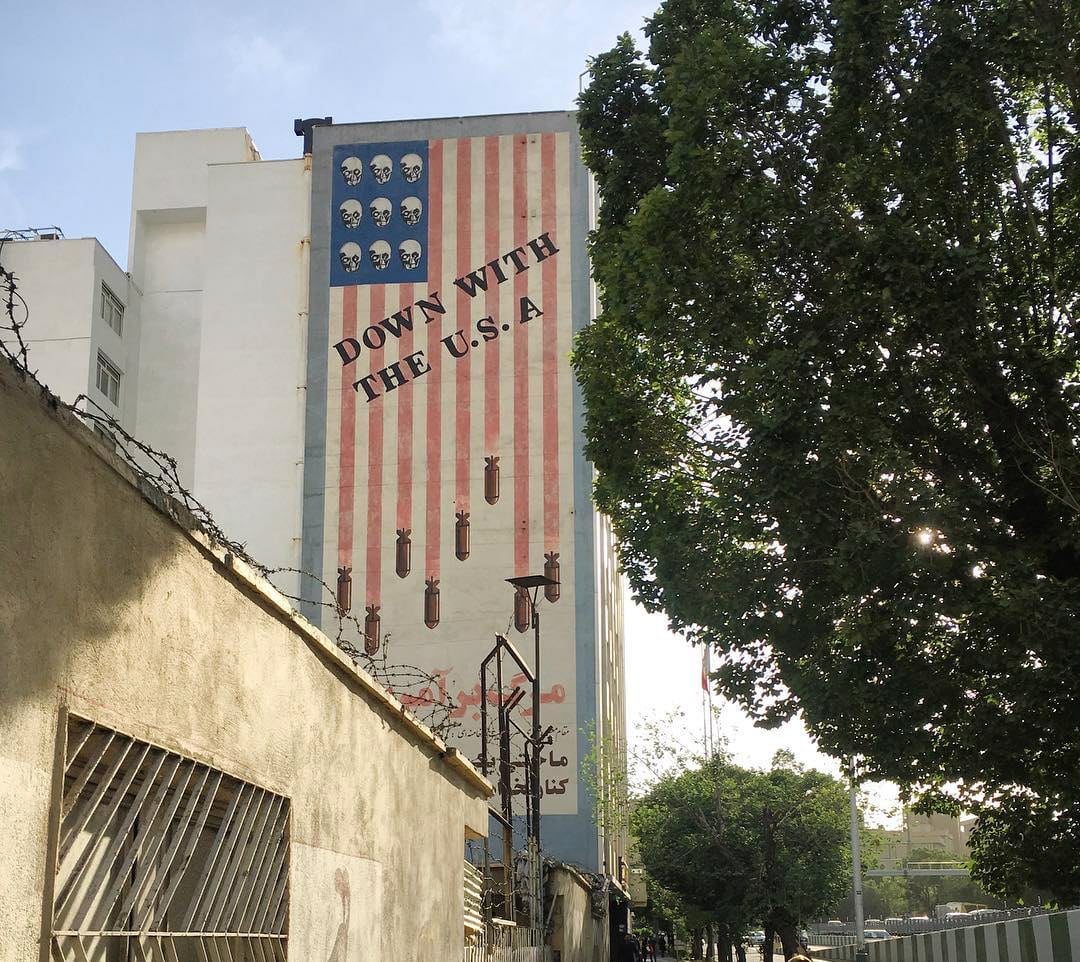
Hassan, a visual-arts instructor who teaches 24 students in Tehran’s Qeytariyeh neighborhood, offered a broader defense of graffiti. “It covers an enormous range of messages and imagery, from peaceful and romantic images to obscene text and pictures,” he said. “That’s exactly why graffiti can’t be judged as simply good or bad.” During the 1980s, Keith Haring used simple, bold figures in New York subways to protest government neglect during the AIDS crisis and apartheid in South Africa. One of Tehran’s most recognizable political murals, painted around 1980 on Karim Khan Zand Avenue, likewise uses the visual language of street art to deliver a political message: it replaces the stars of the American flag with skulls and its stripes with falling bombs. The mural remains, though its original artist remains unidentified.
Street art has long held the power to challenge authority and political and social systems. However, when that challenge comes from a state confronting a Western power, the meaning becomes more complicated. In Iran, a form traditionally associated with dissent can also serve as a vehicle for official political messaging.
Ordinary Tehranis have learned to read the billboard at Valiasr Square almost like a headline. For Arezoo, the recent inclusion of women’s images in Tehran murals, alongside the usual mix of political and national subjects, is part of the story the country tells.
This shift does not necessarily reflect public opinion; rather, it represents an official decision about which aspects of public life are visible. Because this decision plays out on one of the city’s busiest surfaces, it influences how Tehran experiences its own history in real time. Whether produced by a five-person design team going through an institutional approval process or sprayed overnight by an anonymous artist who knows the work could be painted over in days, Tehran’s walls amount to the same wager: a wall, more than a statement or a broadcast, is where a nation’s mood becomes visible fastest, and whoever controls the wall has some claim, however contested, on controlling how that political mood and the winds of change are read.
This story was published in collaboration with Egab.