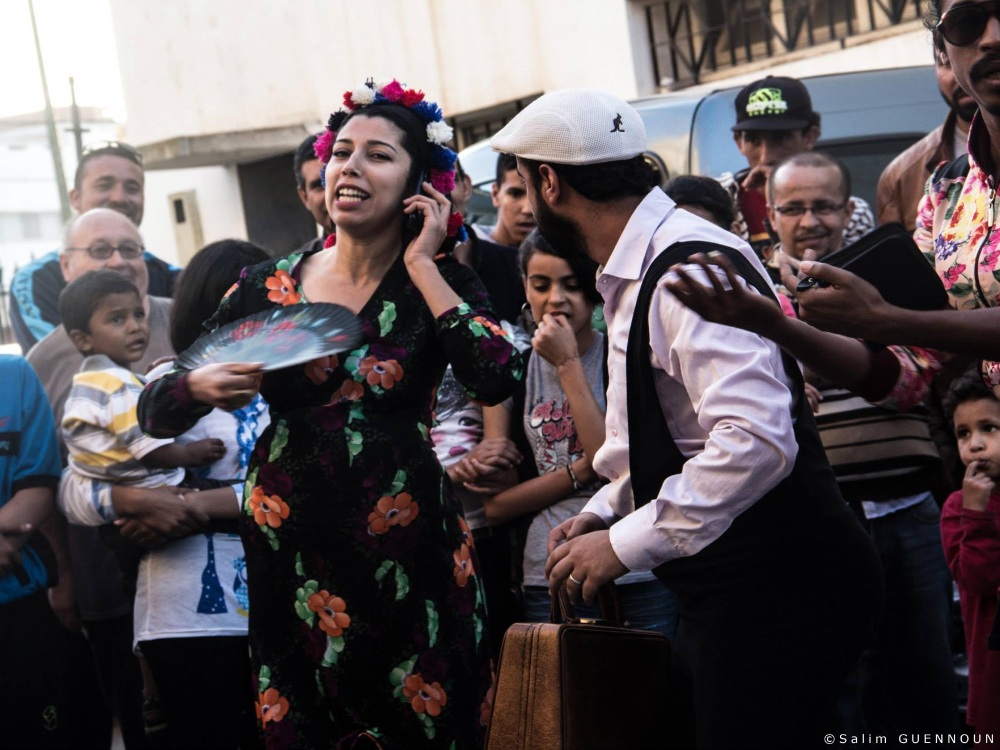
Few people know that a feminist, engaged theater is located in one of the alleys of the popular working-class district Akkari in Rabat, known for its markets for vegetables, meat, spices, and a second-hand market, all in the midst of traditional houses and mosques. The nonprofit feminine Aquarium Association, founded in 1994, is a theater company that has been part of the city’s cultural life for years, raising and advocating for the freedom of female expression in Rabat and other Moroccan cities.
Its anchoring in the Akkari district is a choice, far from the city center known for its cultural activities. A choice that aligns perfectly with its philosophy.
To merge with the population, because we believe that the theater is a collective art par excellence, full of sensations, listening and understanding, says Naima Zitan, founder and director of the company.
Born in 1967 in Chefchaouen, Naima Zitan has had an artistic soul since her birth. She joined the Conservatory of Music and the Chaouen theater at age thirteen, then the Higher Institute of Dramatic Art and Cultural Animation in Rabat. After earning her diploma in 1994, she founded Théâtre Aquarium.
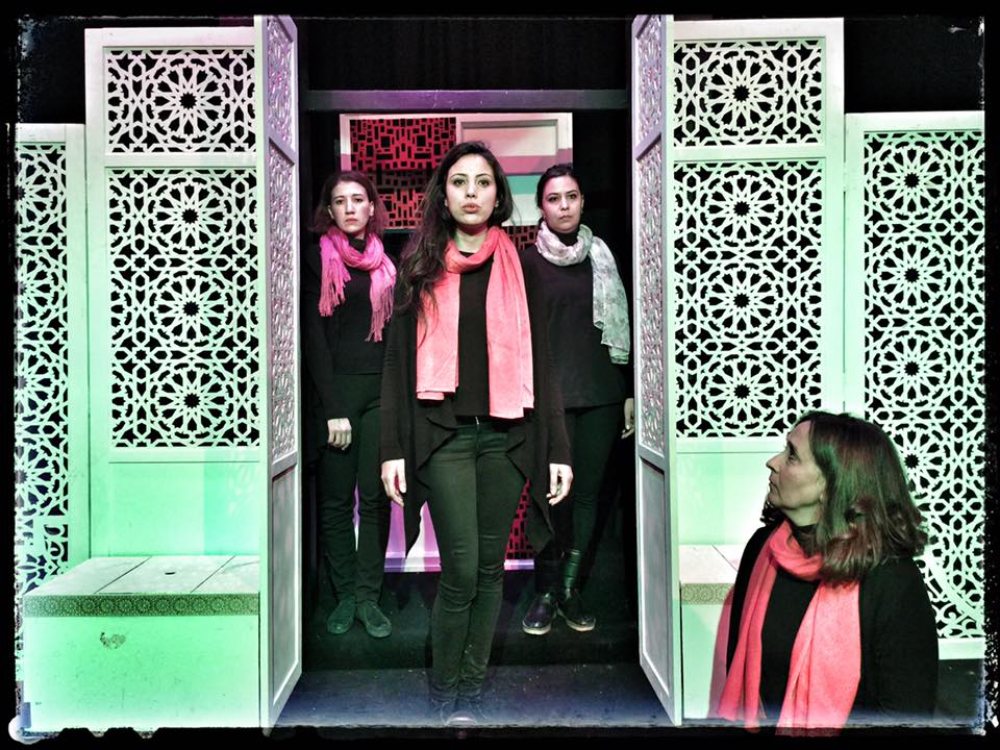
Since its creation, the commitments of Théâtre Aquarium have been clear: to implement the notion of gender equity through art and culture, to denounce all forms of discrimination and violence against women through creation, and to encourage the democratization of society through debates and theater plays. Thus, for more than 25 years, the company has been active in creating a new play each year and touring to the small towns of the Kingdom, such as Lif may N’qot (2001) which with a dramatic humor raises the subject of illiteracy, especially among women; Chaqaiqou Annou’aman (2004), which delves into the Moudawana (the family code) and problems that women face, a work encouraging the urge of legal reform. And also Tata M’Barka (2008), which raises the problems of domestic workers who are cashed in like cattle by their families and who, in their “spare time,” find themselves sexually abused by their employers.
Cities are places of opportunity and liberation, but in Morocco patriarchal cultural codes impede the feminization of public space. By speaking openly about several topics, this feminist theater empowers women’s freedom beyond closed doors, in public spaces where women are at all times harassed and suffocated.
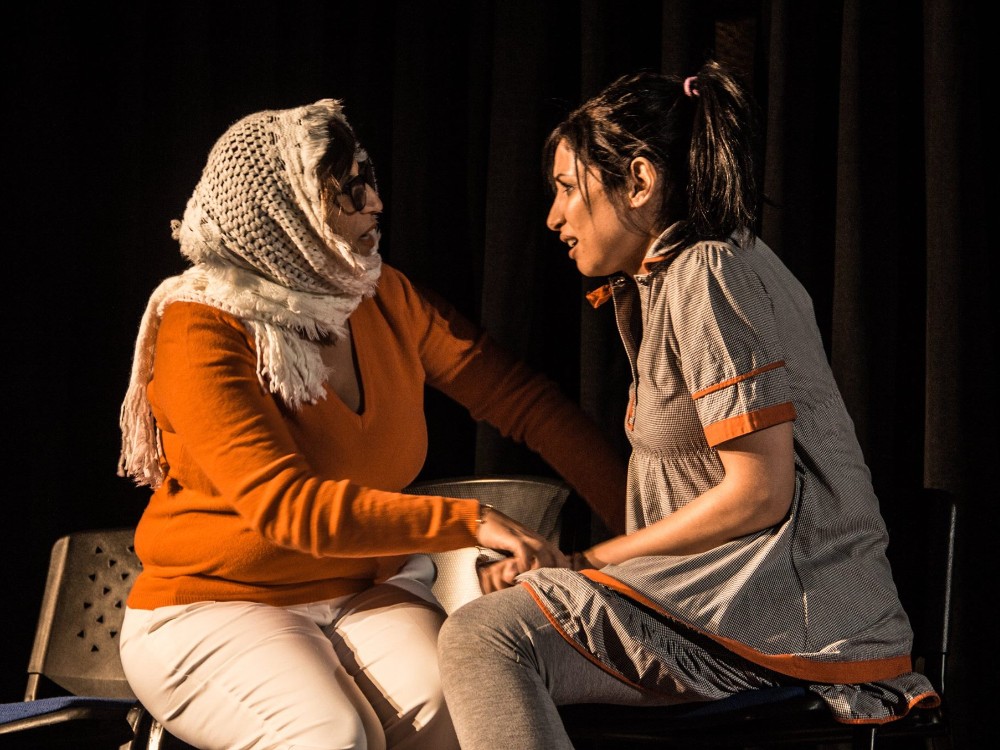
I knew the Théâtre Aquarium for its theater productions, but also for the reputation of its members: serious, combative, and undeniably human in their relationships with others. Several theater companies exist in Morocco, but it’s rare to find one that stays constant and rigorous in both its activities and its creations. You just have to observe its members: the same team working together for years, active in the artistic field but also in the public space. Each time there’s a protest in front of parliament for human rights causes, there they are, as citizens and activists.
There is a sexual revolution, but it is happening underground
In 2011, I joined this great team to co-create a project on female sexuality. It was a project that made the Théâtre Aquarium visible, becoming known by everybody as a feminist theater, to the point of being threatened with death by berserk conservatives.
The idea was to make Théâtre Aquarium’s space a meeting place in the city for the freedom of female expression about sexuality. For eight months, we welcomed women from all horizons and different ages to participate in round tables, evenings, or afternoons hosted by female artists. We discussed our sexuality and our intimacy, which is often secret and taboo, but which traces the lives of each of us.
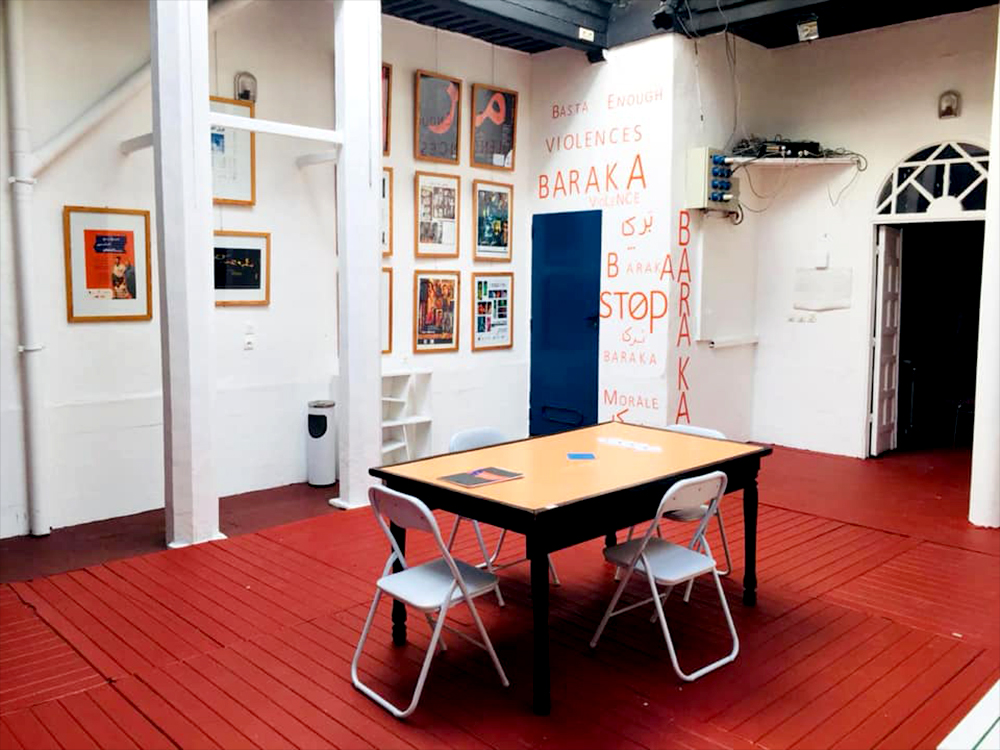
During this process, we remembered a Moroccan tradition called “Achiya” (translated as “afternoon), a tradition where the women of the family gathered for an afternoon to dance, to drink tea, be coquettish, and where taboo subjects were also discussed. Through our approach, I realized that discussions between women, older and younger, have existed for a very long time within our culture. Women’s expression has its place in our society, only in private spaces.
Yet we have forgotten this habit because of a new urbanized way of life and a more individualistic culture. We lost our private space, and hence we started to be alone. Our discussion sessions at Théâtre Aquarium brought back to life women’s cohesion in the busy city, and, above all, women’s freedom to express their feelings, whether painful or joyful.
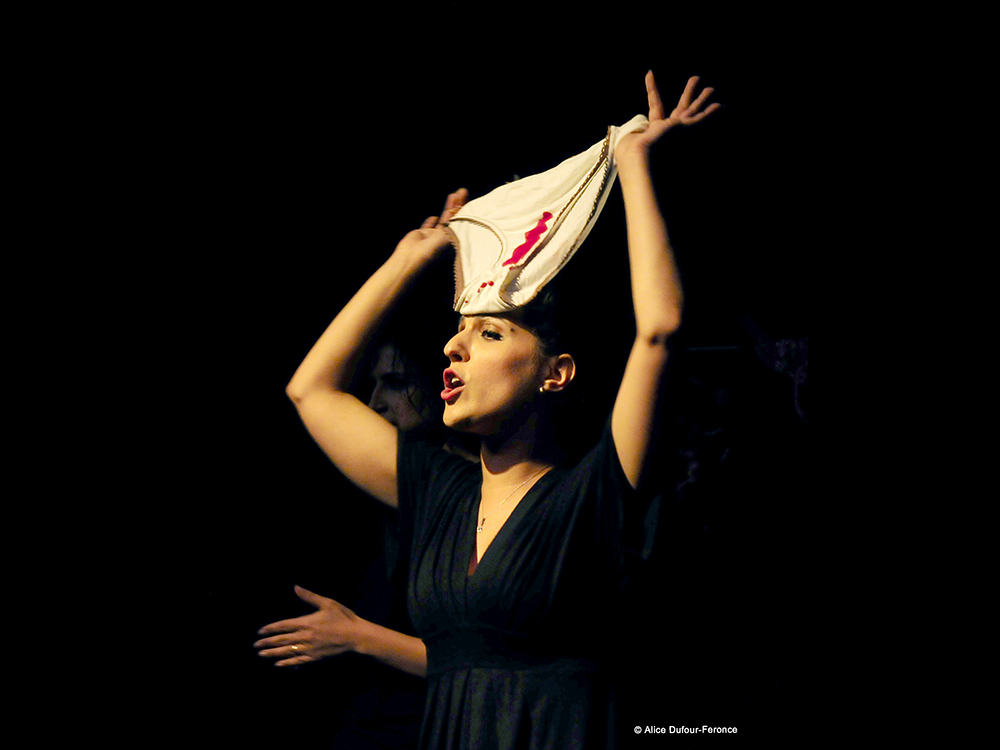
At that moment, what was taboo came to light. We found that the new generation of young women were savvier and ready to lift the veil on female sexuality, and I was one of them. Because, the new youth could talk about sex to their male friends or to their parents. This is rare, but it does exist. Moroccan society also includes contemporary and avant-garde families. Many men, who knew about our program, wanted to join us.
We created mixed sessions and individual sessions for shyer, more reserved women. It was, in truth, eight months of listening, exchanging, and sharing a single problem: the excision of female sexuality, especially in education. We gathered and transcribed the testimonies of more than 150 women, and wrote them as a play called Dialy, which means “Mine,” first performed on June 15th and 16th 2012 at the French Institute of Rabat and the Aquarium Theater.
The audience’s response? Applause and the classic harassment
We were literally moved by the positive interaction with the audience and their encouragement. But journalists and theater experts, who didn’t even attend the play, publicly expressed that actresses bared their vaginas, that they were naked and that the text was just a bunch of dirty words. Despite denying the claims of nudity and blasphemous content, and despite support from the French Institute of Rabat (co-producer) and our friends and supporters of Théâtre Aquarium, it was difficult to stop human madness and society’s anger.
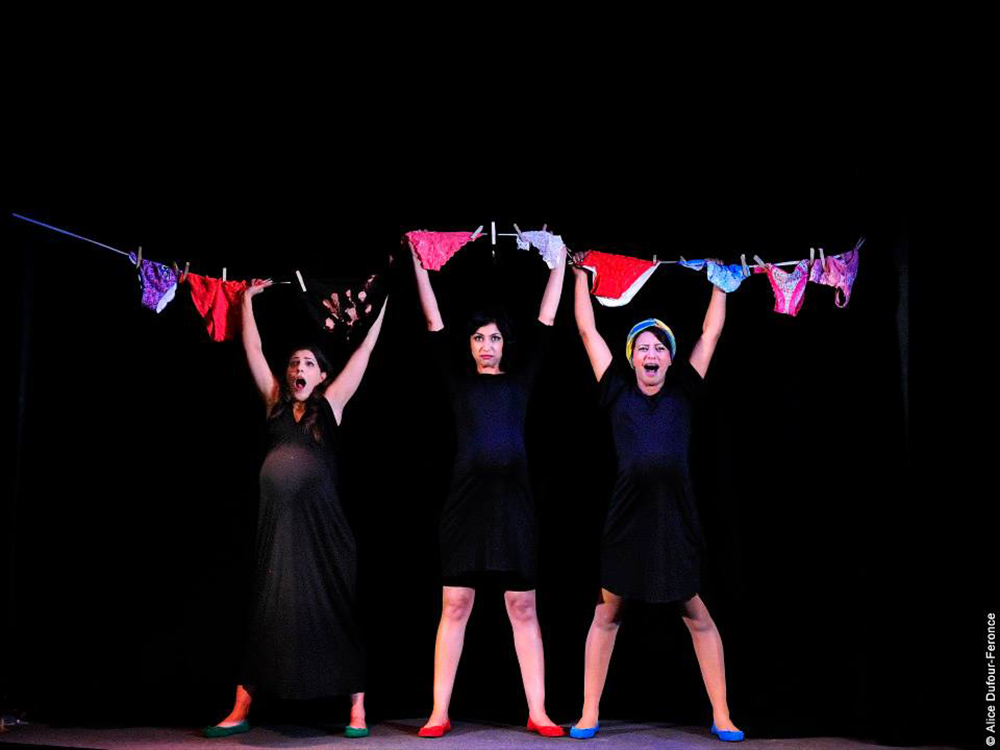
On the other side, freedom of expression is defended by the toughest: a Moroccan national festival and independent cultural centers scheduled Dialy for the following years in big cities of the country and overseas (Tunisia, Germany, France, Spain, Belgium…). Each performance drew a standing ovation, and the audience often exceeded the hall’s capacity. This play, which gives voice to female freedom in the city, won the hearts of Moroccans with its sincerity.
The play ends with: “This is mine, it goes wherever I go… to the school, shop, market, hamman and even to the mosque”. The audience needs more than 30 seconds to applaud, a breathtaking moment to accept the confusing image of the vagina going to the mosque. One day, a woman in the audience shouted out loud: “And it goes also to the sacred mecca”. That day all applause went to her liberated affirmation.
Everyone who came to see the play praised the courage of the Théâtre Aquarium team, and above all, the public praised their perseverance in standing up to the straitjacket of convention. The play stopped being performed by the end of 2018 but set a precedent for female freedom of expression in Moroccan cities.
After Dialy, the director Naima Zitan continued with the creation of Telfa (2015) to raise awareness about women’s condition in prison; Fatema (2017) to talk about the Harem, in homage to writer Fatema Mernissi; Trez Lhsab (2018) about the inequalities of inheritance; and Nezlou 3la slamtkoum (2018) where the roles are reversed, and men experience the joys of pregnancy, breastfeeding and the leading role in child rearing.
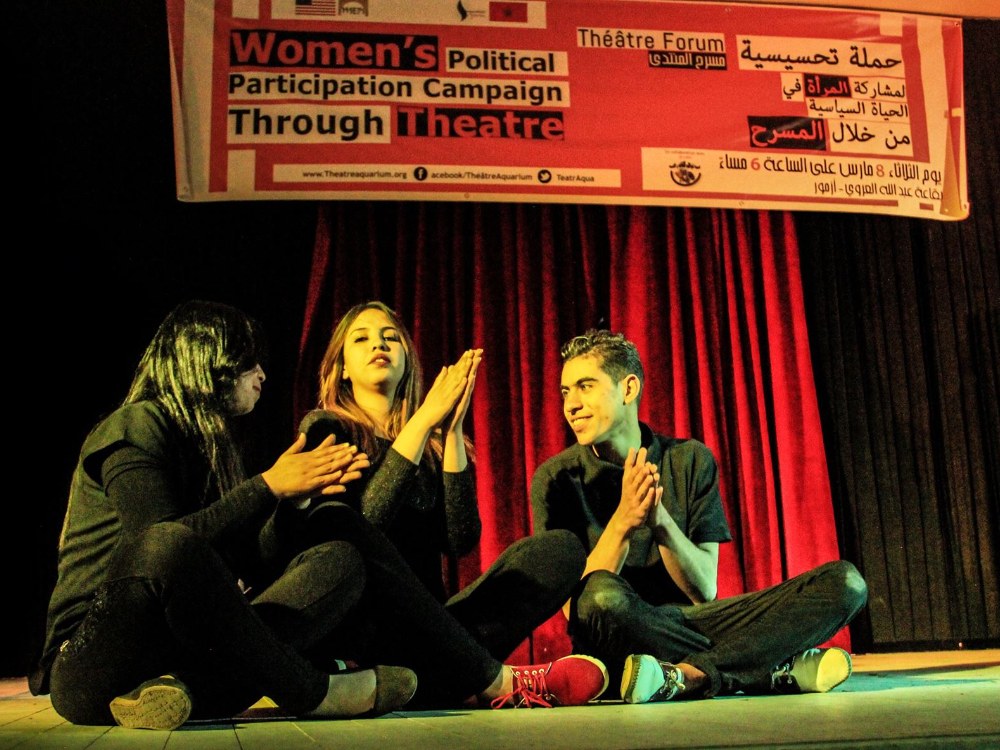
Today, with more than 25 years of activism, Théâtre Aquarium is an institution that has also become a cultural center where several activities are held, including the Forum Theater program, which focuses on several topics of human rights and female freedom of expression in the city. This year, a pilot project called M’ARTSY was launched to support the production of 12 young Moroccan urban artists (rap, slam, and improvisation theater), a reinforcement program with a gender-sensitive approach.
For my part, as the author of Dialy, I continue to collaborate with Théâtre Aquarium, and I am honored to remain a member of this big family. In 2012, to cope with the pressure of various threats, I adopted a German Shepherd dog named Leika, weighing 47 kg, who accompanies me to this day.