
Listen to the audio version of this article (generated by AI).
Last year, Makala moved to New York City after graduating from college and receiving a job offer in her chosen field, like many twenty-somethings setting out to build their careers. Believing she had secured a place to live, she arrived in the city only to discover she had been scammed—first by a girl from her college, then again on Facebook. The stress of the housing scams led her to lose her job offer, and she found herself in a new city without housing and unemployed.
“I don’t have support here, and it was a whole mess,” she said about losing housing.
Makala, who asked that her last name not be shared to protect her privacy, ultimately found herself in a transitional housing program for women at The Bowery Mission, an aid organization dedicated to serving homeless New Yorkers for decades.
That’s how her path crossed with Nick Marsella, 33, the man behind That One Ensemble, a nascent nonprofit organization with an ambitious mission: helping homeless musicians in New York and encouraging them to join an orchestra made up exclusively of players affected by homelessness. Makala is its first member.
“I always loved music,” she said. Before moving to New York, she grew up attending the Battle of the Bands as a young girl in the South, where she watched marching bands from historically Black colleges and universities showcase their talent. She joined her school band, which eventually led her to learn composition and instrumentation. A multi-instrumentalist, she plays different versions of the saxophone, baritone, flute, and the violin.
When Makala’s caseworker at The Bowery Mission received an email from Marsella looking for a musician in need, she applied and became the first recipient of That One Ensemble’s assistance: a $ 500 monthly stipend, private music lessons, and access to instruments and practice space.
“It’s nice to have people supporting you, leading you and guiding you,” Makala said.
In the six months Marsella’s foundation worked with Makala, she found full-time employment in education, stable housing, and, most importantly, she returned to the love of music. Music gave her the strength to build her life after experiencing homelessness in a tumultuous first year in New York City. “I just want my life to be as peaceful as possible,” she said.
Marsella aims to expand Makala’s experience helping more homeless musicians in New York City. “As much as I would love people to think of Makala when they hear the word ‘homeless’ and be inspired by her, unfortunately there is a different image that comes to mind. I think music is uniquely suited to address that stigma and uniquely dignifies people in a way that other things can not,” Marsella noted.
“What we’re trying to do in the larger conversation is restore dignity to people that are not seen as people right now, frankly,” he added.
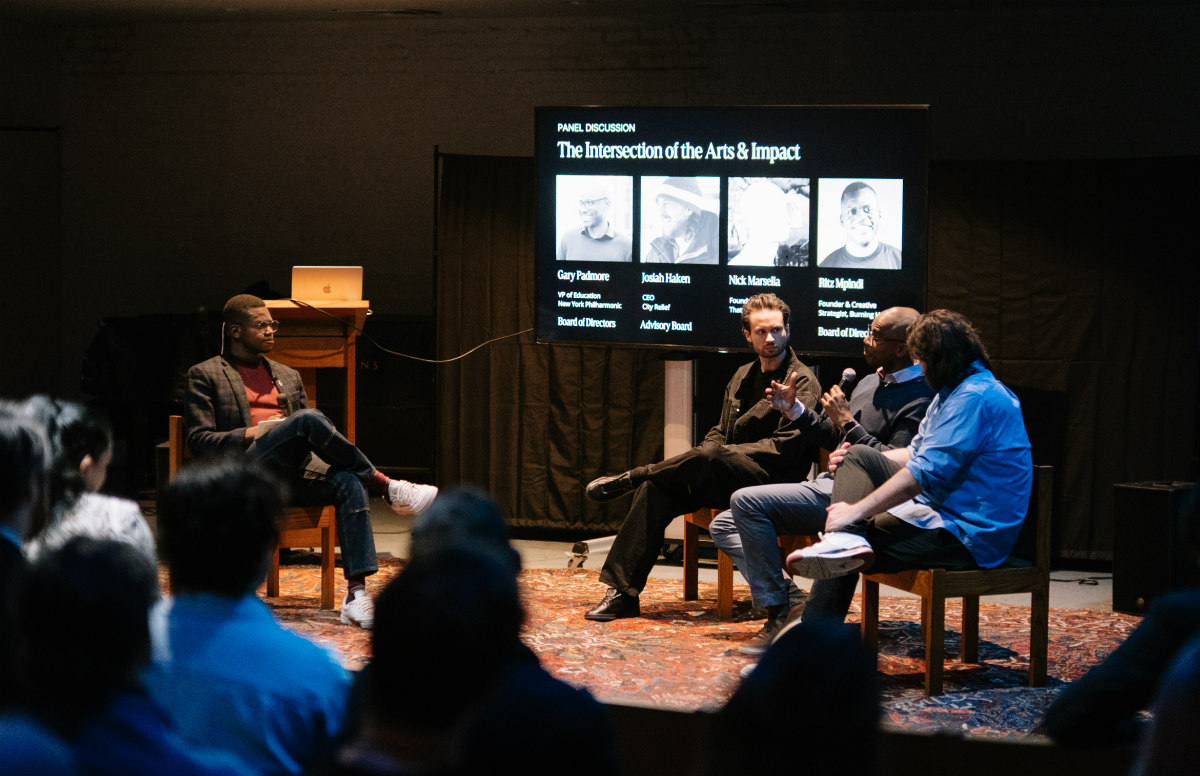
Last week, on November 18, I attended a fundraising event for That One Ensemble at Grace & St. Paul’s Church on a quiet block in Manhattan’s Upper West Side, where Marsella announced, “It’s going to be an ensemble before it’s an orchestra.” The evening began with a performance by Meg Brennan on the flute and saxophone, one half of the jazz electronic duo STELLA, whose melodies echoed off the white brick walls of the dimly lit church.
As the year turns, Marsella hopes to provide the same support, helping three additional homeless musicians in New York. Together with Makala, they would form an ensemble of four, repairing a connection to music interrupted by adversity.
Marsella has been contemplating this idea for over a decade. As the son of a church worship leader, he studied vocal performance in California. There, a professor sparked his love for orchestral music. “I fell in love with this idea that 100-plus people from all walks of life and languages and perspectives could somehow work together so beautifully to create the music,” Marsella said.
“I have always been sensitive to the power that music has to move people to do things,” he said, speaking with an affable earnestness capable of inspiring the fiercest cynic. “There are so many talented people who fall on hard times. How incredible would it be if those people were given another chance to come back to music and form an orchestra?”
He recognized that to achieve this vision, he would need to surround himself with the best individuals in the field. He moved to Staten Island to attend Juilliard School in New York for a master’s in composition, aspiring to be a composer who would one day write music for That One Ensemble.
Initially, he rented an illegal basement apartment, where he slept on the floor, and mice scurried when he opened the door. His first application to Juilliard was immediately rejected, prompting him to take a job in Times Square to pay the bills, and a second job at Juilliard’s bookstore, where he says he learned from anyone who walked through that door for four years.
Juilliard’s bookstore is one of the city’s few remaining physical sheet music stores in New York City, which put Marsella face to face with virtuosos. Through this experience, he was able to prepare a new application and was eventually accepted into Juilliard. He shared his dream with professors and fellow students about attending the conservatory and creating that unusual orchestra. Some skeptics told him it was too late for him and that he was wasting his time.
However, in 2019, despite setbacks and doubts from others, Marsella was admitted to Juilliard’s graduate school. Seven years later, in June 2026, Marsella was a finalist for the David Prize, a $200,000 award for New Yorkers with bold ideas for change. His nonprofit is fully funded by its board of directors, some of whom are friends of Marsella—people he met during various encounters in New York City—who were moved by his dedication over the past decade to helping homeless musicians in New York City.
“You hear Nick talk about this, and he has really lived and breathed this,” said board member Drew D’Agostino at the fundraiser’s reception serving hors d’oeuvres and canned wine. “I found out he was working on this for ten years, and last year was only his first big fundraiser event. I immediately wanted to partner with him because I know he won’t give up on it.”
Recommended Read: An Artist’s Antidote to Gentrification
Josiah Haken, a member of That One Ensemble’s board and the CEO of City Relief, a New York City homeless aid organization, challenged the notion that musical training is frivolous for someone experiencing homelessness. According to Haken, the high cost of living is driving a homelessness crisis in the nation. “It’s not screw-ups, it’s not mental illness, it’s not drug addiction, it’s genuinely the cost of living,” he stated, noting that the fastest-growing groups of people experiencing homelessness are women, children, and elderly individuals.
According to the New York City Department of Social Services’ 2026 announcement, less than 5% of New Yorkers experiencing homelessness are unsheltered (sleeping on streets, in parks, subway stations, etc.). They represent a minority of the homeless population, but they shape the public’s perception of homelessness, even though their circumstances may differ from those living in shelters or other temporary accommodations.
“It’s easy to minimize and trivialize things that most of us take for granted,” Haken said. “We do not offer homeless people the same dignity that we offer ourselves. What excites me about this is it’s actually inviting people into our communities who are left on the outside, trying to find a way in and being told every day that they do not belong.”
Attendee Alicia Kacinski remarked, “It’s really encouraging to hear that it’s about bringing people dignity and peace. It’s giving them autonomy, and something of their own.”
Using Makala’s experience as a model, the board set a fundraising goal of $100,000 for 2027—with an estimated $20,000 going to the cost of services for each ensemble member, covering stipends, private lessons, access to instruments and practice space for one year, with the remaining going to operation and event costs. The goal for next year is to have their first concert with four performing members. Marsella mentioned he has already received referrals for many candidates through nonprofit organizations and public defenders.
Makala hopes that others can benefit from the program as she did and “get back in touch with music if they don’t have any other facilities to do so on their own.”
As for Marsella, he said he is learning how to share a dream that has been his own for so long. “It’s becoming a dream that is stewarded by not just me but my board members and the people I’ve found here who I cast this vision to, and they’ve picked it up.” He clarifies that he isn’t trying to solve homelessness; instead, he is creating a powerful way to address an issue that remains largely unspoken and redefine what “homeless” means.
“We kind of hijack the narrative of wealth to turn people’s perceptions upside down. People’s circumstances do not define them,” he added. Marsella, not one to aim low, aspires to see That One Ensemble’s eventual orchestra on the main stage of Carnegie Hall playing the music he has composed. “I feel like I’m just getting started.”