
Listen to the audio version of this article (generated by AI).
When Donald Trump acquired the Bonwit Teller department store building at Fifth Avenue and 56th Street in 1979, he planned to demolish it and build what would become Trump Tower on the site. The building’s facade featured two enormous Art Deco limestone bas-reliefs depicting stylized, partly nude female figures. In February 1980, Trump agreed to donate the sculptures to the Metropolitan Museum of Art in New York, supporting the historic preservation of the city. Two months later, workers destroyed the sculptures and an ornamental grille. The Trump Organization reportedly decided that carefully removing them would cost too much and delay construction.
The episode captures a conflict that has shaped New York for decades: how much of the city’s historic fabric should be preserved when land is under intense pressure to be redeveloped? Today, the demand for more affordable homes has made that question even more complicated, putting historic preservation increasingly at odds with housing advocates who argue that New York City needs to build more homes to address its affordability crisis. Preservationists, however, question whether the city is truly facing a housing shortage—or whether it is simply adding more housing that remains out of reach for most New Yorkers.
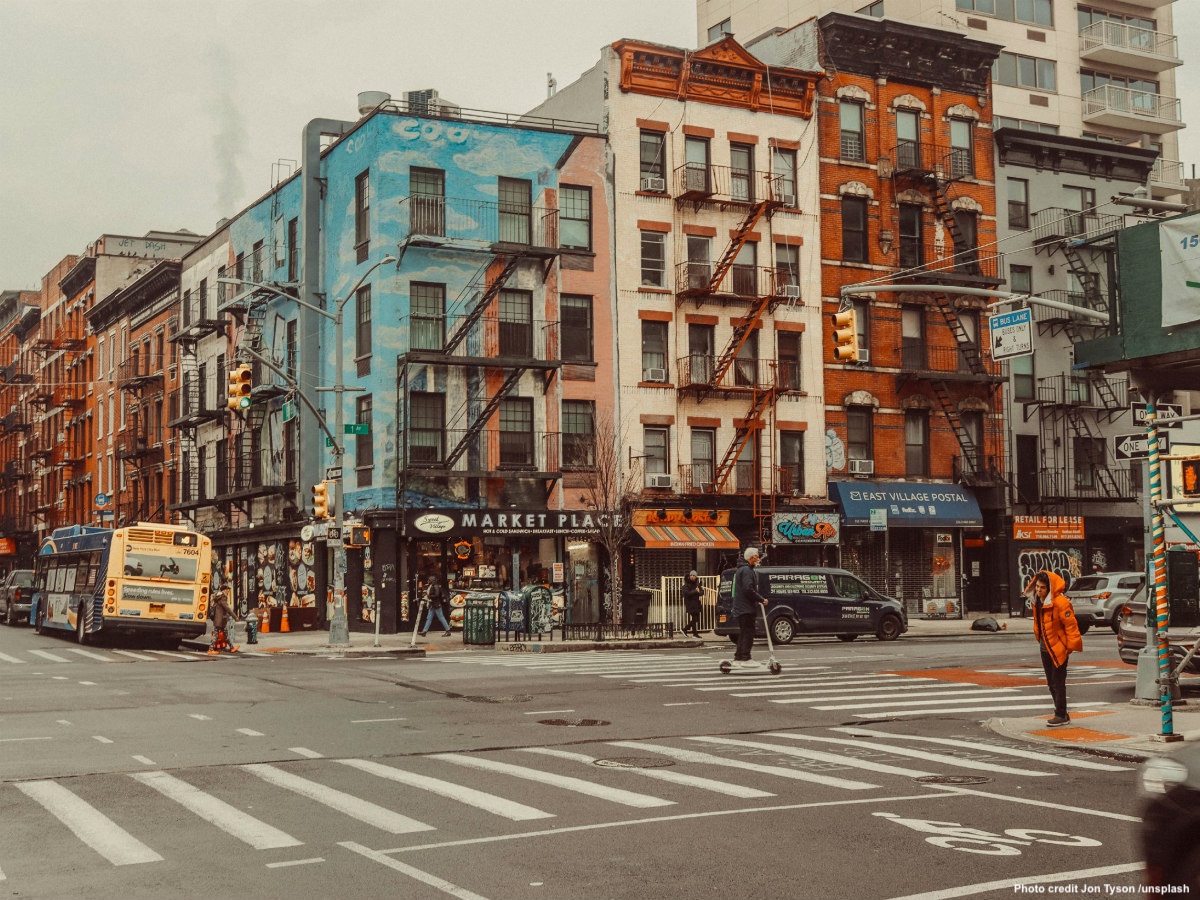
In the same year that New York City lost its Art Deco sculptures, a dedicated group of citizens, community advocates, and architectural historians founded the Greenwich Village Trust for Historic Preservation. Public mistrust of developers and urban planners was so deeply rooted that architect and urban critic Michael Sorkin wrote in 1988 that “the New York skyscraper occurs at the intersection of greed and grid.” By 1980, the New York City Landmarks Preservation Commission (LPC), a city agency, was already in existence, and the group shifted its strategy from Jane Jacobs’ “Stop the Bulldozer” campaigns against Robert Moses’ plans to a more institutional and policy-focused approach to preserve the architectural and cultural heritage of Greenwich Village, the East Village, and NoHo.
What began as a small collective neighborhood trust has evolved into the highly active advocacy group known today as Village Preservation. They methodically researched entire city blocks to achieve sweeping and historic district designations. In total, Village Preservation has secured landmark designation for more than 1,300 historic buildings in their communities and zoning protections for nearly 100 blocks in New York City.
However, in recent years, New York has seen a marked policy shift, with landmark designations declining dramatically. A telling example came in August 2016, when the Landmarks Preservation Commission rejected protection for the four-story cast-iron building at 831 Broadway and its adjacent twin at 827, which contained multiple affordable lofts for artists who’d lived in the neighborhood for decades. Willem de Kooning rented a studio in 1958, which attracted other Abstract Expressionist artists. The plan was to demolish and replace it with a luxury tech office tower. The commission’s director of research argued then that New York already had “enough” buildings with “earlier cast-iron facades,” noting that similar examples existed elsewhere on Broadway.
“The justifications that the city’s Landmarks Preservation Commission offers for not moving ahead with landmark designations are often very thin and arbitrary,” says Andrew Berman, executive director of Village Preservation for the past 25 years. “I will also say there is some truth that nobody wants or expects New York City to be frozen in amber, and obviously you need to draw the line somewhere between what is significant enough to be preserved and what is not,” Berman concludes. Preservation Village has been documenting that trade-off for decades.
The Manhattan Plan, released in November 2025, acknowledged the particularly weak housing production in areas such as District 2—Greenwich Village, West Village, SoHo, NoHo, Hudson Square, and Little Italy. The city administration has pointed to zoning changes to argue for more housing, especially near subway and bus access, raising a larger question of who should live in Manhattan’s most transit-rich, historic neighborhoods. According to the Mandani administration’s comprehensive housing plan, Block by Block, which targets building 200,000 new affordable homes, the Landmarks Preservation Commission will conduct a comprehensive study of housing production in historic districts to identify potential opportunities.
“We don’t have a problem with the administration exploring these issues, but ultimately, the devil is in the details. How do you implement changes in a way that complements and builds upon the important established historic character of these neighborhoods?” says Berman. While the rhetoric around this topic often resonates, he notes, his group frequently disagrees with the execution of the plans put forth. If substantial housing replaces historic buildings, demand in these neighborhoods will likely continue to outstrip supply. Simply building more housing does not solve the scarcity in desirable locations; rather, it raises questions about who gains access to it.
Berman adds that the number of members involved in Preservation Village’s advocacy campaigns and educational efforts has been growing. “There is a strong desire for places that feel authentic, connected to history, and reflective of crucial movements throughout New York and American history. We need to maintain a connection to what was there before,” he adds. His advocacy group focuses on civil rights, social justice history, the LGBTQ rights movement, and artistic and musical heritage. These movements are so deeply rooted in their neighborhoods that much of the work by Village Preservation involves documenting local history through reminiscences and oral memories, maintaining extensive online archives of historic images, installing plaques on historic homes, and making neighborhood history in New York City as accessible to the public as possible.
Recommended Read: The True – Yet Discreet – Love That Preserves Florence
There is no doubt these are among Manhattan’s most desirable neighborhoods, and while many value their historic character, others question whether historic designation can end up protecting the way of life of affluent residents at the expense of the affordable housing New Yorkers need—raising equity issues.
“We certainly hear that accusation often, but I don’t think the facts bear it out if you look at what’s actually going on and what we’re actually doing,” asserts Berman. There’s no denying that many wealthy individuals live in the neighborhoods that Village Preservation strives to preserve, but Berman and his advocacy group are often seen as the neighborhood’s rabble-rousers. “The median donation Preservation Village gets from its members is about $70, which tells you the financial means of the people who support its work. And in most of the instances, we’ve pushed back on big real estate projects for billionaires moving into the neighborhood instead of providing affordable housing.”
In the past, Berman explains, Greenwich, East Village, and NoHo added housing units by adaptively reusing older industrial buildings in ways that aligned closely with a preservation ethos. But others were converted into educational institutions such as NYU, the New School, and Cooper Union, or into hotels, architecture firms, and higher-end office space. Fewer of those opportunities now exist to transform older buildings into residential use, reflecting compounded failures by former city administrations that have contributed to tension over affordable housing in Manhattan. For instance, in 1983, Trump Tower delivered only luxury residential apartments.
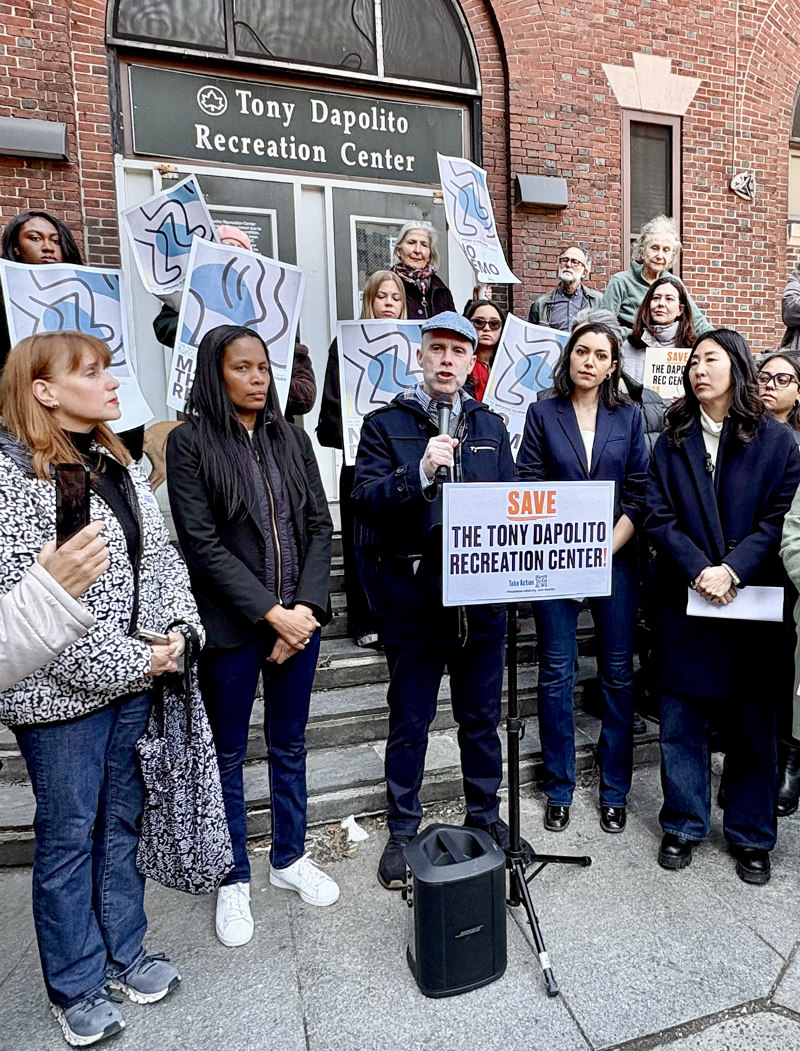
“Over the years, the city has actually made changes to the zoning rules in our neighborhood under the premise of creating more housing. Yet, in almost every case, they have failed to deliver on their promises regarding the quantity of housing built and the inclusion of affordable units,” says Berman. At the Village doorstep, south of Houston Street on the west side, lies a large, formerly industrial neighborhood called Hudson Square. About a dozen years ago, the city rezoned it to encourage residential development, including many affordable units, but the vast majority of the development has been commercial.
“Another factor contributing to New York’s growing unaffordability is that we are losing our existing affordable housing at a rapid pace to make way for new housing that the city claims we need. In many ways, this approach worsens the problem rather than solving it.” Berman points to policies that promote large new developments that demolish older buildings, often containing rent-regulated housing or units that are simply more affordable than new market-rate housing due to their age but are still perfectly livable—like walk-up buildings.
In New York, two key steps get a building project approved. The first involves zoning regulations that define what developers can do by right, while the second requires a process to seek permissions for projects beyond those regulations. The recent “City of Yes” regulation, supported by housing activists such as Open New York, changed zoning rules to make them more permissive, allowing developers to build larger, taller, and more expensive structures without needing special permissions. This adjustment made the initial basis for development significantly more flexible. Additionally, the city recently passed several regulations that make it easier for developers to seek changes to zoning limits, streamlining a process that previously required extensive reviews and approvals from various entities. This earlier process gave local neighborhoods more leverage and a stronger voice in development decisions, but the new rules significantly reduce those requirements.
According to Berman, the “City of Yes” policy not only failed to require affordable housing under any circumstances, but it also stripped away some existing affordable housing incentives that were part of the previous zoning regulations. Berman cites specific examples.
Recommended Read: Freeze Rents and Affordable Homeownership: Can New York City Have It All?
The City of Yes Tower, as his group calls it, is a 538-foot-tall tower under construction on 13th Street. This will be the tallest building ever erected in the neighborhood, towering approximately ten times the height of many buildings on the block. Despite its significant height, it will feature fewer than 30 units of super-luxury housing and no affordable housing whatsoever. Berman is confident that these units will be purchased as pied-à-terres for investment purposes, rather than as primary residences. Moreover, one promise of “City of Yes” was to shift new development away from car-dependent models and toward development centered on mass transit. However, in this case, “City of Yes” made it easier for the developer to construct a very tall tower with substantial open space around it. This open space is being designated for a private, covered driveway for wealthy residents—a relatively uncommon feature in Manhattan. “They can drive directly into the building, completely shielded from the street, without engaging with the public realm as they enter or leave their pied-à-terre in the sky,” says Berman.
Another example involves a development just a couple of blocks away from this tower. A developer purchased a 200-year-old, five-story building that housed 20 units—though relatively small, these were still very nice apartments, with half of them being rent-regulated. Despite objections from Berman’s advocacy group and many others, the developer received permission to demolish the building and constructed fewer housing units (only 17), although the new building is five times taller than its predecessor.
The “City of Yes” is based on the idea that if we build significantly more housing, the overall prices will decrease for everyone, regardless of how expensive the new housing is. “This is the equivalent of saying if we build a lot more Rolls-Royces, the price of a Chevy is going to come down for the buyer,” says Berman with a smile. This analogy raises questions about how to distinguish between adding housing supply that eases pressure and developments that accelerate displacement. Moreover, if the private market is successful enough to make housing “affordable,” it may threaten the value of existing properties that the industry holds. Consequently, private supply tends to limit itself as it is viewed as a financial asset.
About 4% of the city is designated as historic districts. Within these areas, the Landmarks Preservation Commission decides whether a building can be demolished. Generally, demolitions are not permitted in historic districts, though exceptions can occur. Over the years, mayors have appointed all members of this commission, and increasingly, they have been allowing more demolitions. This trend suggests the existing safeguards are being weakened or misused, making them easier to bypass.
Village Preservation has also launched a campaign opposing proposed changes to Section 106 of the National Historic Preservation Act. The proposed changes would streamline or eliminate public review and comment for a broad range of projects, reducing the ability of members of the public and nonprofits such as Village Preservation to weigh in—and, in some cases, even to know about projects before they proceed. “These changes would have a real impact in New York since they grant the real estate industry more freedom while sidelining public input,” says Berman. Indeed, the rule changes could facilitate projects such as renovations at the Kennedy Center and the Trump administration’s proposed triumphal arch in Washington, D.C. Losses to the city’s architectural and cultural heritage could occur without meaningful public scrutiny—much as the destruction of the Art Deco sculptures at Bonwit Teller did decades ago.
Berman argues that this dismantling of time-honored rules, established over the past 65 years, centralizes decision-making power, which should remain balanced and independent of the current mayor, governor, or president. He emphasizes the need for a solid system that maintains checks and balances, ensuring that significant questions are considered in decision-making processes.
Greenwich Village, the East Village, and NoHo—three historic neighborhoods in New York City represented by Village Preservation—are incredibly unique in their scale and character. “If we lose the essence of these areas, we risk losing something irreplaceable,” he says. “It’s about managing housing in the best way possible, so we can keep the irreplaceable aspects we cherish while allowing our city to house everyone,” Berman notes. That includes the next De Kooning.