

This article is part of a series on rethinking museums in cities and how some of their progressive actions address the challenges of our time, in partnership with 1014.
Amid the era of predictable unpredictability, the pandemic has soured a myriad of relationships, blurring the lines between melodrama and comedy, the funny and the repulsive, collateral consequences of a genre-bending time that has put men and women on the verge of a nervous breakdown. One could think of that famous Almodóvar movie where lover Pepa packs her boyfriend’s things into a suitcase, distraught over their breakup. Presents included. A ceramic duck (“who needs a duck anyway?” she murmurs) and a plastic flower; in real life, those things could have ended up in the Museum of Broken Relationships.

Founded in Zagreb in 2010, the Museum of Broken Relationships exhibits objects submitted by enraged lovers who confess their breakup stories. When the first pandemic hit cities, two months of lockdown were enough to send items and stories pouring into the museum.
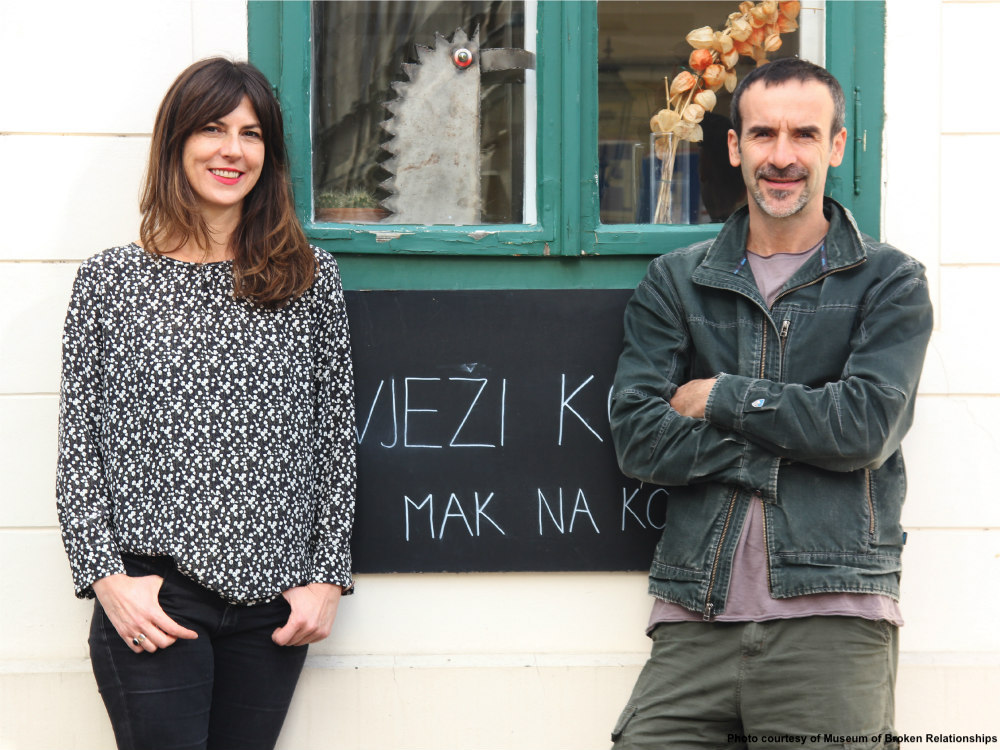
One of the founders, Dražen Grubišić, identifies as a versatile visual artist. So I asked him why he, together with his ex-lover and co-founder, arts and film producer Olinka Vištica, has tackled the topic of abandonment and the misunderstanding between women and men for years through the museum. Mostly, he says, you have an idea for an exhibition, you implement it, it is done, you move forward.
“But this project, which was never meant to be a museum, stuck with us for years because of the overwhelming response we got from people, such sincere emotional feedback that we realized it positively affects visitors’ mental health. We decided to turn it into a museum,” he adds.
By now it has become so established that when a disappointed lover Googles broken relationships, he or she would get a surprising search result ahead of the self-help advice: the museum. Neither Grubišić nor Vištica has a background in museums. Yet they have been frontrunners in highlighting the psychological element museums can offer to improve people’s well-being and mental health. Museums are no longer the custodians of artifacts of the past; rather, people set the scene through their intervention. The museum is located in Zagreb, but lovers can unburden themselves anywhere by sending the museum the item that reminds them of, or symbolizes, a painful experience after a relationship failed.

In fact, the museum keeps wandering through cities around the world, 56 so far, collecting objects and stories through local partners along the way. Together, they tell the story of each city, Grubišić explains; for example, in Manila they mainly focus on the dramatic impact of migration and how remittances sustain many families’ lives in the city. At an exhibition in Alta, Norway, one of the world’s furthest northern cities, we collected many stories of suicide, reveals Grubišić, that we had to balance with some kind of positive which we bring from the permanent exhibition.
But how to find the right balance? I tell him it seems as if visitors feel their emotions owe that right balance a favor, thus the big responsibility they have as museum curators. He also feels the weight of this work. “We change the exhibition completely every three years; in that period, we have over 4,000 donations, and you have to read all the stories. And when you read them, you have to be in the same mood and concentration; it takes time to select the stories to create some kind of flow at the museum and the visual aspects to it.”
The museum creates a rollercoaster of emotions for the visitor, taking a comical, fun origin and turning it into something painful, sobering visitors toward the end, celebrating love, and offering a lesson from it. The Museum of Broken Relationships is a work taken so deeply into its meaning that its founders even encourage participants to send their stories in their own first language, preserving the gist of a collective emotional history.

Even so, beneath this work lies not only the complexity of human relationships but also the political, social, and cultural context in which and where the stories take place. At the height of the refugee crisis in Europe, they collaborate with the Red Cross to expose the break-up experiences of people on the run. The flow of stories can get complicated, Grubišić affirms. The museum dedicates a room to the difficulty of dating in wartime, from the Second World War to Afghanistan.
Some stories at the museum from the US talk of post-traumatic stress disorder (PTSD) and how this mental health condition causes sad break-ups, explains Grubišić.
The museum and the itinerant exhibitions haven’t stopped during the pandemic, from Romania to Portugal and across the Atlantic. They have four or five exhibitions per year. Part of the magic of Grubišić’s and Vištica’s work is that, while serious, it’s also playful, poking fun at the absurdity of the social media frenzy, which portrays people as always loved and living their best lives, without the dark sides. Instead, at the museum, as Grubišić claims, we see anonymous real lives explained and exposed, creating a feeling of “this is not only happening to me”.
“Man and I thought I had a bad time!” wrote one visitor in the Book of Confessions at the museum after the exhibition.
From the café where Grubišić sometimes works, he observes how the exhibition affects couples entering and exiting. “Often she wants to go in, and the guy is just keeping company, but then you see the guy doing much more of the reading than she does,” says Grubišić. Every woman or man can recognize himself or herself in some of those stories, and feel relief and validation because of the complexity of love.
Yet the exhibition also provides donors with catharsis on a more personal level, explains Grubišić; the participatory aspect of the museum has real value for mental health. “Any psychologist would advise you to write down a dramatic story that happens to you as an effective way of sending it away and getting over it.”

Of course, it is difficult to say how much impact this museum has on people’s mental health, but it has certainly influenced others in many ways. So far, the museum’s approach has earned Croatians a new law allowing individuals to donate to museums. Since then, museums with private collections have sprouted around the country. It also inspired the Museum of Failure in Helsingborg, Sweden, which once recognized its founder.
In New York, the private initiative Mmuseums, founded in 2017, offered a glimpse into others’ psyches and examined humanity through objects. Writer Orhan Pamuk also explored emotional well-being and mental health through the Museum of the Innocence, where he collected objects related to his lover, Füsun. Later, Pamuk turned fiction into reality and opened a museum of the same name to evoke everyday life and culture of Istanbul.
At the end of our conversation, I asked the irrefutable question of whom most of the stories come from, men or women: “Actually, 70% of the objects received by the museum are from women, 30% from men. In terms of visitors, 60% are women, 40%men,” answers Grubišić.
This pandemic has affected men and women equally, and their broken stories are part of that eternal struggle to understand each other. In Women on the Verge of a Nervous Breakdown, Pepa’s apartment fills with people and their complicated stories in lively Madrid, setting off a strange chain reaction that spirals into a deliciously chaotic series of events. At some point, as Pepa collides with a range of frantic problems, she realizes she’s got over her own. Paying a visit to the Museum of Broken Relationships could provoke a similar kind of effect.